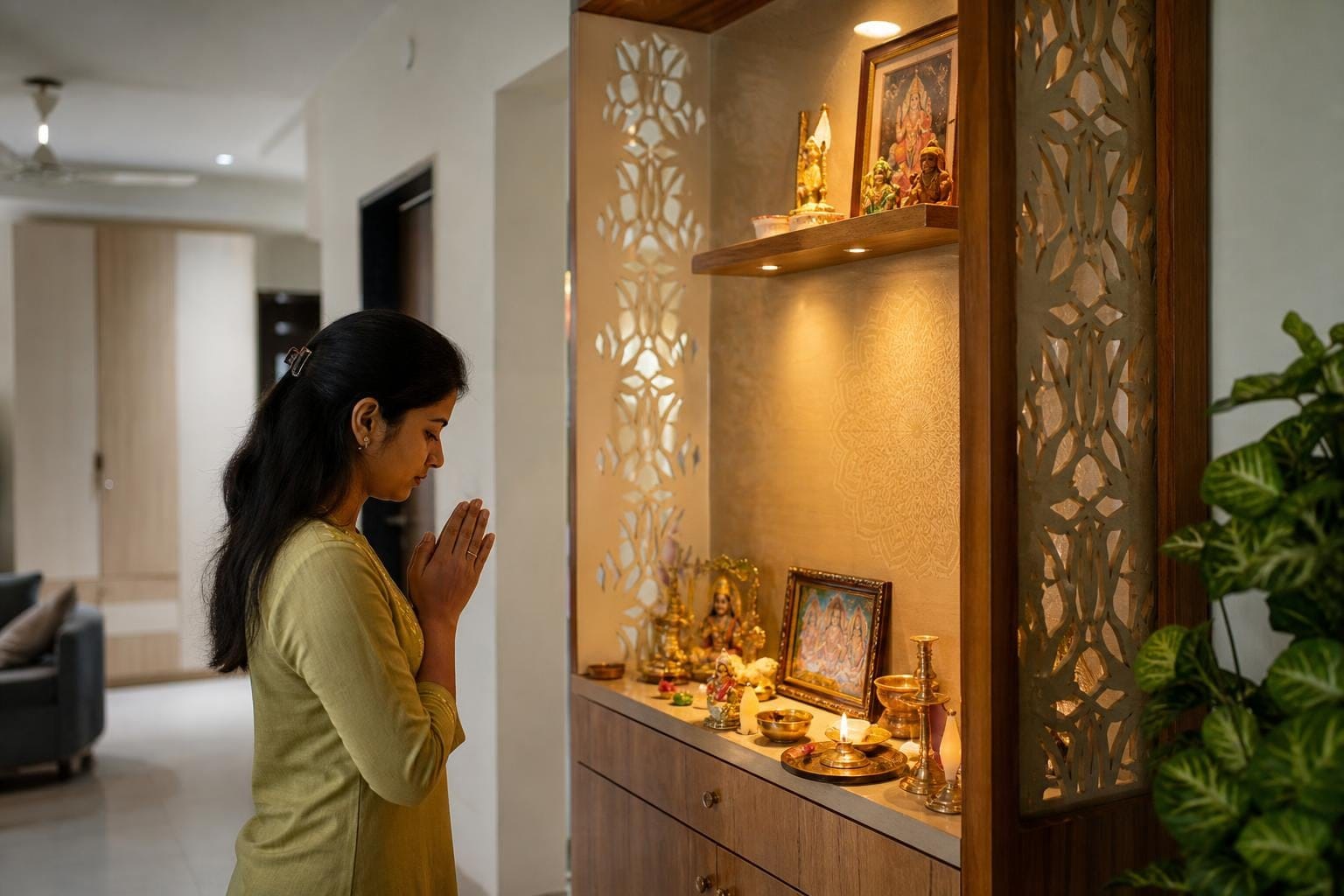
Pooja Room Design in Flats: 10 Ideas, Costs & Vastu (2026)
TL;DR
Designing a pooja room in a flat is fundamentally different from a standalone house. Space is limited, walls are shared, and Vastu compliance requires compromise. This guide covers 10 apartment-friendly pooja room designs, from ₹10,000 floating shelves to ₹5 lakh+ marble mandirs, with real cost ranges, material trade-offs for Bangalore’s humidity, practical Vastu guidance, and lighting specs that actually make a difference. The sweet spot for most 2BHK and 3BHK flat owners sits between ₹20,000 and ₹80,000 for a well-designed plywood unit with layered lighting.
Why Pooja Room Design in Flats Needs a Different Approach
A pooja room in a villa can occupy an entire dedicated space with ideal Vastu orientation, natural ventilation, and generous proportions. Apartments don’t offer that luxury. Most Bangalore flats, dominated by 2BHK and 3BHK layouts, force homeowners to work within 600 to 1,500 square feet. The northeast corner might house a washing machine. The only available wall might share a boundary with a bathroom. Builder floor plans rarely account for a prayer space.
This doesn’t mean your pooja room has to feel like an afterthought. It means the design approach must start from constraint, not tradition. Wall-mounted units, corner installations, concealed cabinets, and niche designs aren’t compromises. They’re smart design when properly executed.
Bangalore adds another layer of complexity. Monsoon humidity warps cheap plywood and swells MDF within a year or two. Enclosed apartments trap incense smoke and diya heat in ways that standalone houses never do. Fire safety clearances matter more when you have shared walls, false ceilings with concealed wiring, and limited cross-ventilation.
If you’re planning a full apartment interior alongside your pooja room, our 2BHK interior design guide covers how to budget and prioritize across every room.
Quick Comparison: 10 Pooja Room Designs for Flats at a Glance
| Design Type | Best For | Cost Range (₹) | Timeline | Vastu Flexibility | Space Needed |
|---|---|---|---|---|---|
| Wall-mounted mandir | 1BHK/2BHK, zero floor space | 18,000–80,000 | 2–4 weeks | High | Minimal |
| Corner pooja unit | Underused corners in living/dining | 30,000–1,00,000 | 3–5 weeks | Medium | Small corner |
| Niche/alcove (built-in) | New flats or renovations | 40,000–1,50,000 | 4–6 weeks | High | Wall depth |
| Sliding door unit | Privacy + concealment | 50,000–1,50,000 | 4–6 weeks | Medium | Moderate |
| Cabinet/concealed unit | Renters, hidden spiritual space | 35,000–1,20,000 | 3–5 weeks | High | Moderate |
| Glass-enclosed unit | Modern/contemporary flats | 60,000–2,00,000 | 4–6 weeks | Medium | Moderate |
| Partition-integrated unit | Open-plan 2BHK/3BHK | 80,000–2,50,000 | 5–8 weeks | Low | Large |
| Open/floating shelf | Minimalists, ultra-compact 1BHK | 15,000–40,000 | 1–2 weeks | High | Minimal |
| Portable freestanding mandir | Renters who move often | 10,000–60,000 | Ready-made | High | Floor footprint |
| Marble luxury room | Premium 3BHK/4BHK | 1,50,000–5,00,000+ | 6–12 weeks | Low | Dedicated room |
Now let’s break down each design type with the detail you need to make an informed decision.
1. Wall-Mounted Mandir Unit
Best for: 1BHK and 2BHK flats with zero spare floor space.
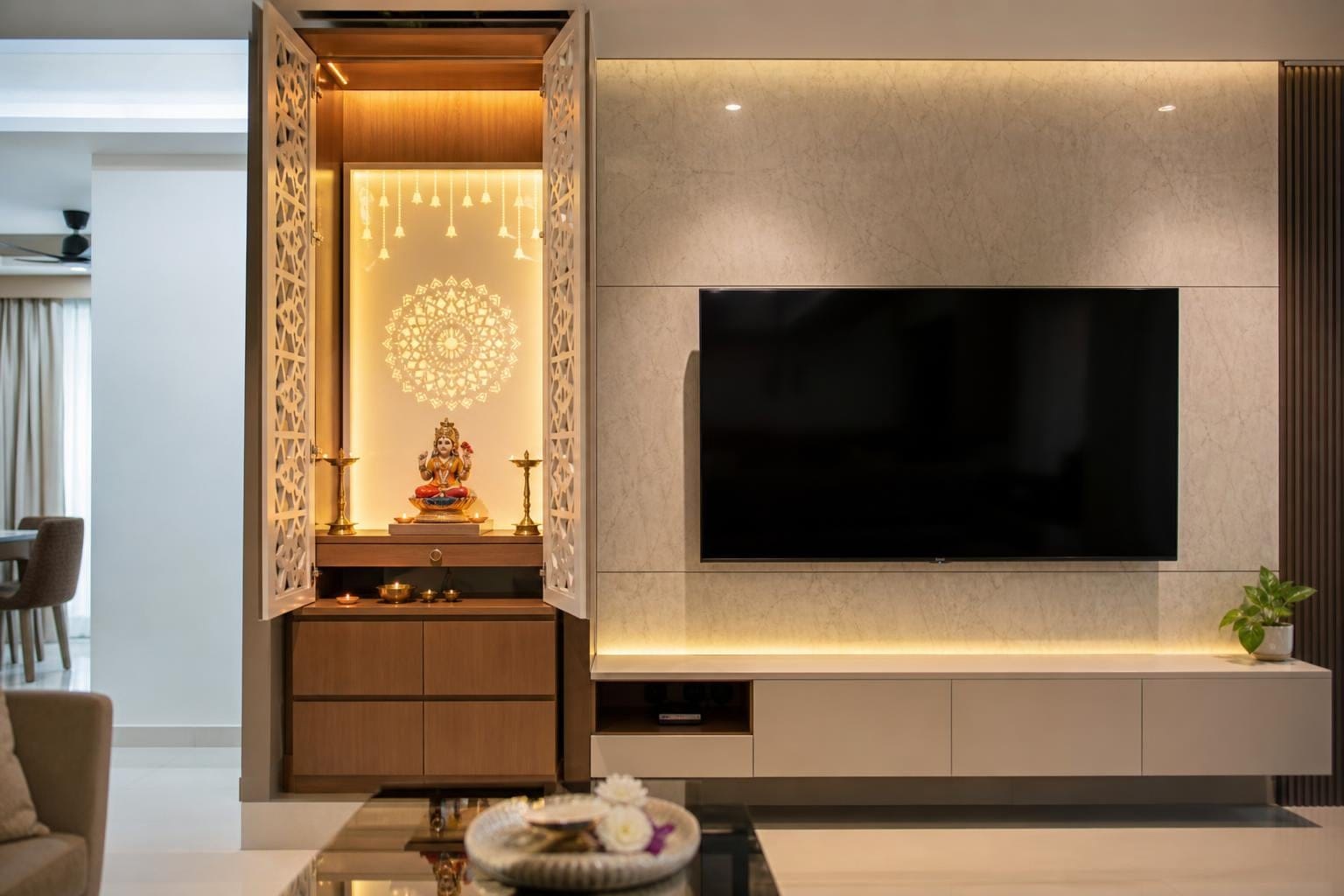
Wall-mounted units are the most popular pooja room design in flats for a reason: they consume no floor area while creating a dedicated, elevated sacred space. These units mount directly to the wall and can incorporate backlit panels, jaali doors, and concealed drawers for pooja essentials.
Key features:
- Saves all floor space while giving the pooja area visual prominence
- Can include CNC-cut jaali doors, LED backlighting, and pull-out trays
- Works on any solid wall in living room, dining area, or hallway
- Concealed drawers store agarbatti, kumkum, and diya trays
Materials: Plywood with laminate or veneer finish, MDF for budget versions, marble veneer for a premium look.
Cost range: ₹18,000–₹80,000. At the lower end, a basic plywood unit with laminate finish runs around ₹18,000–₹22,000. A unit with jaali panels and backlighting tops out around ₹80,000.
Trade-offs:
- Limited idol space compared to larger formats
- Needs solid wall anchoring (not suitable for partition walls without reinforcement)
- Swing space for hinged doors must be planned, or opt for sliding panels
- Weight capacity limits the size of marble or brass idols
Bangalore-specific note: Use BWR or BWP-grade plywood for humidity resistance. MR-grade plywood will warp within 1–2 monsoon seasons if your flat doesn’t have consistent air conditioning. Learn more about why BWP plywood matters for longevity in humid climates.
2. Corner Pooja Unit
Best for: Flats with underused corners in living or dining areas.
Every apartment has dead corners that serve no functional purpose. A corner pooja unit turns that wasted space into a prayer area with surprisingly generous capacity. L-shaped shelving maximizes what would otherwise be unusable square footage.
Key features:
- Utilizes vacant corner space that typically collects dust or hosts a side table
- L-shaped or triangular shelving wraps around the corner for maximum storage
- CNC jaali partitions can create visual separation from the living area
- Works well with a small partition or screen for privacy during aarti
Materials: Plywood with CNC jaali partition, wood with frosted glass panels, or a combination of both.
Cost range: ₹30,000–₹1,00,000 depending on the level of customization and partition complexity.
Trade-offs:
- Corner orientation may not align with the northeast Vastu preference
- Requires a partition or screen if you want privacy during prayer
- Proportioning is tricky: too small looks token, too large overwhelms the corner
- Corners near windows can cause direct sunlight on idols, which some traditions discourage
Practitioner insight: Designers on forums note that corner units work best when the partition is kept light, using jaali or ribbed glass rather than solid wood. A heavy partition in a small flat makes the living area feel boxed in.
3. Niche / Alcove Design (Built-in Wall Recess)
Best for: New flats where civil work is still possible, or renovation projects.
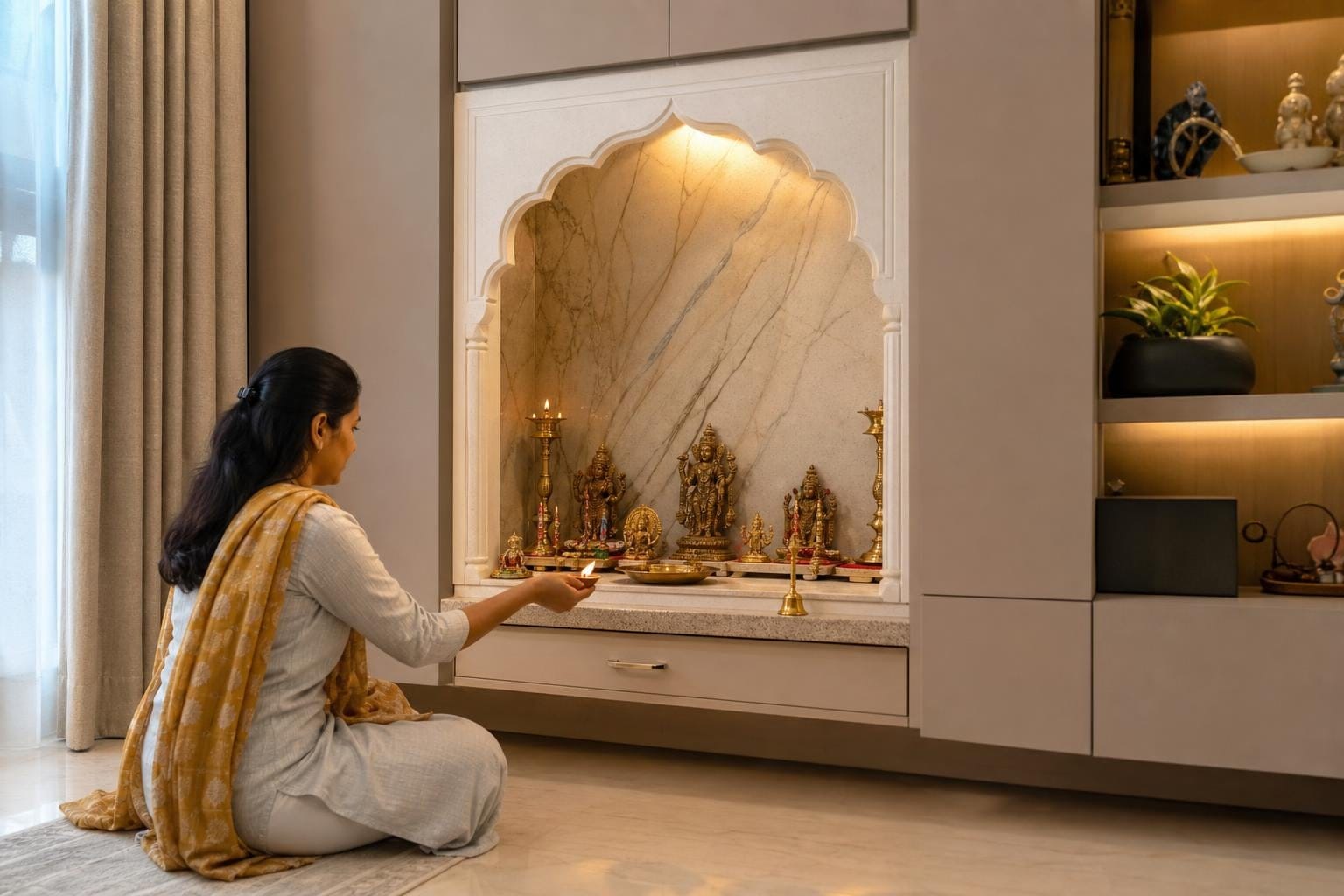
A wall niche is the most architecturally integrated pooja room design for flats. The mandir sits flush with the wall, creating a clean, intentional look that doesn’t protrude into the room. It reads as part of the architecture rather than furniture placed against a wall.
Key features:
- Flush with the wall surface for a seamless, unobtrusive appearance
- Shallow drawers (10–12 cm deep) fit matchboxes, kumkum containers, and diya trays
- Backlit panels behind the recess create a glowing, temple-like effect
- Can be finished in marble, stone veneer, or painted plaster
Materials: Plaster recess with marble or stone finish, backlit acrylic or onyx panel, marble counter for the altar.
Cost range: ₹40,000–₹1,50,000. The higher end reflects the civil modification costs (breaking into the wall, plastering, waterproofing, finishing).
Trade-offs:
- Niche depth in existing walls rarely exceeds 20 cm, which limits idol size significantly
- Requires civil work that may not be permitted in some apartment complexes
- Not reversible: once you create a recess, you can’t easily undo it
- Needs waterproofing behind the recess if the wall is an external wall exposed to rain
As one designer perspective puts it, a 20 cm niche means you must curate, not collect. Choose a few meaningful idols rather than cramming the space.
4. Pooja Room with Sliding Doors
Best for: Families wanting privacy during prayer and clean concealment when not in use.
Sliding-door pooja units solve a practical problem specific to apartments: swing doors eat up space. In tight hallways or living rooms, a hinged door that opens 90 degrees can block a walkway or bump into furniture. Sliding panels sit on slim tracks and allow the mandir to be opened fully during prayer and closed afterwards.
Key features:
- No swing clearance needed, making it ideal for narrow corridors
- Panels can feature frosted glass, etched glass, laser-cut jaali, or wood slats
- When closed, the unit looks like a decorative wall panel
- Can be combined with a built-in niche or wall-mounted design
Materials: Plywood carcass with frosted glass, etched glass, or wood slat sliding panels on aluminum or stainless steel tracks.
Cost range: ₹50,000–₹1,50,000. Track hardware quality drives much of the cost variation.
Trade-offs:
- Track mechanism needs periodic maintenance (cleaning, lubrication)
- Glass panels show fingerprints and accumulate incense soot, requiring frequent wipe-downs
- Bottom tracks collect dust and pooja debris (floor-mounted tracks are worse than top-hung systems)
- Cheaper tracks jam after 6–12 months; invest in quality hardware upfront
For context on how sliding mechanisms compare to hinged alternatives, our sliding vs. hinged door comparison applies the same principles.
5. Cabinet / Concealed Pooja Unit
Best for: Renters or anyone wanting a completely hidden spiritual space.
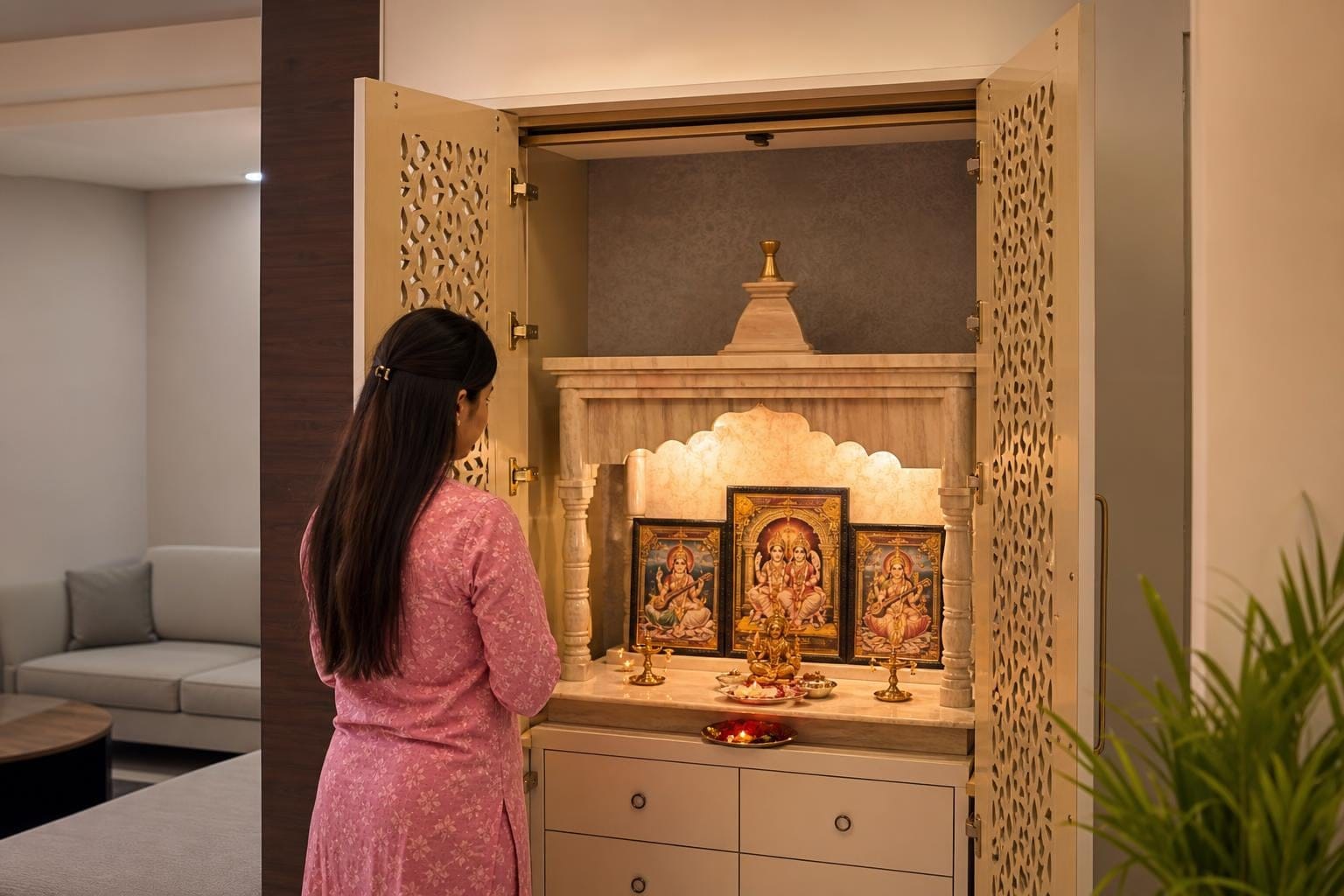
A tall wooden cabinet that opens to reveal a fully equipped pooja area is the most discreet option. When closed, it blends with your living room or bedroom furniture. This design works particularly well for people who entertain frequently and prefer the pooja space to remain private.
Key features:
- Looks like a regular wardrobe or storage cabinet when closed
- Interior can include dedicated shelves, LED lighting, pull-out trays, and incense holders
- Hinged doors, bifold doors, or lift-up mechanisms for access
- Can be placed in bedroom, living room, or even a walk-in closet area
Materials: Plywood or MDF with hinged or bifold doors, interior LED strip lighting, laminate or veneer exterior.
Cost range: ₹35,000–₹1,20,000. The bifold door mechanism and interior fittings push costs toward the higher end.
Trade-offs:
- Enclosed space traps heat from diyas and incense smoke, creating a buildup that stains the interior
- Needs ventilation cutouts (jaali panels or mesh inserts) at the back or top
- Door hinges bear significant weight if the doors are tall, so commercial-grade hinges are essential
- Interior finishes darken over time from smoke residue unless you use wipe-clean laminate
Important safety note: If you light diyas inside a concealed cabinet, maintain at least 300–500 mm clearance around the flame and ensure the cabinet has adequate ventilation openings. Enclosed cabinets in apartments are a genuine fire risk when textiles or paper items sit near open flames.
6. Glass-Enclosed Pooja Unit
Best for: Contemporary and modern flats where visual openness is the priority.
Glass-enclosed pooja units create a sense of spaciousness that solid wood designs cannot match. The idols and brass decor become a display piece visible from multiple angles, making the pooja area feel like a curated gallery rather than a closed-off room.
Key features:
- Transparent panels maintain visual continuity in open-plan layouts
- Tempered or laminated safety glass prevents shattering
- Works beautifully with LED backlighting and spotlights on idols
- Metal frames (brass, gold-toned, or matte black) add a contemporary edge
Materials: Tempered or laminated glass panels with wood, metal, or brass frame. Stone or marble base.
Cost range: ₹60,000–₹2,00,000. The glass quality, frame material, and size drive the price variation.
Trade-offs:
- Glass means frequent wipe-downs: fingerprints show on every surface
- If you burn incense regularly, soot collects on textured glass patterns and requires a specific cleaning routine
- Glass is less forgiving of imperfect installation (misaligned panels are immediately visible)
- Sound travels through glass, so chanting and bell sounds carry further into the flat
Practitioners on design forums recommend using frosted or fluted glass on the lower panels (where fingerprints are most common) and clear glass only on the upper display area. This practical compromise reduces maintenance significantly.
7. Partition-Integrated Pooja Unit
Best for: Open-plan 2BHK and 3BHK flats that need a room divider doubling as a sacred space.
This is the most architecturally ambitious pooja room design in flats. The unit acts as a partition between the foyer and living room (or living and dining areas) while combining display shelving, storage, and a mandir into one cohesive piece of furniture.
Key features:
- Serves dual purpose: room divider and pooja space
- Can incorporate display niches on one side and the mandir on the other
- Backlit jaali panels create a stunning visual effect from both sides
- Marble counter, wood frame, and glass accents can all be combined
Materials: Plywood carcass with backlit panels, jaali screen, marble counter, and optional glass inserts.
Cost range: ₹80,000–₹2,50,000. This is the most expensive non-marble option because of the dual-function engineering and larger footprint.
Trade-offs:
- Requires careful proportioning so the partition doesn’t make the flat feel smaller
- Most complex design to execute, needing precise measurements and 3D visualization before fabrication
- Electrical wiring for backlighting must be planned during civil work, not as an afterthought
- Difficult to relocate if you rearrange your living room layout later
For a deeper look at how pooja units integrate with living room design, see our guide on pooja units in living rooms which covers layout options and Vastu placement in detail.
If you’re planning a 3BHK where a partition-integrated unit makes sense, our 3BHK interior design guide covers how to budget for these larger installations within the overall project.
8. Open-Shelf / Floating Shelf Pooja Design
Best for: Minimalists, renters, and ultra-compact 1BHKs on a tight budget.
Floating shelves are the simplest and most affordable pooja room design for flats. Two or three well-placed shelves on a wall, combined with a small backlit panel and a few meaningful idols, create a prayer space that feels intentional without consuming any meaningful area.
Key features:
- Lowest cost and fastest installation of all options
- Works in living rooms, bedrooms, hallways, or even kitchens
- Adding a small backlit panel behind the shelves elevates the look dramatically
- Easy to modify, expand, or remove without damage
Materials: Solid wood or engineered-wood floating shelves with concealed mounting brackets.
Cost range: ₹15,000–₹40,000, making this the most budget-friendly option. Basic setups with good lighting have been completed for as little as ₹18,000.
Trade-offs:
- No doors means dust accumulates on idols and accessories constantly
- Limited storage for pooja essentials (no drawers or concealed compartments)
- Less privacy during prayer
- Can look unfinished if the wall backdrop isn’t treated (consider a painted accent wall or a simple wall panelling design behind the shelves)
9. Portable / Freestanding Mandir
Best for: Renters who cannot drill into walls and tenants who move frequently.
Portable mandir units come pre-assembled and can be placed anywhere in the flat without wall mounting, drilling, or any modification to the apartment. This is the only option that requires zero commitment to the space.
Key features:
- No wall drilling or permanent installation needed
- Can be repositioned as your layout changes or when you move homes
- Available in a wide range of styles from traditional carved wood to sleek modern designs
- Some models include built-in LED lighting and storage drawers
Materials: Pre-assembled wood, engineered wood, or marble-topped units. Available on e-commerce platforms in dozens of configurations.
Cost range: ₹10,000–₹60,000. The range is wide because portable mandirs span from basic MDF boxes to ornately carved sheesham wood units.
Trade-offs:
- Takes up floor space, which is the scarcest resource in most flats
- May feel unanchored or temporary compared to built-in designs
- Limited customization (you get what the manufacturer offers)
- Quality varies wildly at the budget end; check for sealed edges and stable joinery before buying
10. Marble Pooja Room (Luxury Tier)
Best for: Premium 3BHK and 4BHK flats where families want a temple-grade finish.
A full marble pooja room is the most traditional and visually striking option. Italian or Makrana marble altar tops, carved pillars, dome structures, and pietra dura inlay work create a space that feels like a private temple. This is the premium end of pooja room design in flats.
Key features:
- Temple-grade finishes: carved marble pillars, dome ceiling, inlay work
- 20 mm marble slab for the altar top with an 18 mm marine plywood carcass
- Marble laminate or 6–9 mm slim stone veneer on the sides to manage weight
- Brass accents, carved frames, and dedicated lighting transform the space
Materials: Marble (Italian, Makrana), granite, brass, solid teak for the frame. Slim stone veneers for weight management.
Cost range: ₹1,50,000–₹5,00,000+. This includes civil modifications, marble procurement, installation, and lighting.
Trade-offs:
- Solid marble fronts add significant weight; structural wall assessment is necessary before installation
- Lightweight marble veneers need carefully finished edges to avoid looking thin or cheap
- Marble is porous and stains from oil, turmeric, and kumkum if not sealed properly
- Longest lead time of any option (6–12 weeks for custom carving and installation)
For an in-depth look at marble mandir options specifically, our home mandir marble design guide covers stone types, finishes, and cost breakdowns.
Vastu for Pooja Rooms in Apartments: What Actually Works
Most articles on Vastu and pooja rooms list rigid rules without acknowledging that apartments don’t give you the freedom to choose where every room goes. The builder decided your floor plan. Working within that reality is not a spiritual compromise; it’s practical wisdom.
The ideal, when possible:
The northeast direction (Ishanya corner) is considered the best location for a pooja room, associated with clarity, peace, and spiritual energy. This direction allows morning sunlight to enter the space naturally, which aligns with traditional prayer times.
If northeast isn’t available, east or north-facing walls are also considered auspicious. South-facing placement is generally avoided.
The apartment reality:
Not every home can have a northeast room. In apartment layouts designed by builders, the northeast corner might house a washing machine, a utility area, or a storage cupboard. Forcing Vastu into leftover spaces usually results in a pooja area that feels like an afterthought.
Practical guidelines that work in flats:
- Prioritize daily usability over strict directional compliance. A pooja room you use every day in the “wrong” corner beats a perfectly oriented space you never visit.
- Avoid placing the pooja unit sharing a wall with a bathroom. If this is unavoidable, ensure proper separation and maintain extra ventilation on the pooja side.
- Nothing should be placed above the idols. All storage, whether drawers or cabinets, should sit below the idol shelf. This is one Vastu principle that’s easy to follow in any design format.
- Face east or north while praying if possible. This is simpler to achieve than positioning the entire room in the northeast, since you can orient the mandir on the appropriate wall regardless of the room’s location.
- Idol height should be at chest level when you’re seated in your prayer position. This is both a Vastu guideline and an ergonomic one.
The bottom line: Vastu is a guide, not a cage. Ancient wisdom accommodates contemporary constraints when approached with flexibility rather than fear.
Material Selection for Bangalore Flats
Material choice matters more in Bangalore than in drier cities. The monsoon season brings sustained humidity that warps MR-grade plywood, swells MDF edges, and causes laminate to peel. If your pooja room involves oil lamps, water rituals, or daily flower offerings, moisture resistance becomes critical.
| Material | Durability | Humidity Resistance | Relative Cost | Best For |
|---|---|---|---|---|
| BWP/Marine Plywood | High | Excellent | Medium | Bangalore monsoon areas, daily ritual use |
| MR-Grade Plywood | Medium | Low | Budget | Dry zones only, air-conditioned spaces |
| MDF + Laminate | Medium | Low | Budget | Quick installs, temporary setups for renters |
| Solid Teak/Rosewood | Very High | Good | Premium | Traditional carved mandirs |
| Marble | Very High | Excellent | Premium | Luxury flats, statement pieces |
| Glass + Metal Frame | High | Excellent | Medium-High | Modern aesthetics, open-plan layouts |
BWP (Boiling Water Proof) or marine-grade plywood costs more upfront but prevents sagging doors and peeling laminate within 1–2 years. This is where a professional designer’s specification rigor pays for itself. Using MR-grade plywood to save ₹3,000–₹5,000 on materials only to replace the entire unit in three years is a false economy.
For a deeper understanding of plywood grades and when each matters, read our guide on BWP plywood and why it matters in humid Indian climates.
Lighting That Creates Serenity (Not Just “Add Warm Lights”)
Lighting transforms a pooja room more than any other single element. Warm, layered lighting makes a ₹30,000 plywood unit look like it cost ₹1 lakh. Harsh white fluorescent light makes a ₹2 lakh marble installation look clinical. This is the highest-ROI upgrade most people skip.
The three-layer framework:
Ambient layer: A single dimmable ceiling fixture or cove light provides overall illumination. Keep the color temperature between 2700K and 3000K (warm white). This reduces eye strain during extended prayer and creates the warm, golden atmosphere associated with temple spaces.
Task layer: A 2–3W spotlight directed at the main idol ensures the focal point is always well-lit, even when the ambient light is dimmed for evening aarti.
Accent layer: A 4–6W LED strip behind panels or shelves creates the glowing backdrop effect that elevates any pooja room from functional to beautiful. This is the layer most people see in design magazines and assume requires expensive materials. It doesn’t. It requires good lighting placement.
Color Rendering Index (CRI): Keep it above 90. High CRI renders the reds, golds, and brass tones of pooja accessories beautifully. Low CRI washes them out. This spec is rarely mentioned in pooja room guides, but it makes an enormous visual difference.
Ritual lighting: Traditional diyas should sit on heat-resistant brass or stone trays. Maintain 300–500 mm clearance around any open flame, and keep all textiles, paper decorations, and dried flower garlands clear from the flame’s path.
Layering these light sources supports different moments: morning japa, evening aarti, and quiet meditation each call for different intensity levels. A single dimmable fixture paired with separately controlled accent strips gives you this flexibility at minimal cost.
For more on how lighting transforms home interiors, including the technical specs behind color temperature and CRI, we’ve written a dedicated deep-dive.
2026 trend: Smart home integration is entering pooja rooms. Voice-controlled or app-controlled lighting lets you set different scenes for morning and evening prayers. Motion-activated LED strips that glow softly when you approach the mandir and dim when you leave are becoming popular in premium Bangalore apartments. Automated scheduling (lights on at 6 AM and 6 PM) removes the daily task of manual switching.
5 Common Pooja Room Design Mistakes in Flats
Mistake 1: Overcrowding the Space
A cluttered mandir disrupts both visual harmony and spiritual focus. In a flat where the pooja unit might be 2 feet wide, every inch matters. Choose a few meaningful idols rather than filling every shelf. Thoughtful curation with minimal decor ensures the space remains serene. Storage for the excess (spare garlands, seasonal decorations, extra agarbatti boxes) belongs in drawers below the idol shelf, not on it.
Mistake 2: Wrong Lighting
Using harsh white fluorescent tubes or a single overhead bulb is the most common lighting mistake. It creates unflattering shadows and makes the space feel utilitarian rather than sacred. Even a basic ₹500 LED strip in warm white behind the mandir makes a bigger difference than spending ₹10,000 more on fancier materials.
Mistake 3: Inappropriate Materials
Choosing porous stones, untreated wood, or MR-grade plywood in a humid city like Bangalore makes cleaning difficult and shortens the unit’s lifespan. If you perform daily rituals involving water, oil, or flowers, your materials need to resist moisture and staining. Sealed edges, laminated surfaces, and BWP-grade plywood are not upgrades; they’re baseline requirements.
Mistake 4: No Ventilation Planning
Enclosed cabinets and sliding-door units trap incense smoke and diya heat. Over months, this causes yellowing, soot buildup, and in extreme cases, heat damage to laminate surfaces. Every enclosed pooja unit needs ventilation cutouts, whether that’s jaali panels at the back, mesh inserts at the top, or simply leaving a gap between the unit and the ceiling.
Mistake 5: Ignoring Fire Safety
Unlike standalone houses, apartments have shared walls, false ceilings with concealed electrical wiring, and limited escape routes. Place open flames on a metal or stone tray. Maintain 300–500 mm safety clearance around any diya. Keep dried flowers, fabric drapes, and paper decorations well away from the flame path. This is non-negotiable in any flat, and it’s the one detail that most design mistakes guides don’t cover specifically for pooja rooms.
2026 Pooja Room Design Trends Worth Knowing
Several trends are shaping pooja room design in flats this year:
Quiet luxury over ornate temple replicas. Urban families are choosing restrained designs with natural materials, clean lines, and intentional simplicity. The goal is a space that feels special during aarti but blends with the rest of the home otherwise. Fluted laminates, ribbed glass, and cane accents create privacy without heavy partitions.
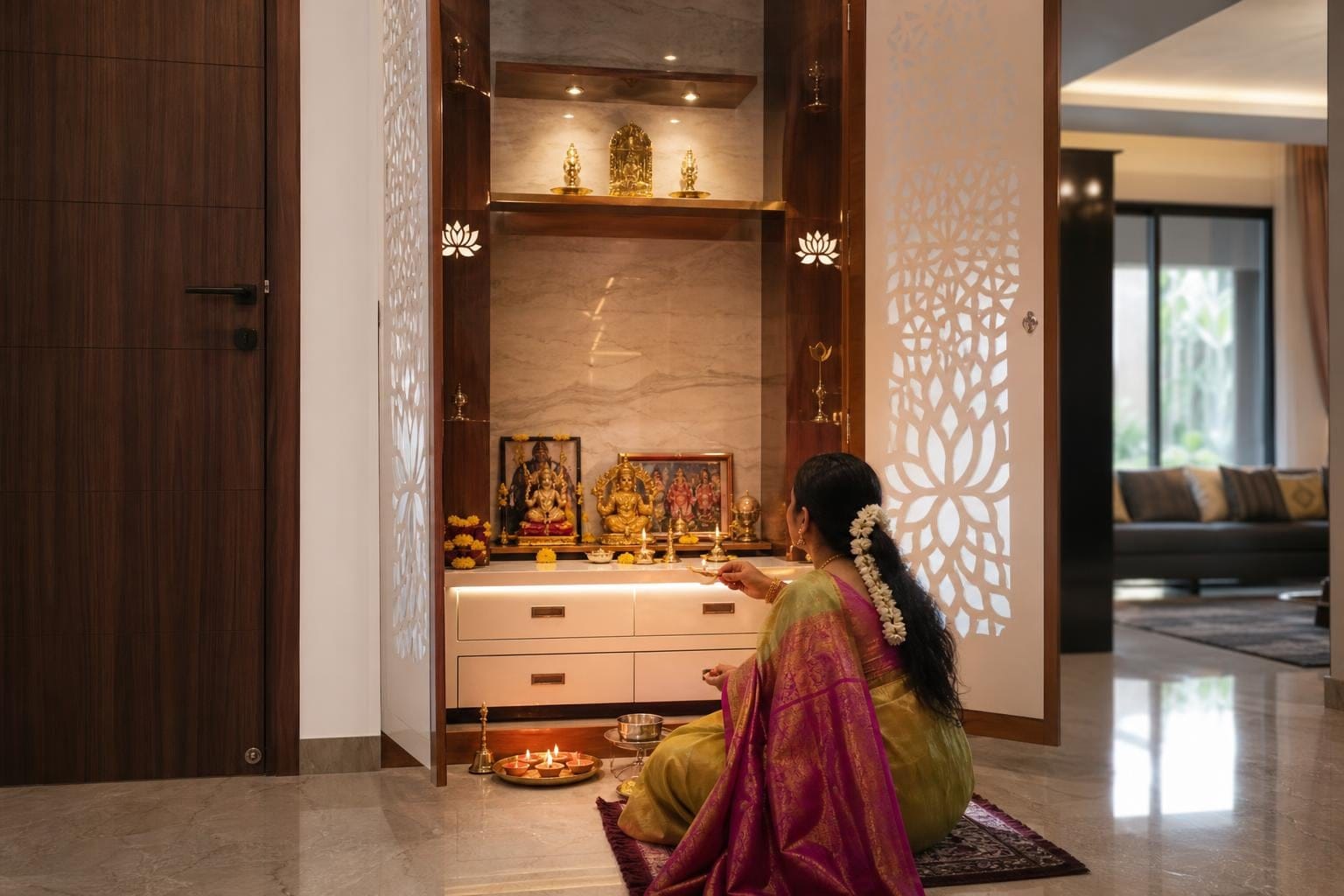
Laser-cut jaali and CNC motifs. Om, lotus, swastik, and geometric patterns cut into MDF or plywood panels act as elegant screens that filter light beautifully. Soft LED lighting behind these panels creates a glowing divine aura that photographs well and, more importantly, feels right during prayer.
Motion-activated and dimmable LED strips. These highlight idols and brass decor while responding to your presence. The technology has become affordable enough that it’s no longer a luxury add-on.
Integrated prayer corners in living areas. Rather than dedicating a separate room, many apartment owners are designing prayer corners that sit inside the living or dining area yet feel special during use. Sliding lattice screens provide privacy without permanent walls.
If you’re curious about how false ceiling designs with cost breakdowns can incorporate cove lighting around your pooja area, that guide covers concealed strip lighting options in detail.
Frequently Asked Questions
What is the minimum size for a pooja room in a flat?
A functional pooja space can work in as little as 2 feet x 2 feet (wall-mounted or niche format). A dedicated pooja room typically needs at least 4 feet x 4 feet to accommodate comfortable seating during prayer. For most flats, the practical range is 3 feet x 3 feet to 5 feet x 5 feet.
Can I place a pooja room in the kitchen or bedroom?
Kitchens are generally discouraged per Vastu because of the fire element conflict, though a small shelf in a clean corner is common in very small flats. Bedrooms are acceptable if no other option exists, but the pooja area should not face the bed, and it should be at a height where your feet don’t point toward the idols while sleeping.
What is the best direction for a pooja room in an apartment?
Northeast is considered ideal per Vastu, followed by east and north. If none of these are available, focus on facing east or north while praying rather than relocating the entire unit to a direction that disrupts your flat’s functionality.
How long does it take to install a custom pooja unit?
Most custom pooja room projects take 3 to 8 weeks depending on design complexity, material procurement, and any civil modifications needed. A simple wall-mounted unit can be done in 2 weeks. A marble installation with custom carving takes 6 to 12 weeks.
Is MDF suitable for a pooja room in Bangalore?
MDF works for budget installations in air-conditioned rooms, but it’s not recommended for Bangalore’s humid conditions if the room lacks climate control. MDF edges swell with moisture, and the board weakens over time. BWP-grade plywood is a safer long-term investment.
How can I make a rented apartment’s pooja room without damaging walls?
Portable freestanding mandirs (₹10,000–₹60,000) and floating shelves with removable adhesive mounts are the best options. Avoid drilling if your lease restricts it. Some renters use tall bookshelf-style units and dedicate the top shelf as a mandir.
Should I use 3D visualization before finalizing my pooja room design?
For any custom pooja unit above ₹50,000, 3D visualization is worth the investment. It shows exactly how the unit will look in your specific flat, with your wall colors, your lighting, and your proportions. This is especially valuable for partition-integrated and niche designs where getting the proportions wrong is costly to fix. Learn more about how 3D visualizations help you finalize design decisions before fabrication begins.
What does a professionally designed pooja room cost in Bangalore?
Based on current Bangalore market data, expect ₹18,000–₹80,000 for wall-mounted designs, ₹50,000–₹1,50,000 for mid-range sliding or cabinet units, and ₹1,50,000–₹5,00,000+ for marble or luxury installations. For a detailed breakdown of how pooja rooms fit into your overall apartment interior budget, see our Bangalore interior design cost guide.