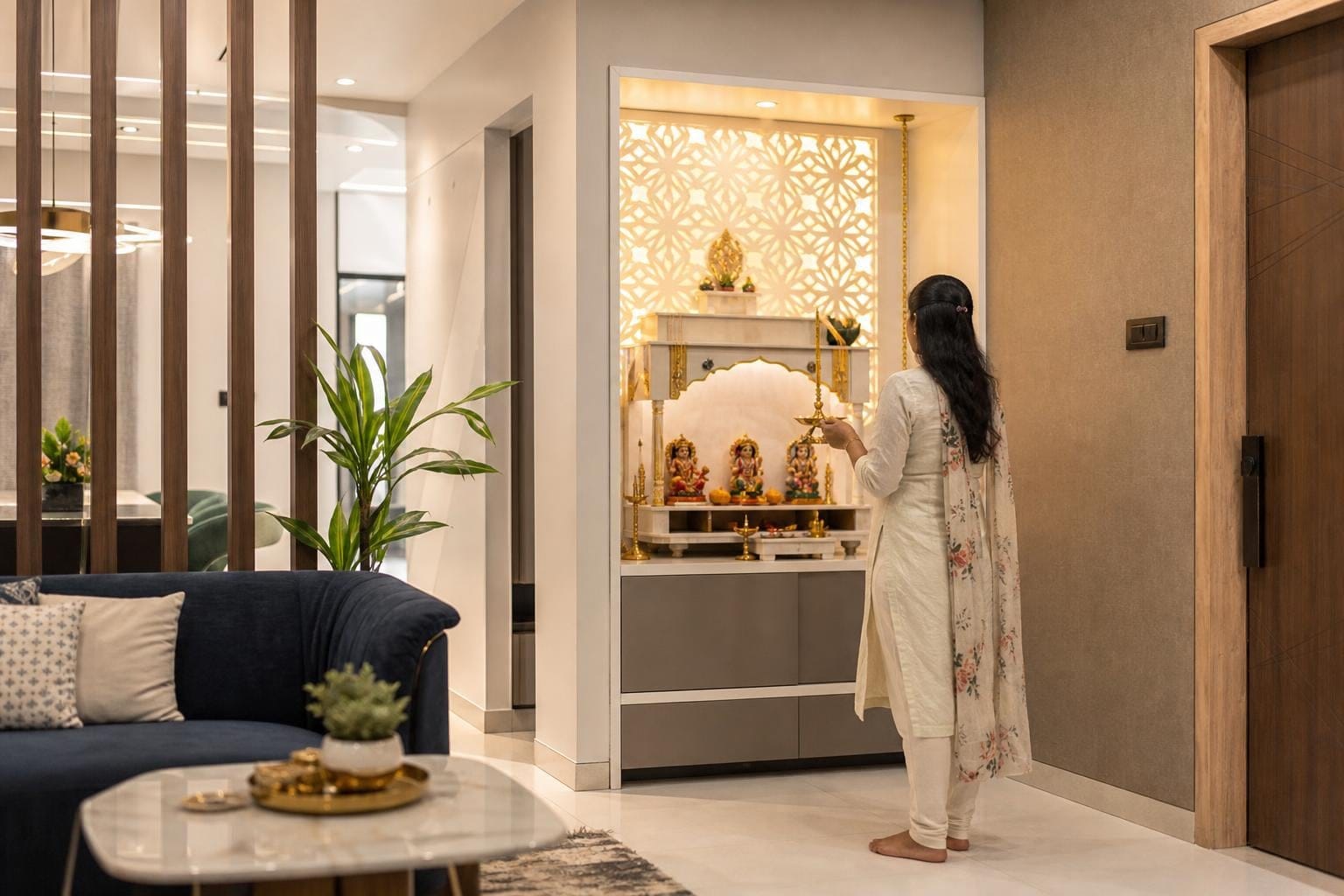
12 Pooja Unit in Living Room Ideas: Designs, Costs 2026
TL;DR
If your apartment doesn’t have a separate pooja room, your living room is the next best spot. This guide covers 12 pooja unit in living room ideas ranging from ₹8,000 floating shelves to ₹2,80,000 backlit Corian compositions. Each design includes material options, approximate costs, Vastu compatibility, and maintenance realities. Wall-mounted units and concealed cabinets work best for 2BHKs, TV-integrated designs save 20-30% wall space in open-plan homes, and backlit marble or Corian units suit luxury apartments. For Bangalore homes, humidity-resistant materials like Corian and marine-grade plywood deserve serious consideration.
The Real Problem Nobody Talks About
Modern apartment living presents a bitter reality for Indian families. Sprawling ancestral homes with dedicated room-sized puja areas are long gone. Today, a 2BHK in Whitefield or a 3BHK in HSR Layout accounts for every square foot, and a separate pooja room simply doesn’t exist in many floor plans.
So the mandir goes into the living room. And that’s where most homeowners hit a wall, figuratively and literally. You can buy a ready-made wooden box online and place it on a shelf, but it rarely feels integrated. It looks like an alien object dropped into the room, disconnected from the surrounding design language.
A well-designed pooja unit in the living room solves this tension. It honors tradition without compromising modern aesthetics, and it treats sacred space as a design element worth the same attention as your TV unit or bookshelf. If you’re planning a full pooja room design for your Bangalore apartment, the ideas below will help you understand what’s possible.
At-a-Glance Comparison Table
Design Type | Best For | Starting Cost | Material Options | Vastu Friendly | Maintenance Level |
|---|---|---|---|---|---|
Wall-Mounted Floating | 2BHK, renters, minimal floor space | ₹8,000 | MDF, engineered wood, marble laminate | Yes (if NE/East wall) | Low |
Built-In Niche/Alcove | New construction, renovation | ₹25,000 | Wood, marble, Corian | Yes | Low |
Corner Unit | Vastu-conscious, underused corners | ₹15,000 | Wood, MDF, marble | Excellent (NE corner) | Low-Medium |
TV Wall Integrated | Open-plan, no spare wall | ₹40,000 | Engineered wood, laminate, marble | Moderate (needs zoning) | Low |
Jaali Partition | Open living-dining layouts | ₹20,000 | Wood, MDF, brass, acrylic | Yes | Medium |
Concealed Cabinet | Clean-look families | ₹25,000 | MDF, wood, frosted glass | Yes | Low |
Backlit Marble | Luxury apartments, villas | ₹35,000 | Onyx, alabaster, marble cladding | Yes | Low |
CNC-Cut Corian | Modern homes, humid climates | ₹30,000 | Corian solid surface | Yes | Very Low |
Open-Shelf Minimalist | Young professionals, minimal interiors | ₹8,000 | Engineered wood, metal, MDF | Yes | Very Low |
Glass Partition | Open-plan, contemporary | ₹18,000 | Frosted/etched glass, toughened glass | Yes | Low |
South Indian Temple-Style | Traditional families, larger rooms | ₹50,000 | Teak, sheesham, brass | Excellent | High |
Full-Wall Composition | Premium 3BHK/4BHK, villas | ₹1,00,000 | Multi-material | Yes | Medium |
12 Pooja Unit in Living Room Ideas
1. Wall-Mounted Floating Pooja Unit
Best for: 2BHK apartments, renters, and anyone who can’t sacrifice floor space.
This is the most common pooja unit in living room idea for compact Indian homes, and for good reason. A floating unit mounted at eye level (around 30-36 inches from the floor) keeps the mandir accessible while freeing up the area below for seating or storage.
Cost range: ₹8,000 to ₹45,000 depending on material and complexity. Add ₹8,000 to ₹20,000 for carved jaali doors.
Materials: Engineered wood with laminate, MDF, or marble-texture laminate. Solid wood is possible but adds weight and cost.
Key features:
Zero floor footprint
Easy to install and relocate
Works with slim cabinets or open shelves
Can include a small drawer for agarbatti and matchboxes
Limitations:
Wall load matters. Solid walls are preferred. Hollow drywall partitions need reinforcement with backing plates.
If you use oil lamps frequently, soot collects near the jali and stains the surrounding wall.
Limited space for larger idols or elaborate setups.
Vastu note: Mount on the northeast or east wall, and you’re aligned with traditional placement guidelines. Keep the unit away from the wall directly behind a TV.
Pro tip: Use a marble-texture laminate backing instead of actual marble to keep the unit light enough for standard wall mounting. You get the visual effect at a fraction of the weight and cost.
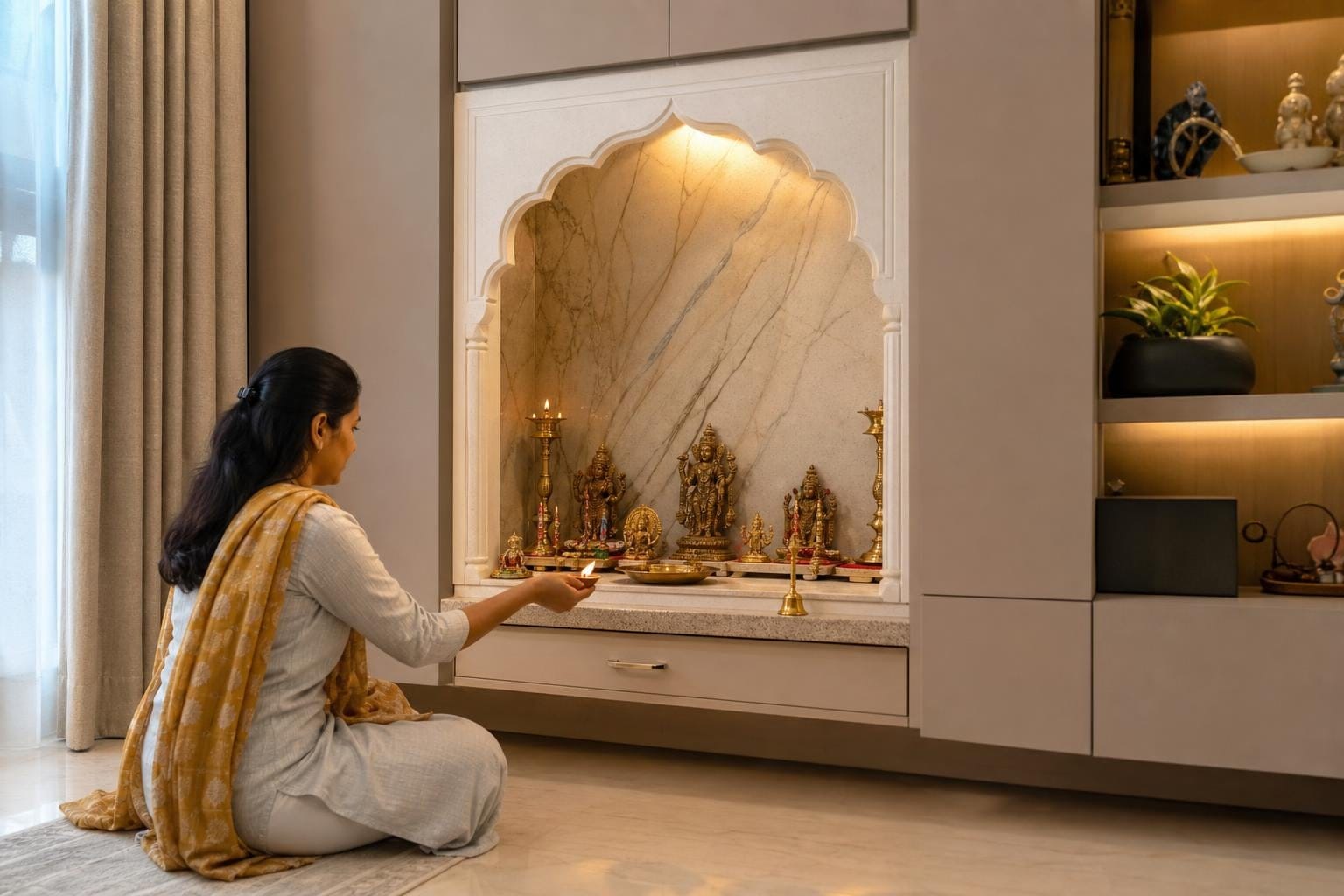
2. Built-In Niche / Alcove Pooja Unit
Best for: Homes under construction or undergoing renovation where you want zero-footprint sacred space.
This is one of the smartest pooja unit in living room ideas for space-conscious homeowners. Most Indian apartment walls have a thickness of 6 to 9 inches. By carving out a section of an internal wall (typically one separating the living room from the kitchen or a corridor), you create a dedicated pooja alcove without eating into your room’s usable area.
Cost range: ₹25,000 to ₹75,000 including civil work, finishing, and lighting.
Materials: The niche itself is structural. The finishing can be marble cladding, wooden paneling, or Corian. Latticework doors in carved wood add privacy.
Key features:
Truly flush with the wall surface when closed
Can be designed with internal lighting for a glowing effect
Feels intentional, not afterthought
Works beautifully in Bangalore apartments where every foot counts
Limitations:
Requires civil work, so this is only practical during construction or a major renovation
You can’t do this on load-bearing walls without a structural engineer’s clearance
Retrofitting adds cost compared to planning it from day one
Vastu note: If the niche falls on the northeast or east wall, it’s ideal. For shared walls, check that the other side isn’t a bathroom or toilet, as Vastu strongly discourages this.
Pro tip: Discuss this with your interior designer early in the planning stage. Adding a niche after the walls are plastered and painted costs roughly 40% more than incorporating it during construction.
3. Corner Pooja Unit
Best for: Vastu-conscious homeowners with an underutilized northeast corner in the living room.
Corner mandirs follow an L-shaped or triangular layout that fits snugly into the corner, making the space feel purposeful instead of wasted. Some designs extend vertically with open shelves or wall-mounted panels, creating a tall, slender composition that draws the eye upward.
Cost range: ₹15,000 to ₹55,000 depending on height, material, and carving detail.
Materials: Solid wood (teak or sheesham for traditional aesthetics), engineered wood with veneer for a modern look, or marble for a premium finish.
Key features:
Perfect Vastu alignment when placed in the northeast corner
Uses otherwise dead space
Vertical designs can include shelving for flowers, lamps, and small framed images
Works in both traditional and contemporary interiors
Limitations:
Corners near windows can expose the unit to direct sunlight and rain splash during monsoons
Triangular shapes limit the depth available for larger idols
Corner placement can feel tucked away if not properly lit
This design trend is extremely popular in Bangalore apartments where builders sometimes leave awkward corner spaces that are hard to furnish otherwise.
Vastu note: The northeast corner is considered the Ishanya corner in Vastu, associated with clarity, peace, and spiritual energy. This is the single best location for a pooja unit.
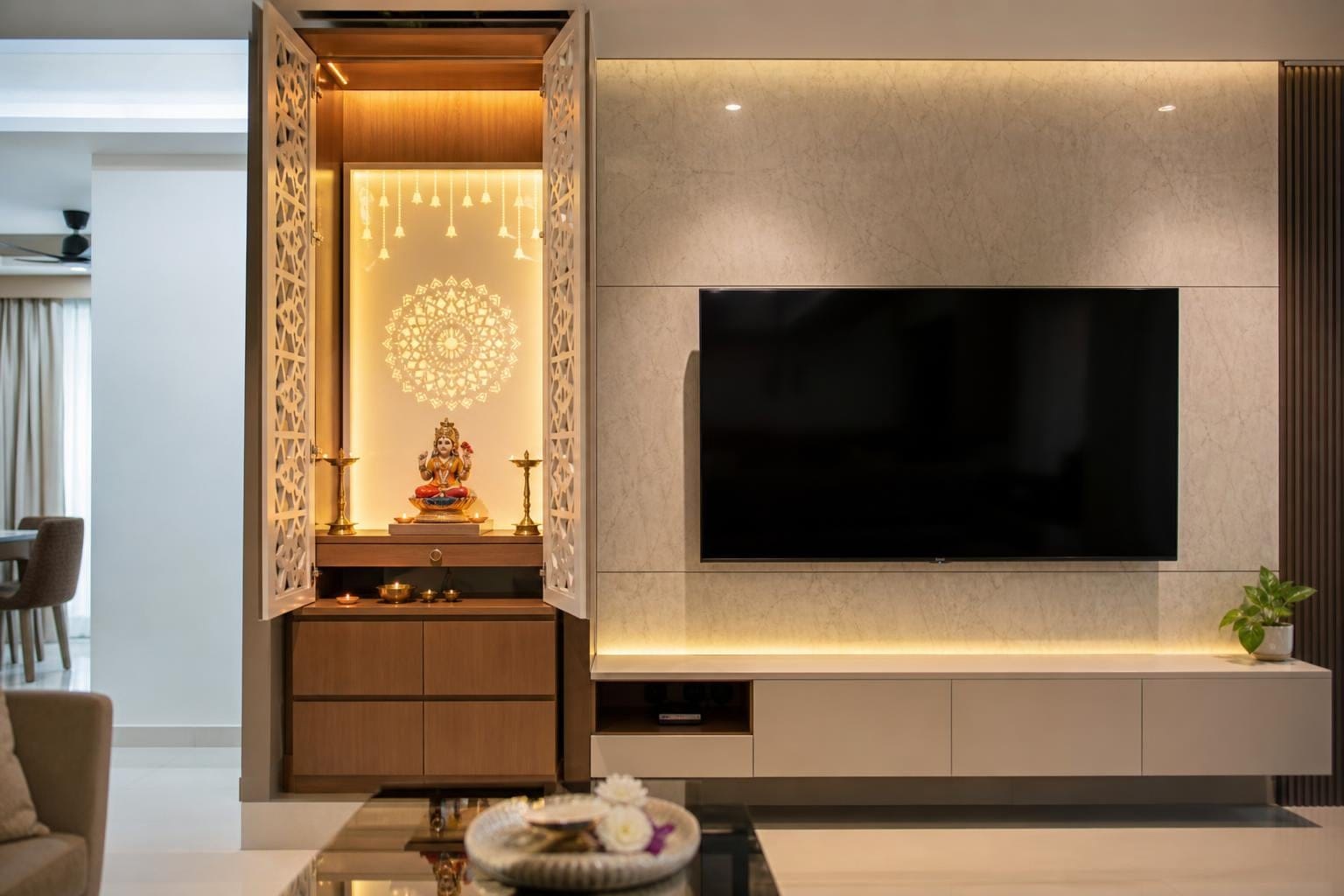
4. TV Wall Integrated Pooja Unit
Best for: Open-plan living rooms without a single spare wall to dedicate to a mandir.
Combining a TV unit with a mandir is a practical solution that can save 20-30% wall space compared to having two separate units. When planned well, the mandir section remains respectful while the TV unit stays functional.
For detailed TV unit layouts and design approaches, check out this guide on TV unit design ideas.
Cost range: ₹40,000 to ₹1,50,000 for the combined unit. The cost rises significantly with marble accents, concealed lighting, and premium hardware.
Materials: Engineered wood for the structure, laminate or veneer finish, with marble or stone accents for the pooja section.
Key features:
Single wall handles both entertainment and devotion
Different textures and finishes create visual zoning between the two functions
The mandir section is typically elevated and set apart with sliding shutters for privacy
Saves significant wall space in 2BHK and compact 3BHK apartments
Limitations:
Vastu purists may object to placing a pooja unit near a TV
Without clear visual separation, the sacred and secular can blur together
The mandir section tends to be smaller than a standalone unit
Incense smoke near electronics is a real concern; ventilation planning matters
Vastu note: This design needs careful planning. Keep the pooja section on the northeast or east side of the TV wall. Use a physical divider, even a subtle wooden partition, to create separation. Avoid placing the TV directly facing the idols.
Pro tip: Sliding shutters are non-negotiable here. They let you close the mandir section during TV time and open it for prayers, maintaining the sanctity of both activities.
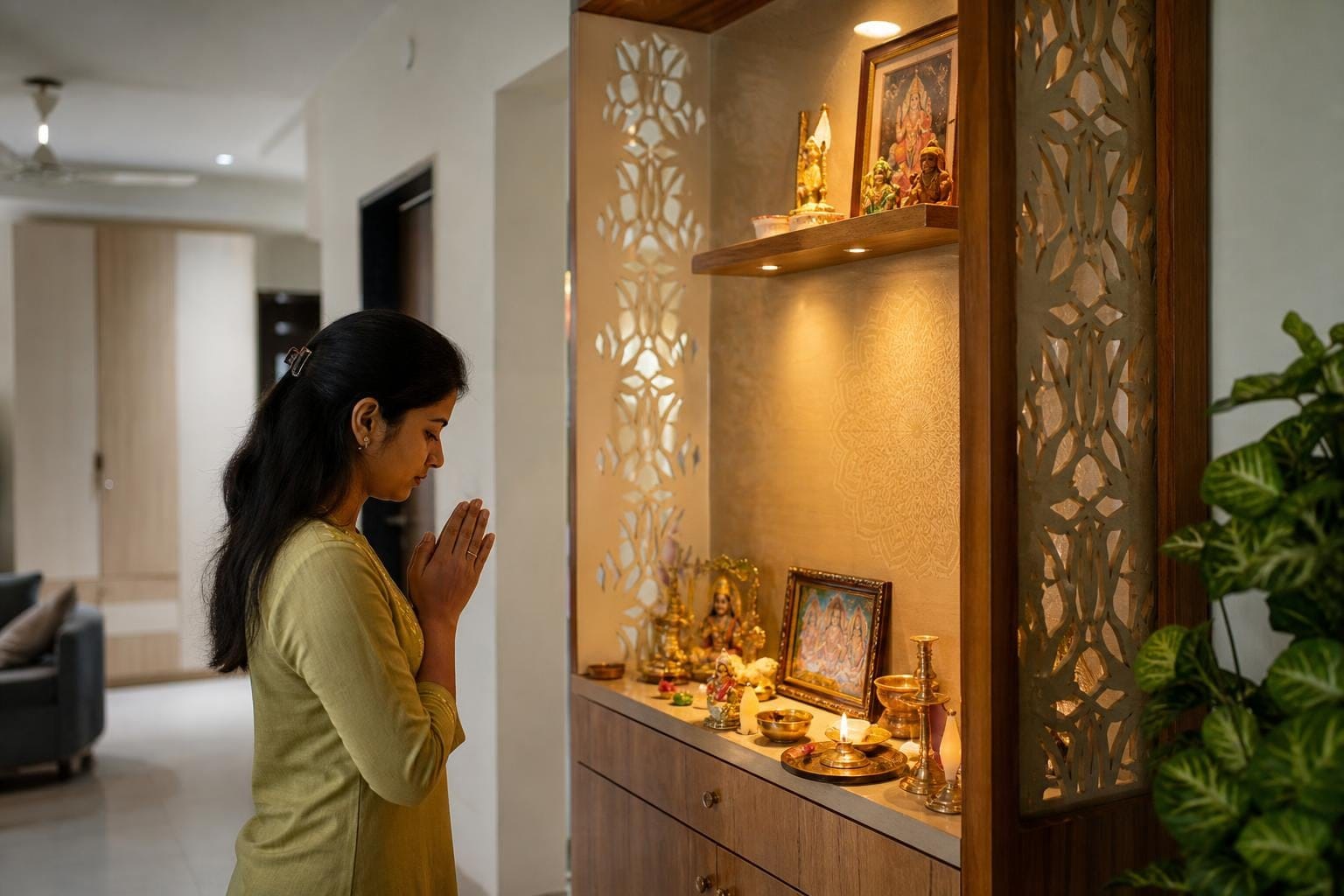
5. Jaali-Partition Pooja Corner
Best for: Open-plan living-dining layouts where you want visual separation without blocking light.
Laser-cut jaali panels are dominating pooja room design in 2026. These intricate screens allow light and air to flow while adding privacy and cultural depth. A jaali partition creates a semi-enclosed pooja corner within the living room that feels distinct from the main seating area.
Beyond aesthetics, jaali helps with passive temperature control. It acts as a natural ventilator and reduces glare, which is particularly useful for spaces where you burn incense or light diyas regularly.
Cost range: ₹20,000 to ₹70,000 depending on material, size, and pattern complexity. Brass jaali costs significantly more than MDF or PVC.
Materials: Wood, MDF, brass, steel, acrylic, PVC. For more on wall panelling options including jaali and fluted panels, there’s a detailed comparison available.
Key features:
Filters light beautifully, creating patterned shadows
Defines the pooja space without a solid wall
Available in traditional motifs (lotus, geometric, temple patterns) and modern abstract designs
Can be floor-to-ceiling or partial height
Limitations:
Deep-cut patterns collect dust and incense residue quickly
MDF jaali doesn’t hold up well in high-humidity areas
Brass and steel options are expensive and require periodic polishing
Free-standing jaali partitions can feel wobbly without proper anchoring
Vastu note: A jaali partition doesn’t violate any Vastu guidelines as long as the pooja area itself is in the northeast or east zone. The partition should not completely block the energy flow from the northeast.
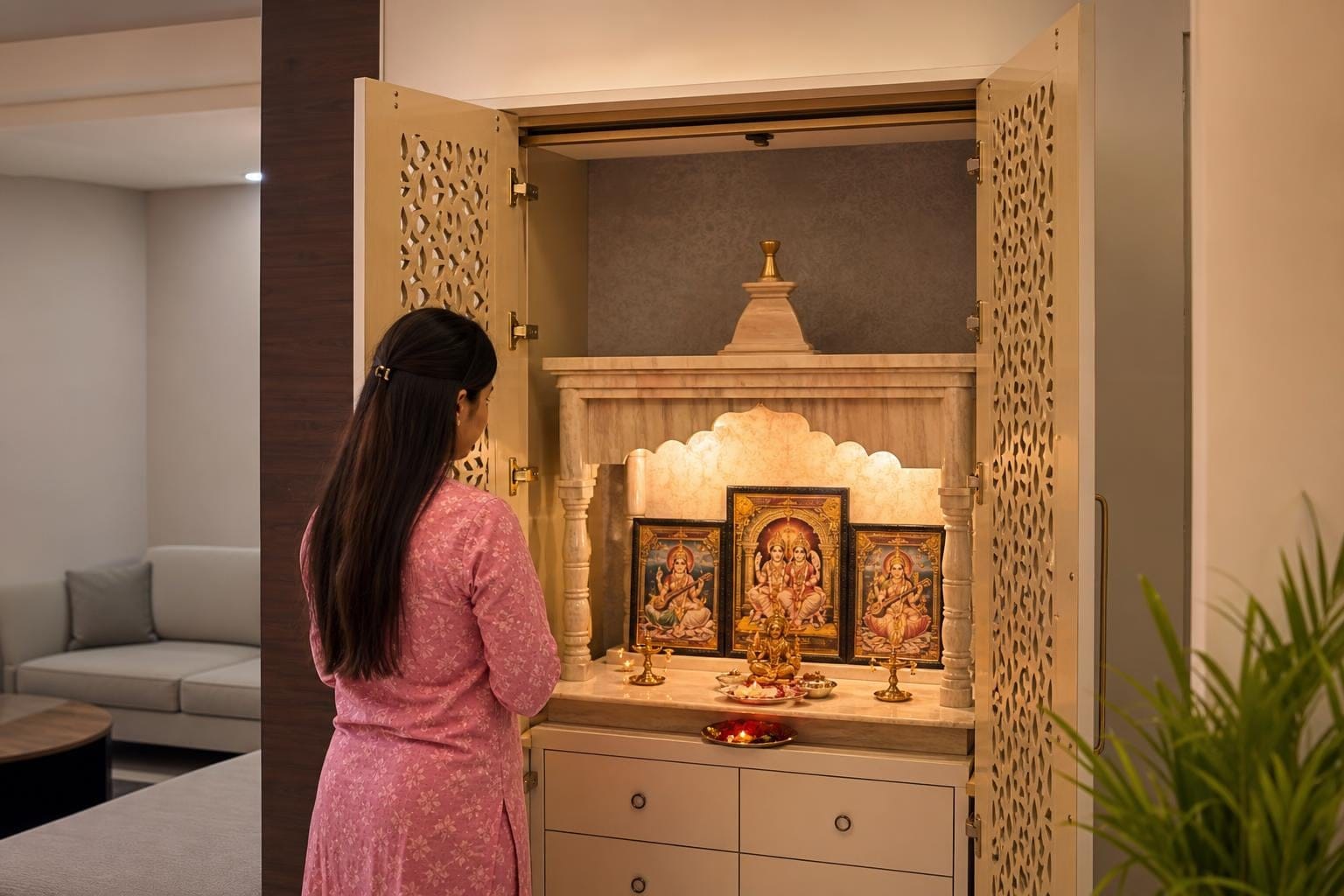
6. Concealed Cabinet Pooja Unit
Best for: Families who want a clean living room appearance when the mandir is not in active use.
This is the chameleon of pooja unit in living room ideas. When closed, it looks like a regular wall cabinet or part of your storage system. When opened, it reveals a fully appointed mandir with lighting, idol placement, and storage for accessories.
Cost range: ₹25,000 to ₹80,000. Premium sliding mechanisms and soft-close hardware push costs higher but are worth it for daily use.
Materials: MDF with laminate, solid wood, or a combination. Door options include carved MDF, jali-pattern wood, and frosted glass.
Key features:
Hidden storage drawers below for agarbatti, flowers, matchboxes, and accessories
Shutter options that close for a clean look when not in use
Internal LED lighting that activates when doors open
Maintains privacy and sanctity in open-plan homes with frequent guests
Limitations:
Hinged doors need clearance space to open fully
Sliding mechanisms need quality hardware (commercial-grade) to avoid jamming over time
Concealed units can feel cramped if not designed with enough depth for comfortable pooja
Ventilation inside the closed cabinet matters if you store flowers or use incense regularly
Vastu note: Fully compatible, provided the cabinet is placed on an appropriate wall. Ensure idols face west (so the person praying faces east), which is the standard Vastu recommendation.
Pro tip: Insist on soft-close hardware for the doors. A mandir cabinet that slams shut feels wrong on every level. Also, consider marine-grade plywood for the interior shelves if you regularly place fresh flowers or water vessels inside.
7. Backlit Marble Pooja Unit
Best for: Luxury apartments and villas where the pooja unit doubles as a statement piece.
A backlit marble feature wall instantly elevates your mandir design, creating a soft, divine glow. This is lighting used as a design element rather than just an add-on. Onyx and alabaster sheets are the most popular choices for backlighting because they’re translucent enough to let LED light pass through.
Cost range: ₹35,000 to ₹1,10,000 including electricals. Onyx and alabaster sheets range from ₹3,500 to ₹12,000 per sq ft. Marble cladding costs ₹250 to ₹900 per sq ft. Quality LED panels with drivers add ₹4,000 to ₹15,000.
Materials: Natural marble, onyx, alabaster, with LED strip lighting or panel backlighting.
Key features:
Creates an ethereal, warm glow that feels sacred
The marble surface is easy to wipe clean
Works as a focal point even when prayers aren’t happening
Can be combined with a niche or wall-mounted design
Limitations:
Marble is heavy. Wall mounting needs structural assessment, and you may need a steel frame behind the cladding.
Acidic substances like turmeric, kumkum, and lemon can cause staining on marble surfaces. Sealed or polished marble mitigates this.
Onyx sheets are fragile and expensive. Breakage during installation is a real risk.
Electrical work needs to be planned in advance. Retrofitting LED channels behind marble is messy and expensive.
Vastu note: Warm-toned backlighting aligns with the positive, inviting energy Vastu encourages for a pooja space. Avoid harsh white or blue LEDs.
For more on how layered lighting transforms a living room, including cove lighting above pooja areas, see this living room lighting guide.
8. CNC-Cut Corian Pooja Unit
Best for: Modern homes, humidity-prone areas (especially relevant for Bangalore’s monsoon season), and families wanting near-zero maintenance.
Corian, a solid surface material made from acrylic polymer and alumina trihydrate, is becoming a serious contender for pooja units. It doesn’t absorb liquids, resists bacteria, mold, and mildew, and can be shaped into virtually any form using CNC cutting. For Bangalore apartments where monsoon humidity causes wooden units to swell and warp, Corian is a compelling alternative.
Cost range: Most customers choose from three tiers: Tier 1 (₹30,000 to ₹55,000), Tier 2 (₹55,000 to ₹1,20,000), or Tier 3 (₹1,20,000 to ₹2,80,000). The tier depends on size, pattern complexity, and whether backlighting is included.
Materials: Corian or similar solid surface brands. Often combined with wood or marble accents for warmth.
Key features:
Non-porous surface stays cleaner than wood or marble
CNC cutting allows intricate patterns, temple motifs, and custom shapes
Can be backlit for a soft glowing effect (though this increases cost)
Seamless joints possible, meaning no visible seams where dirt collects
Limitations:
Higher upfront cost than wood or MDF
Requires specialized fabricators; not every carpenter can work with it
Can look too clinical or “synthetic” in traditional interiors
Color options are broad but may not match natural stone aesthetics perfectly
To understand why material quality matters so much in the long run (and how to tell BWP plywood from cheaper alternatives), that link is worth reading.
Vastu note: No material-specific restrictions in Vastu. Corian works in any compliant placement.
9. Open-Shelf Minimalist Pooja Unit
Best for: Young professionals, minimalist or Scandinavian-influenced interiors, and anyone who wants a pooja space without visual bulk.
Minimalism is a dominant trend in 2026 pooja unit design. Clean lines, simple shelves, and subtle color palettes are replacing the heavily carved wooden temples that defined the previous generation. Floating shelves make a modest pooja unit in the living room feel more expansive, creating the illusion of more space in compact homes.
Cost range: ₹8,000 to ₹25,000. This is one of the most budget-friendly pooja unit in living room ideas.
Materials: Engineered wood, MDF with laminate, metal brackets, or a single marble shelf.
Key features:
Clutter-free, airy appearance
Easy to install and rearrange
Works in rental apartments without permanent modifications
Can be styled differently for festivals and daily use
Limitations:
No concealment. Everything on the shelf is always visible.
No protection from dust, incense smoke, or cooking grease in open-plan homes
Can look too casual or impermanent if not styled carefully
Limited storage for pooja accessories
Vastu note: Open shelves are Vastu-friendly. Just ensure idols are placed on a raised platform (even a small marble or wooden base) rather than directly on the shelf surface. Keep at least six inches of space between the idols and the wall behind them.
10. Glass Partition Pooja Space
Best for: Open-plan apartments where you want the pooja space to be visible yet clearly defined.
Glass partitions create a see-through enclosure that maintains visual continuity with the living room while giving the pooja area its own identity. Frosted or etched glass provides privacy. Clear glass with etched temple motifs offers a decorative middle ground.
Cost range: ₹18,000 to ₹60,000 depending on glass type, framing, and size.
Materials: Frosted toughened glass, etched glass, or back-painted glass. Frames can be stainless steel, aluminum, or wood.
Key features:
Allows natural light to reach the pooja area
Contemporary appearance that suits modern interiors
Etched glass can incorporate Om symbols, lotus patterns, or geometric motifs
Combines well with warm lighting and muted flooring for a luxurious feel
Limitations:
Glass shows fingerprints and smudges easily, especially near handles
Not suitable for heavy idol placement on glass shelves
Incense smoke leaves a residue on glass surfaces that needs weekly cleaning
Toughened glass is safe but expensive; regular glass is a safety hazard
Vastu note: Transparent materials don’t obstruct energy flow, which aligns well with Vastu principles. However, ensure the pooja area behind the glass still follows directional guidelines.
11. South Indian Temple-Style Pooja Unit
Best for: Traditional families with larger living rooms or villa settings who want an authentic temple aesthetic.
This style draws directly from temple architecture: dome ceilings (vimana), carved wooden pillars, arches, brass bells, and intricate detailing. It’s the most culturally rich of all pooja unit in living room ideas, and it transforms a corner into a space that feels genuinely sacred.
Cost range: ₹50,000 to ₹2,00,000 or more. The deep carving work, especially in solid teak or sheesham, is what drives the cost.
Materials: Teak wood, sheesham, rosewood. Brass and copper accents for bells, lamps, and door handles.
Key features:
Authentic temple ambiance with carved woodwork, soft lighting, and compact layouts
Dome ceiling or arch detailing that replicates actual temple architecture
Brass bells and traditional hardware add cultural depth
Can accommodate multiple idols with proper elevation tiers
Limitations:
Requires significant floor and wall space. Not practical for compact 2BHKs.
Deep carvings collect ash, dust, and incense residue. Cleaning is time-consuming.
Solid wood in Bangalore needs termite treatment and periodic polishing to prevent moisture damage, especially during monsoon months.
The traditional aesthetic may clash with modern living room decor
Vastu note: Temple-style units align perfectly with Vastu when placed in the northeast. The elevated dome structure symbolically directs positive energy upward.
Pro tip: If you love the temple style but live in a compact apartment, consider a scaled-down version: a single carved arch frame mounted on the wall with one or two pillars, rather than a full freestanding structure.
12. Full-Wall Pooja Composition
Best for: Premium 3BHK/4BHK apartments and villas with a dedicated living room wall available for a cohesive design.
In 2026, the most requested designs involve a fully built-in pooja unit designed alongside the TV unit, display shelves, and seating wall as a single composition. The era of the freestanding wooden mandir placed against a blank wall is giving way to integrated, architect-designed compositions where every element relates to the next.
Cost range: ₹1,00,000 to ₹3,00,000+ depending on materials, size, and complexity. This is the highest-investment option.
Materials: Multi-material combinations: engineered wood for structure, marble or Corian for the pooja section, veneer or laminate for shelving, metal or glass accents.
Key features:
Single, unified design language across the entire wall
The pooja unit is contextually integrated, not an add-on
Can include display niches, book storage, a TV section, and seating all in one composition
Makes a strong visual statement and adds genuine value to the home
Limitations:
Requires professional design and execution. This is not a DIY project.
High cost and long lead time
Redesigning later means redoing the entire wall
The complexity demands detailed 3D visualization before committing
Vastu note: The pooja section within the composition should still adhere to northeast or east placement. If the wall runs in a different direction, the pooja niche can be oriented to allow east-facing prayers.
For a broader understanding of how to plan your entire living room interior around a composition like this, that guide provides the full framework.
How to Choose the Right Pooja Unit for Your Living Room
With 12 options on the table, the decision can feel overwhelming. Here’s a simple framework:
Step 1: Room size. If you’re in a 2BHK under 1,000 sq ft, options 1 (wall-mounted), 6 (concealed cabinet), and 9 (open-shelf) are your strongest bets. For 3BHKs and above, you can explore integrated (4, 12) and statement designs (7, 8, 11).
Step 2: Budget. Under ₹25,000 limits you to wall-mounted, open-shelf, or basic corner units. Between ₹25,000 and ₹75,000 opens up concealed cabinets, niches, jaali partitions, and glass options. Above ₹75,000, you can consider backlit marble, Corian, temple-style, or full-wall compositions.
Step 3: Material. For low maintenance in humid Bangalore conditions, Corian and glass win. For warmth and tradition, solid wood is unmatched. For budget-friendliness, MDF with laminate is the practical choice. The material comparison section below goes deeper.
Step 4: Vastu. Identify which walls in your living room face northeast or east. That’s your pooja wall. If no wall faces these directions, a corner unit in the northeast is the fallback.
Step 5: Aesthetic. Does your living room lean modern, traditional, or transitional? Match the pooja unit style accordingly. A CNC-cut Corian unit in a traditional room (or a temple-style mandir in a Scandinavian living room) will look jarring.
Vastu Guidelines for Living Room Pooja Placement
Vastu isn’t just superstition for most Indian homeowners. It’s a real factor in design decisions and sometimes even in property purchasing. Here’s what you need to know for placing a pooja unit in the living room.
Direction: The northeast direction (Ishanya corner) is considered the best location. This direction is associated with clarity, peace, and spiritual energy. It also allows morning sunlight to enter, which is traditionally considered auspicious. East-facing placement is the next best option.
What to avoid:
Positioning the pooja unit near bathrooms or against shared walls with toilets
Placing it under a staircase
Positioning it in the south or southeast direction
Placing it directly facing the main entrance door
Idol placement rules:
Idols should face west, so the person praying faces east
Keep at least six inches between idols and the wall behind them
Idols should rest on a raised base made of marble, stone, or wood, not directly on the floor or shelf surface
Avoid placing broken or chipped idols in the mandir
Practical workarounds for standard apartments: Not every Bangalore apartment has a northeast-facing wall in the living room. In such cases, place the pooja unit on the east wall. If that’s also not possible, a north-facing wall is acceptable. The key is to avoid south-facing placements entirely.
For a comprehensive look at Vastu for home interiors beyond just the pooja room, including bedroom and kitchen guidelines, that resource covers the full picture.
Color considerations: Vastu recommends white, cream, light yellow, and light blue for the pooja area. These colors enhance the sense of purity and calm. Avoid dark colors like black or deep red in the immediate pooja zone, even if the rest of your living room uses a bolder palette. For broader inspiration on living room color combinations, including Vastu-friendly options, there’s a dedicated guide.
Material Deep-Dive: Wood vs. Marble vs. Corian vs. Glass vs. MDF
Choosing the right material is the single most important decision after placement. Here’s an honest comparison based on real-world performance.
Teak / Sheesham Wood
Starting cost: ₹800 to ₹2,000 per sq ft. Highly durable with proper treatment, and nothing matches wood for warmth, carving detail, and traditional aesthetics. The catch: it requires regular polishing and termite treatment. In Bangalore’s monsoon humidity, untreated wood swells, warps, and eventually cracks. If you choose solid wood, insist on kiln-dried timber and apply anti-termite treatment before installation.
Engineered Wood / MDF
Starting cost: ₹400 to ₹900 per sq ft. The budget-friendly workhorse of Indian interiors. Laminate-finished MDF is easy to clean, available in hundreds of textures (including convincing wood grains), and works well for wall-mounted and concealed cabinet designs. The downside: MDF doesn’t tolerate moisture or heat well. If you use heavy diyas or agarbattis directly on an MDF shelf, the heat and residue will damage the surface over time.
Indian Marble
Starting cost: ₹250 to ₹900 per sq ft. Beautiful, durable, and culturally associated with temples and purity. Can be wiped clean with a damp cloth. However, acidic substances like turmeric, kumkum, and lemon cause staining. For a pooja unit where these materials are used daily, sealed or polished marble is essential. The weight is another consideration: marble cladding on a wall needs structural assessment.
Corian (Solid Surface)
Starting cost: ₹700 to ₹1,500 per sq ft. The modern choice for families who prioritize hygiene and low maintenance. Non-porous, resistant to mold and bacteria, and capable of seamless construction. Ideal for Bangalore homes dealing with humidity issues. The premium cost is the main drawback, along with limited availability of skilled fabricators.
Glass (Frosted / Etched)
Starting cost: ₹500 to ₹1,200 per sq ft. Clean, contemporary, and light-transmitting. Perfect for partitions and door panels. But glass shows fingerprints, is fragile, and isn’t suitable for placing heavy idols on glass shelves. Use toughened glass for safety, and expect regular cleaning to keep it looking presentable.
What your designer should specify before building a pooja unit:
Plywood grade: BWP (Boiling Water Proof) or marine-grade for any unit that will hold water, flowers, or be near humidity. Regular commercial plywood degrades faster.
Hardware grade: Commercial-grade soft-close hinges and ball-bearing drawer slides. Avoid cheap hardware that jams within months.
Edge sealing: All exposed edges should be sealed, especially on MDF, to prevent moisture absorption.
Finish curing: Laminate and veneer need proper curing time. Rushing this step leads to peeling within a year.
Wall anchor type: For wall-mounted units, the anchor type depends on wall material. Solid brick and concrete need different anchors than hollow block walls.
Lighting Essentials for Living Room Pooja Units
Lighting transforms a pooja unit from a shelf with idols into a space that feels sacred. The goal is to create warmth that is directional and reverent without competing with the living room’s ambient lighting.
LED strip lighting: The most common choice. Warm white strips (2700K to 3000K color temperature) placed behind the idols or under shelves create a soft glow. Avoid cool white (5000K+), which feels clinical in a devotional context. Practitioners consistently note that warm concealed lighting works better than bright white LEDs because softer light feels calmer and reduces glare around marble or glossy surfaces.
Backlighting: For marble, onyx, or Corian units, backlighting is a transformative feature. LED panels placed behind translucent material create a luminous effect that makes the mandir glow. Budget ₹4,000 to ₹15,000 for quality LED panels and drivers.
Spotlights: A single recessed spotlight angled down onto the idol creates a focused, dramatic effect. This works well for niche and alcove designs. Pair it with a dimmer switch to adjust intensity for different times of day.
Cove lighting above the pooja area: If your living room has a false ceiling design, a cove light detail above the pooja zone visually anchors the space and provides gentle ambient light.
Practical note: If you use diyas and agarbattis regularly, ensure the electrical fittings are at least 12 inches away from any open flame. Heat from diyas can melt LED strip adhesive over time, causing the strip to detach.
Common Mistakes to Avoid
Treating the pooja unit as an afterthought. This is the most frequent mistake. The mandir gets designed last, squeezed into whatever space is left over, with whatever budget remains. The result looks exactly like what it is: an afterthought.
Ignoring ventilation. During daily pooja, there is accumulation of smoke from diyas and agarbattis. Without proper ventilation, this smoke stains walls, discolors marble, and creates a stuffy atmosphere. If your pooja unit is in a concealed cabinet, include ventilation slots or keep the doors open during and after prayers.
Wrong material for the climate. Choosing untreated solid wood in Bangalore without termite protection or moisture sealing is asking for trouble within two monsoon seasons. Pick materials that match your local conditions, not just your aesthetic preferences.
Overcrowding the space. A pooja unit doesn’t need every idol, photo frame, and accessory you own. A cluttered mandir feels chaotic, not sacred. Choose a few meaningful items and keep the rest in storage.
Skipping the 3D visualization. For any custom-built pooja unit, especially integrated designs (TV wall, full-wall, niche), seeing a 3D render before construction begins prevents expensive mistakes. Proportions, color relationships, and lighting effects are nearly impossible to judge from a 2D floor plan alone.
Poor hardware choices. Cheap hinges and drawer slides fail within 6 to 12 months of daily use. A mandir cabinet door that sags or a drawer that sticks ruins the experience. Commercial-grade hardware costs more upfront but eliminates these problems.
Bringing It All Together
The right pooja unit in your living room doesn’t just accommodate your spiritual practice. It elevates the entire room. Whether you choose a ₹8,000 floating shelf or a ₹2,80,000 backlit Corian composition, what matters most is that the design feels intentional, the materials are chosen for longevity, and the placement respects both your daily rituals and the room’s flow.
If you’re planning a pooja unit as part of a larger living room or full-home interior project in Bangalore, working with a studio that handles everything from 3D visualization to material selection to on-site execution makes a meaningful difference. The Artful Abode offers turnkey interior design for Bangalore apartments and villas, with transparent material specifications and on-time delivery.
FAQs
What is the minimum size for a pooja unit in the living room?
A functional pooja unit needs at least 18 inches wide, 18 inches deep, and 24 inches tall. This accommodates 2-3 small idols, a diya, and basic accessories. For a more comfortable setup with multiple idols and storage drawers, plan for at least 24 inches wide and 30 inches tall.
Which direction is best for a pooja unit in the living room as per Vastu?
The northeast (Ishanya) direction is the most auspicious. If that’s not possible in your apartment layout, the east wall is the next best option, followed by north. Avoid south and southeast placements entirely. The person praying should ideally face east.
Can a pooja unit go next to the TV in the living room?
Yes, but with clear boundaries. Use different materials, textures, or a physical divider (even a slim wooden partition) to create visual and functional separation between the TV and pooja sections. Sliding shutters on the pooja side help maintain sanctity during TV time. Keep the pooja section elevated relative to the TV.
What is the best material for a low-maintenance pooja unit?
Corian is the lowest-maintenance option: non-porous, stain-resistant, and humidity-proof. For a more affordable alternative, MDF with high-quality laminate is easy to clean and available in many finishes. Avoid untreated wood if you’re not prepared for regular polishing and termite treatment.
Is Corian worth the premium for a pooja unit?
For homes in humid climates like Bangalore, yes. Corian resists mold, mildew, and staining from turmeric and kumkum far better than wood or standard marble. The ability to backlight it is a bonus. The cost is 40-60% higher than MDF, but the near-zero maintenance over 10+ years often justifies the investment.
How do I ventilate a concealed pooja cabinet?
Include ventilation slots or grilles at the top and bottom of the cabinet. If your pooja unit has solid doors, leave them open for at least 15-20 minutes after burning incense. Some homeowners install a small exhaust fan (the kind used in bathroom ventilation) behind the unit to pull smoke away.
Does a well-designed pooja unit add to resale value?
In the Indian property market, a thoughtfully integrated pooja space in the living room can positively influence a buyer’s emotional connection to the home. While it’s hard to quantify a specific rupee value, real estate professionals note that Vastu-compliant pooja spaces are a selling point, particularly for family buyers in Bangalore.
Should I choose a professional designer or DIY for a living room pooja unit?
For basic floating shelves or simple open-shelf designs, DIY or a pre-fabricated unit works fine. But for anything integrated (TV wall, niche, full-wall composition, backlit marble), professional design and execution is strongly recommended. The material selection, structural assessment, electrical planning, and finish quality all require expertise that a generic carpenter typically can’t provide.