 ChatGPT
 Perplexity
 Google AI
 Grok
Grok Claude
Quick Summary
Living room lighting types, layering approach, planning before false ceiling installation, colour temperature, and cost ranges in Bangalore.
Key points:
- A single central ceiling light handles none of the living room's lighting needs well. Three types, planned separately, are what a living room actually needs.
- Ambient, task, and accent lighting work together. Ambient provides overall illumination. Task lights work-zones and reading corners. Accent lights highlight the TV wall, shelves, and architectural features.
- Plan all lighting before the false ceiling goes up. Retrofitting lighting positions after the ceiling is fixed is expensive and almost always involves compromise.
- Warm white at 2700K to 3000K for all living room lighting. Cool white above 4000K in a living room makes the space feel clinical and actively makes people look less good.
- Dimmer switches on ambient lighting change how the room feels without changing anything physical. One of the highest-impact, lowest-cost improvements available.
Want lighting ideas, planning tips, and cost breakdowns? Keep reading.
Designing your living room in Bangalore? Book a free consultation with The Artful Abode and we'll plan the lighting properly.
Why Does Living Room Lighting Matter More Than Most People Think?
Lighting changes how colour reads. The warm ochre wall that looked perfect in the daytime can look muddy under the wrong artificial light in the evening. The furniture that seemed to coordinate disappears into the background when the only light source is an overhead fixture pointing straight down.
Most Indian living rooms are lit by a single central ceiling light. It illuminates the room. It doesn't do anything else. It doesn't create atmosphere. It doesn't make the TV wall look designed. It doesn't help with reading. It just puts photons in the space.
The layering principle is simple. Three types of light, on separate circuits, used in different combinations at different times of day. An Indian living room used for TV in the evenings needs different lighting from the same room used for hosting guests or working during the day. Layered lighting handles all of these. A single overhead fixture handles none.
Planning lighting before the false ceiling goes up: this is the critical constraint. The electrical points for recessed downlights, cove light channels, and pendant drops all need to be roughed in before the ceiling is fixed. Changing them after means cutting through finished work. It's the most common and most avoidable lighting mistake in Indian home renovations.
What Are the Best Living Room Lighting Ideas for Indian Homes?
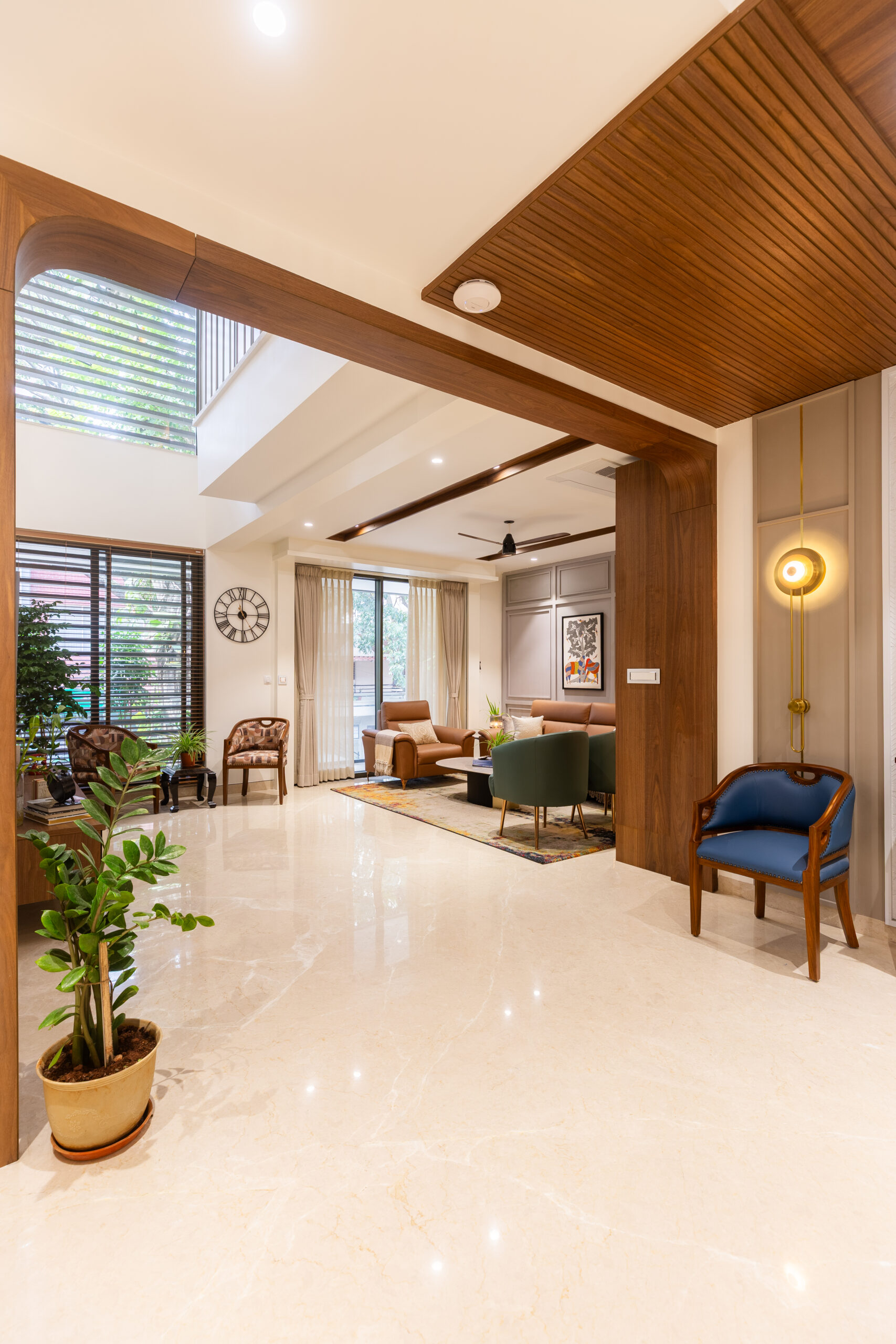
Ceiling Living Room Lighting Ideas
Recessed downlights on a false ceiling are the standard ambient lighting approach in Bangalore living rooms. They clean up the ceiling surface, distribute light evenly, and sit flush rather than intruding into the visual field. Four to six downlights in a standard living room, positioned to cover the sofa group and the floor space in front of the TV unit.
Cove lighting in the false ceiling perimeter gives the living room its warm evening character. The LEDs sit in a recessed channel around the ceiling edge and wash light upward. It doesn't illuminate the room directly. It changes the room's entire atmosphere. This is what makes a living room feel like a considered space rather than just a room with lights in it.
Modern Living Room Ceiling Lighting Ideas
Profile lights recessed into a ceiling channel rather than a full cove give a continuous line of warm light. Cleaner and more architectural than traditional cove lighting. Works well in contemporary living rooms where the ceiling treatment is minimal.
Pendant lights in living rooms: a pendant hung over the coffee table area creates a zone, defining the seating group visually. The pendant height matters. Too high and it loses its effect. Too low and it interrupts sightlines. The bottom of the shade at roughly 180 to 200 cm from the floor works for most living room heights.
Ceiling lighting without a false ceiling: track lighting mounted directly to the structural slab gives directional flexibility without ceiling work. Surface-mounted downlights are another option. Neither looks as resolved as recessed lighting in a false ceiling, but both work better than a single central fixture.
How Do You Layer Lighting in a Living Room?
Ambient lighting provides the room's overall illumination. Recessed downlights, cove lighting, or a ceiling fixture. This is the base layer. On a dimmer switch so the level can be adjusted for time of day and activity.
Task lighting serves specific functions. A floor lamp behind the sofa for reading. A lamp on a side table for close work. Task lights are directional and positioned for the person using them, not the room as a whole.
Accent lighting highlights specific elements. LED strips in the TV unit shelves. A picture light above artwork. Strip lighting in a display cabinet. Backlighting the TV panel. Accent lights create visual interest within the room and draw attention to the elements the design is built around.
How the three layers work together: in the evening, the cove lighting and the TV panel backlight are on at low intensity. The ambient downlights are dimmed. The floor lamp is on for whoever is reading. The room feels completely different from a room with a single overhead light at full brightness, using the same fixtures that cost only marginally more.
What Are the Best Living Room Lighting Design Ideas?
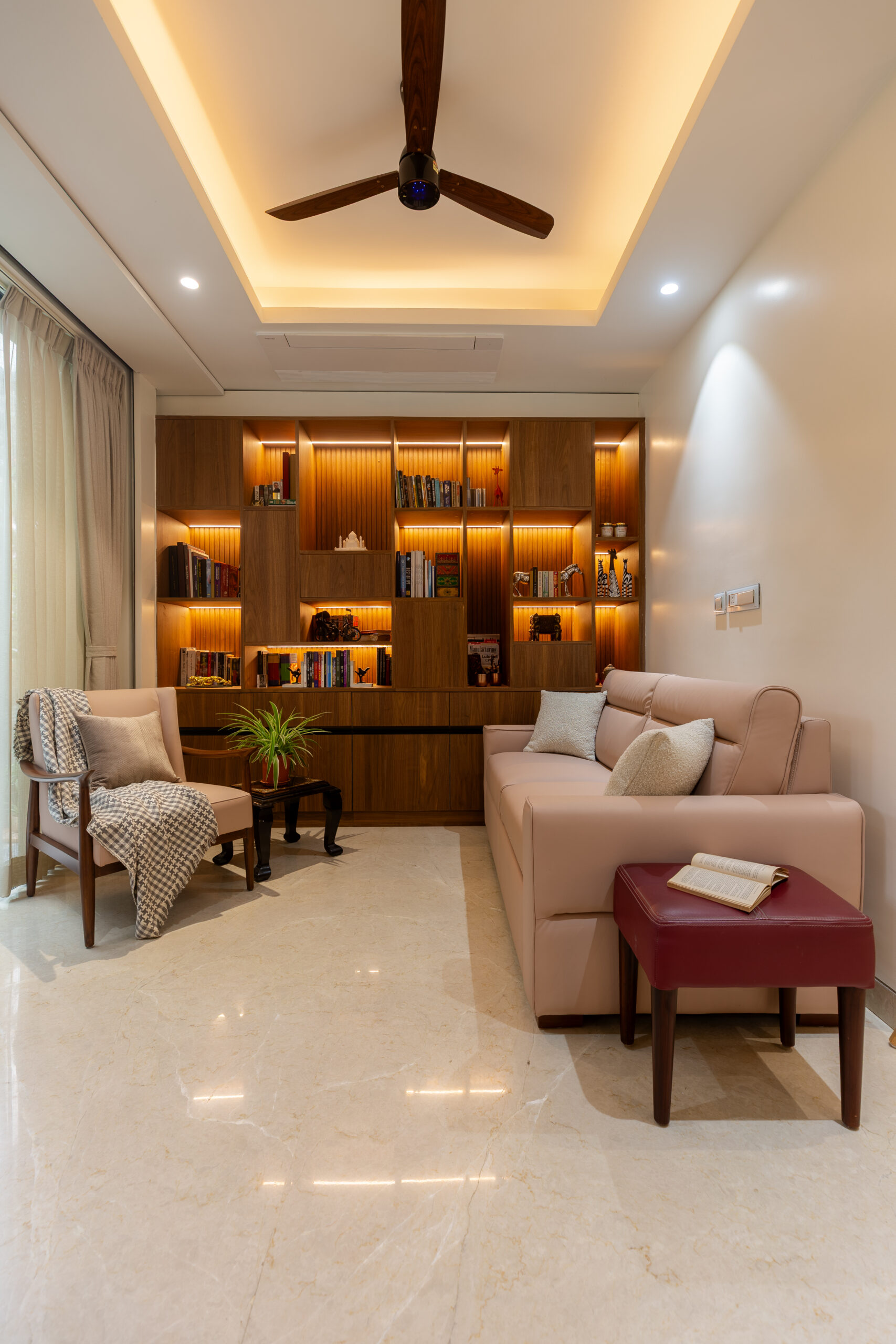
Living Room Wall Lighting Ideas
Wall sconces on either side of the TV unit add accent lighting at a mid-level that recessed ceiling lights don't reach. They also make the TV wall feel more designed, even when the TV is off. Matte black or brushed brass sconces work in most contemporary Indian living rooms.
Picture lights above artwork highlight the piece and add focused accent interest at wall level. Works in rooms where there's a clear artwork display on the sofa backing wall.
TV backlighting: an LED strip running around the back of the TV panel reduces eye strain in dark viewing conditions and adds ambient glow to the TV wall. Warm white at 2700K to match the room's other lighting.
Living Room Corner Lighting Ideas
A floor lamp in the corner behind or beside the sofa is the most practical corner lighting solution. It adds warmth at a mid-level that ceiling lights don't reach. A drum shade or arc lamp works in most living room styles. The arc lamp, with its long curved arm, brings the light over the sofa for reading without needing a side table.
Lighting zones in open-plan living rooms: where the living area opens into a dining area, the two zones need separate lighting circuits. The dining area pendant should be dimmable independently of the living room ambient. At mealtimes the dining light is up and the living room ambient is down. In the evening they reverse.
For lighting that integrates with the TV unit design, see our TV unit design guide. For ceiling lighting planning, see our ceiling design guide.
What Colour Temperature Works Best for Living Room Lighting?
Warm white at 2700K to 3000K for all living room lighting. This is the most important single lighting decision in a living room. It's also the one most often ignored on cost grounds.
Cool white above 4000K in a living room makes the space feel like a showroom or a workplace. It's harsh on skin tones, it washes out warm wall colours, and it actively makes the furniture look less appealing. The same furniture under warm white LEDs looks significantly better.
How colour temperature affects mood: warm white is calming and social. Cool white is alerting and task-oriented. A living room is primarily a social and relaxation space. 2700K is the right specification. If the room doubles as a home office where concentration matters, a separate task light at 3500K to 4000K on the desk only, not the main room, handles that need without changing the room's character.
Mixing colour temperatures: avoid mixing warm and cool sources in the same room. A warm cove light with cool downlights creates visual tension. All sources at 2700K, or at most 2700K cove with 3000K downlights. Nothing above 3000K in a residential living room.
Dimmer switches and smart lighting: dimmer switches on the ambient circuit cost Rs.800 to Rs.2,000 per switch. The difference they make to the room's usability is significant. Smart lighting systems, where colour temperature and brightness are controlled by an app or voice, cost more but give genuine flexibility across different scenarios.
Planning Your Living Room Lighting?
At The Artful Abode, we plan living room lighting across Bangalore 2BHK and 3BHK apartments. We specify all three lighting layers before the ceiling goes up, so there are no compromises after.
How Do You Light a Living Room Without a False Ceiling?
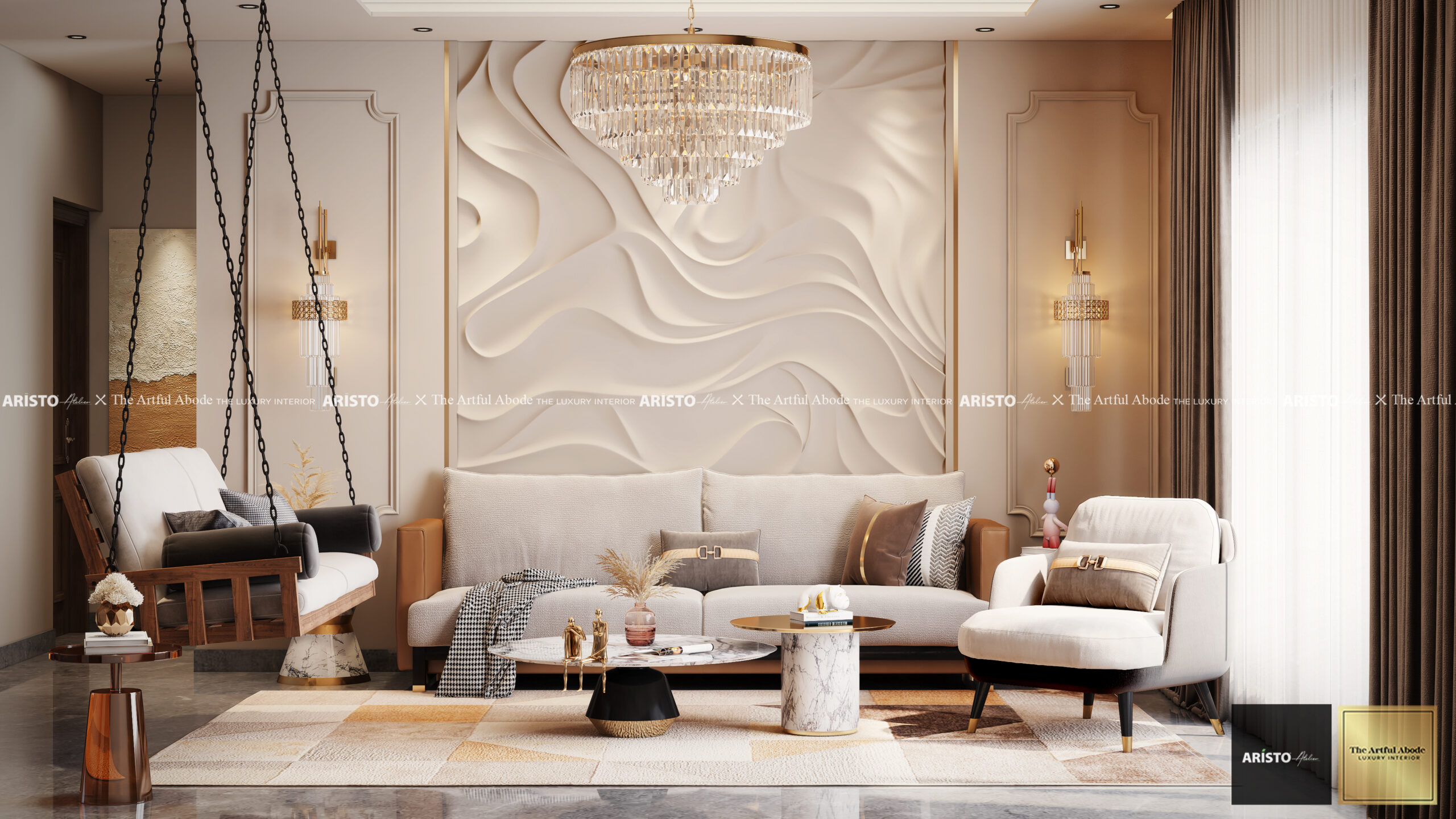
A false ceiling is the ideal surface for recessed lighting, but it's not the only way to layer a living room's light. Without a false ceiling, the approach shifts to mid-level and floor-level sources rather than ceiling-level ones.
Floor lamps provide ambient light at a lower level than ceiling fixtures. A tall arc lamp over the sofa, a tripod lamp in a corner, a drum-shade floor lamp beside a side table. Used together, two or three floor lamps can illuminate a living room warmly without anything happening at the ceiling.
Table lamps on the TV unit shelves or side tables add accent light at a level that creates visual warmth without directing harsh light into the room. A pair of table lamps flanking the TV unit looks designed and adds light where recessed fixtures can't reach.
Track lighting mounted to the structural slab gives the directional flexibility of recessed lighting without the ceiling work. The track is visible, which is a compromise aesthetically, but it allows lights to be pointed at the TV wall, the sofa group, and artwork independently.
Pendant lights on exposed ceilings: a single pendant hung on a long cable over the coffee table area at the right height creates a lighting zone without requiring ceiling work beyond a single electrical point. This is the most effective single-fixture approach for a room without a false ceiling.
Lighting solutions for rented flats: floor lamps, table lamps, and plug-in wall sconces. All of these need only existing electrical points and remove cleanly when the lease ends. A well-chosen set of floor lamps and table lamps can transform a rental living room without touching the ceiling or the walls.
How Much Does Living Room Lighting Cost in Bangalore?
Honest 2026 ranges:
- Recessed LED downlight (per fitting, installed): Rs.600 to Rs.1,500
- Cove lighting (per running foot, installed): Rs.180 to Rs.400
- Profile light channel (per running foot): Rs.250 to Rs.600
- Pendant light (mid-range): Rs.3,000 to Rs.15,000
- Floor lamp (quality): Rs.5,000 to Rs.25,000
- Wall sconce (pair, installed): Rs.4,000 to Rs.18,000
- Dimmer switch (per point): Rs.800 to Rs.2,500
- Smart lighting system (basic setup): Rs.15,000 to Rs.50,000
A full living room lighting plan, including cove lighting, six to eight recessed downlights, two wall sconces, dimmer switches, and TV backlighting, typically runs Rs.40,000 to Rs.90,000 all-in for a standard 2BHK living room. Smart lighting adds Rs.15,000 to Rs.40,000 on top of that.
Budget vs premium options: the biggest cost variable is the fixture brand and quality. A basic LED downlight at Rs.400 looks similar to a premium one at Rs.1,200 until you see the quality of light it throws and how long it holds that quality. For ambient and cove lighting that runs many hours a day, quality LEDs pay back in longevity.
What Lighting Mistakes Should You Avoid in a Living Room?
Single central ceiling light as the only source. It creates flat, even illumination that makes the room look like a storage unit. Everything is equally lit. Nothing is highlighted. The room has no atmosphere.
Wrong colour temperature. Cool white in a residential living room. It makes the room feel like a working environment rather than a living one. Warm white at 2700K throughout. No exceptions for the main room sources.
No dimmer switches. A dimmer on the ambient lighting circuit costs almost nothing relative to the overall lighting budget and changes how usable the room is in the evening. Fixed full-brightness ambient lighting in a living room is a design limitation that's entirely avoidable.
Lights planned after false ceiling installation. The ceiling is the most common constraint on living room lighting, and it's completely avoidable if the lighting plan is part of the false ceiling design rather than an afterthought to it.
Accent lighting forgotten entirely. The TV wall, the display shelves, the cove channel. These are what give a living room its character in the evening. Skipping accent lighting leaves the room functional but flat.
For the full living room design context, see our living room interior design guide. For colour choices that work with the lighting plan, see our living room colours guide.
Ready to Plan Your Living Room Lighting?
At The Artful Abode, we design living rooms across Bangalore 2BHK and 3BHK apartments. Get in touch and let's plan yours.