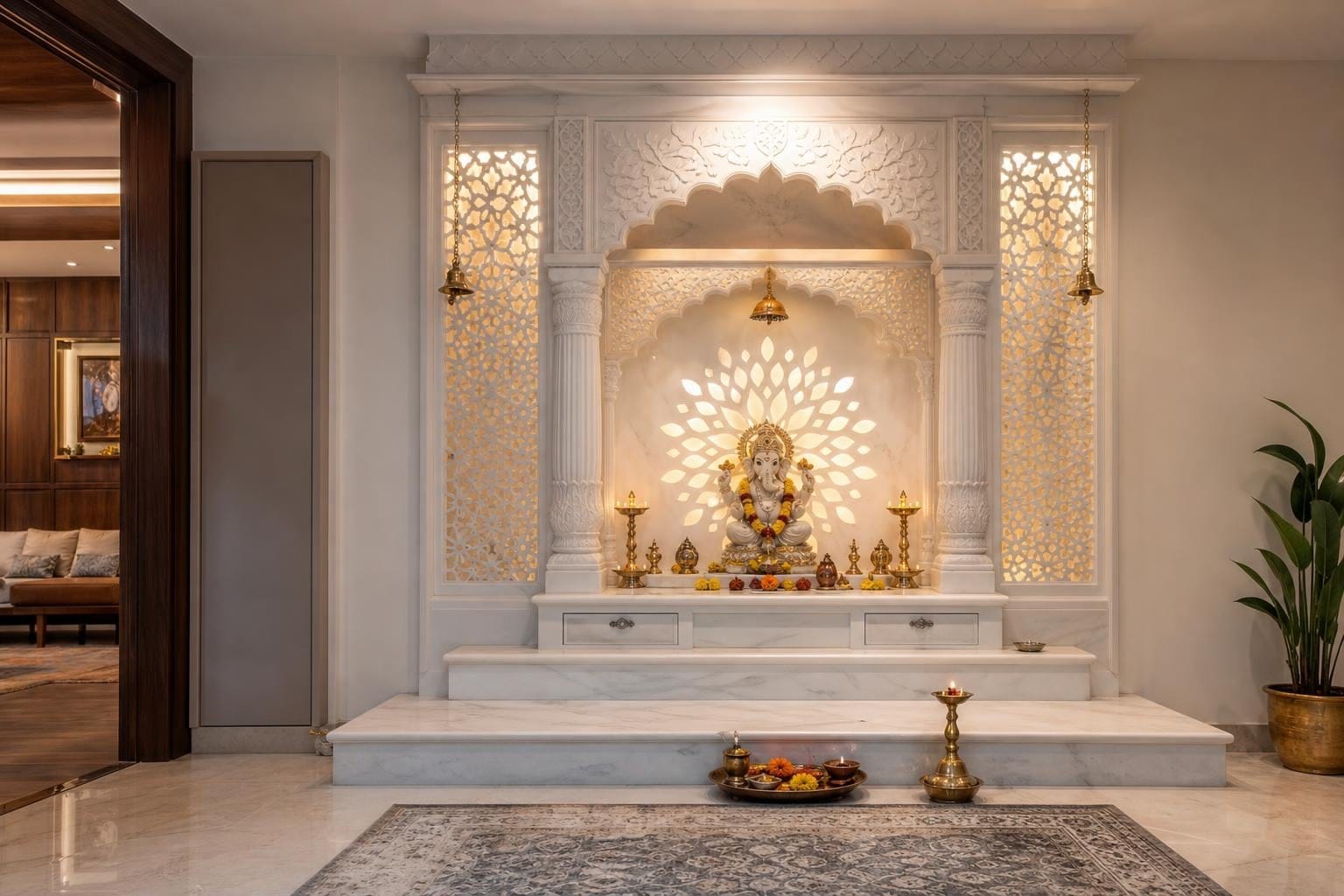
Home Mandir Design Marble: 12 Stunning Ideas for 2026
TL;DR
Marble remains the gold standard for home mandir design, offering generational durability, Vastu alignment, and a spiritual aesthetic that no other material matches. This guide covers 12 marble mandir designs (from ₹15,000 wall-mounted units to ₹5,00,000+ luxury pooja rooms), compares Makrana, Vietnamese, and Italian marble grades, and includes Vastu placement rules, pricing breakdowns, and maintenance tips for Indian homes. If you’re in a humid city like Bangalore, marble’s moisture resistance gives it a clear edge over wood.
Why Marble Is the Best Material for a Home Mandir
Marble isn’t just beautiful. It’s one of the few materials considered inherently auspicious in Hindu tradition, which is why temples across India, from ancient shrines to modern mandirs, use it almost universally. For a home mandir design in marble, the practical advantages are just as compelling as the spiritual ones.
Durability that outlasts generations. High-quality Makrana marble contains roughly 98% calcium carbonate with minimal impurities, making it exceptionally hard and resistant to wear. A well-maintained marble mandir will look nearly identical in 30 years.
Humidity resistance. This matters more than people realize, especially in cities like Bangalore where monsoon season (June through September) brings sustained moisture. Marble doesn’t warp, swell, or attract termites, unlike wooden alternatives in poorly ventilated apartments.
Vastu compatibility. White and light-coloured marble aligns with Vastu recommendations for worship spaces. Natural stone is considered a spiritually resonant material, and marble specifically is listed alongside wood as an auspicious choice for mandirs.
Aesthetic range. From hand-carved Rajasthani temples with floral pillars to sleek backlit panels that glow in modern apartments, marble adapts to virtually any interior style.
👉 Planning a complete pooja room? Read our pooja room interior design guide for the full picture.
At-a-Glance: 12 Marble Mandir Designs Compared
# | Design | Best For | Style | Price Range (₹) | Marble Type |
|---|---|---|---|---|---|
1 | Classic White Makrana | Dedicated pooja rooms, villas | Traditional | 60,000–1,80,000 | Makrana White (AAA) |
2 | Wall-Mounted | Apartments, studio homes | Modern/Compact | 15,000–65,000 | Vietnamese or Makrana |
3 | Backlit with LED Panel | Contemporary homes | Modern | 50,000–1,50,000 | White marble (any grade) |
4 | Jaali Lattice Backdrop | Transitional interiors | Indo-Modern | 45,000–1,20,000 | Makrana or Italian |
5 | Marble + Fluted Panels | 2026 trend-forward homes | Contemporary | 40,000–1,00,000 | Any white marble |
6 | Marble + Wood Combo | Mid-range budgets | Warm Traditional | 30,000–90,000 | Vietnamese + Teak |
7 | Coloured/Dual-Tone | Non-traditional aesthetics | Modern | 35,000–1,10,000 | Beige, onyx, green marble |
8 | Integrated Storage | Daily worship families | Practical | 50,000–1,40,000 | Makrana or Vietnamese |
9 | Corner Space-Saving | Small apartments | Compact | 20,000–60,000 | Vietnamese or Makrana |
10 | Full Marble Pooja Room | Luxury villas, large flats | Premium | 2,00,000–5,00,000+ | Italian Statuario or Makrana |
11 | South Indian Temple Style | South Indian families | Traditional | 80,000–2,50,000 | Makrana White |
12 | Marble + Granite Combo | Cost-conscious stone lovers | Practical | 25,000–80,000 | Marble top + granite base |
12 Best Home Mandir Designs in Marble
1. Classic White Makrana Marble Mandir (Traditional Rajasthani)
Best for: Dedicated pooja rooms in villas and luxury apartments
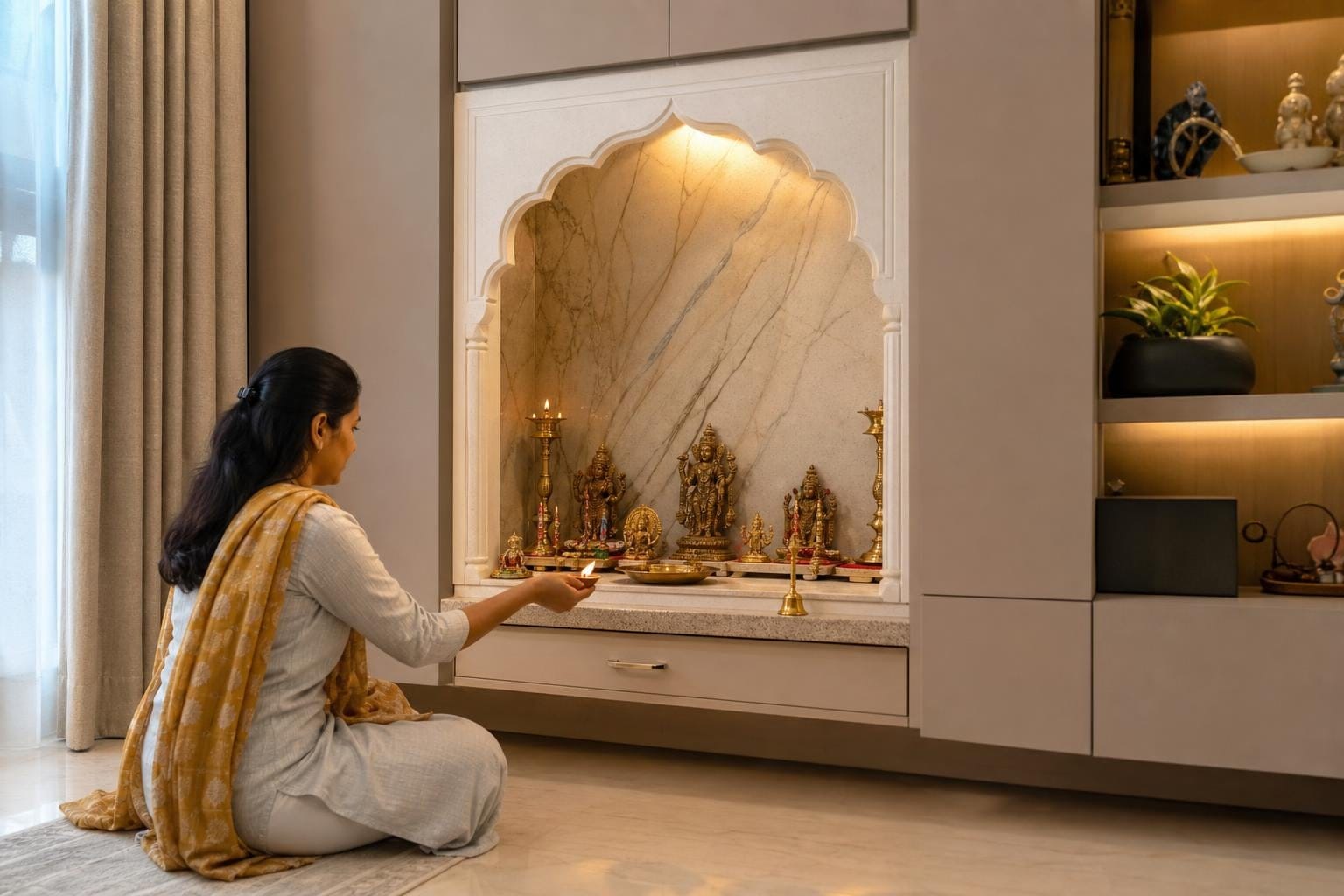
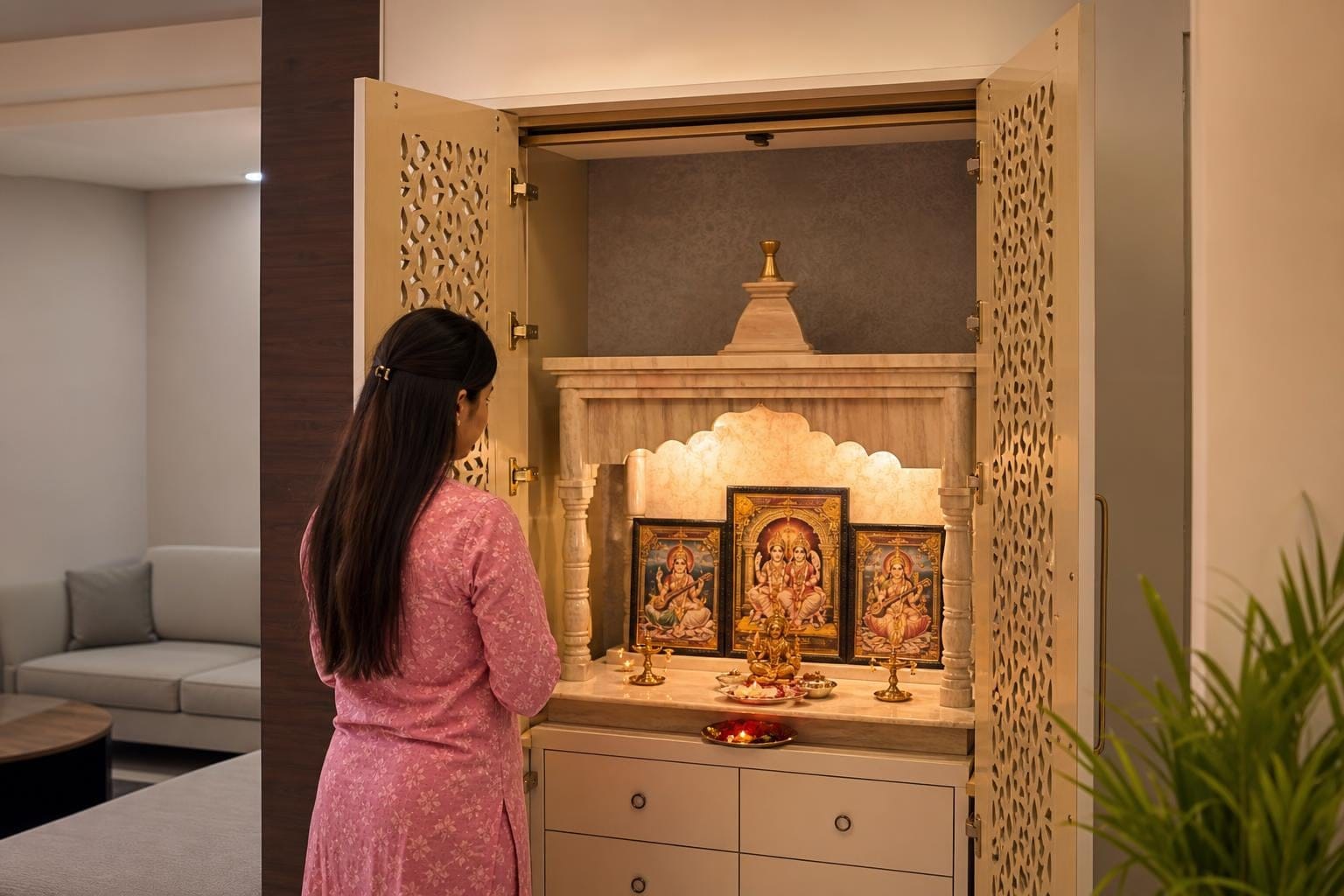
This is the benchmark. A classic Makrana marble mandir features hand-carved floral motifs, miniature domes, lotus patterns, and ornate pillars that evoke the grandeur of Rajasthani temple architecture. The idol sits on a raised platform, typically two-tiered, allowing placement of primary and secondary deities.
Key details:
Marble type: Makrana White (AAA grade), the same stone used in the Taj Mahal. Carves with exceptional sharpness and holds detail for generations.
Typical sizing: 24–36 inches wide, 18–24 inches deep, 48–60 inches tall for most homes.
Price range: ₹60,000–₹1,80,000 depending on carving complexity, Makrana grade, and hardware.
Lead time: Handcrafted marble mandirs take around 3–5 weeks to manufacture, plus installation time.
Tradeoffs:
Extremely heavy, requiring strong flooring and permanent placement.
Often built on-site or pre-assembled in parts, so plan for installation access.
Intricate carvings collect dust and soot, meaning more frequent cleaning.
Pro tip: Choose hand-carved over CNC machine-carved panels. Machine-carved mandirs are uniform but often lack depth. Hand-carved pieces have slight variations that give each panel a living quality, a distinction practitioners in online marble forums frequently highlight.
2. Wall-Mounted Marble Mandir
Best for: Apartments, studio homes, living room corners
A wall-mounted marble mandir is one of the most practical home mandir designs in marble for limited floor space. Mounted at eye level, it keeps the floor completely clear, which is a significant advantage in 2BHK and 3BHK apartments where every square foot counts.
Key details:
Typical dimensions: 18–30 inches wide, 8–12 inches deep.
Price range: ₹15,000–₹45,000 for a basic wall unit. Add ₹8,000–₹20,000 for carved jaali doors. Installation and wall reinforcement can add ₹3,000–₹8,000.
Marble type: Vietnamese white marble works well here since the smaller size doesn’t demand the density of Makrana.
Tradeoffs:
Wall load is the critical factor. Solid brick or concrete walls are strongly preferred. Hollow partition walls (common in newer Bangalore high-rises) may need steel reinforcement before mounting.
Limited space for larger idols or multiple deities.
Not ideal if you use heavy brass items during worship.
If you’re considering this for a living room setup, plan the wall-mount location before the painting and panelling stage, not after.
3. Backlit Marble Mandir with LED Panel
Best for: Modern and contemporary homes, mood lighting setups
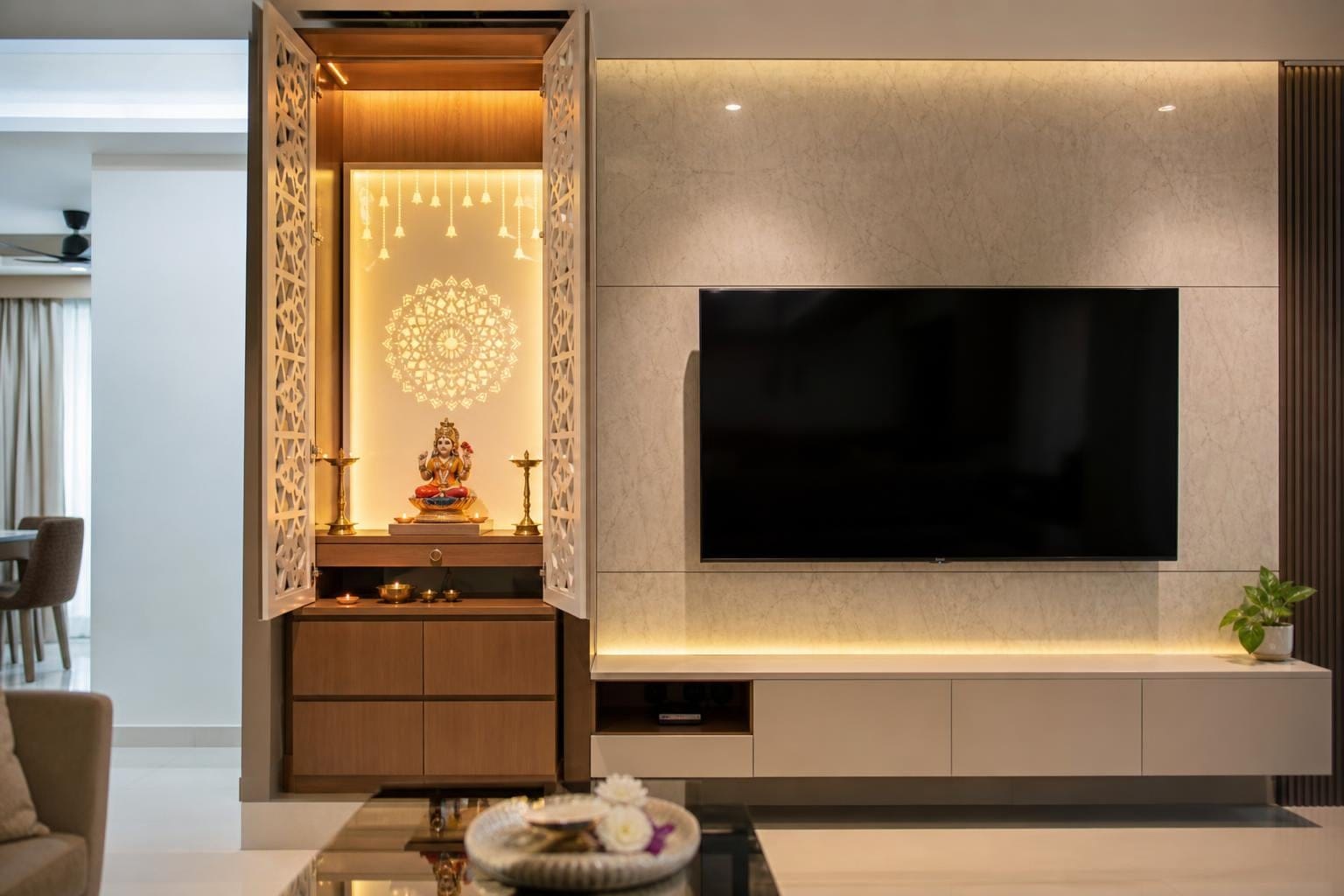
This is among the most sought-after marble mandir features in 2026. Warm white LED strips secured behind a marble panel make the stone’s natural veins glow from within, creating an ethereal, meditative atmosphere that transforms the entire pooja corner.
Key details:
Colour temperature: Warm white (2700–3000K) feels most devotional and flattering to white marble. Avoid cool white, which can make the space feel clinical.
Pairing: Works beautifully with a false ceiling above the mandir featuring recessed downlights. The combination of cove lighting from the ceiling and backlighting from the marble panel creates layered illumination that no single source can achieve.
Price premium: Add ₹8,000–₹25,000 over a standard marble panel for quality LED strips, diffusers, and wiring.
Tradeoffs:
Requires electrical planning from the start, not something you can easily retrofit.
LED strips need replacement every 3–5 years.
Poorly executed backlighting (uneven strips, visible hotspots) looks worse than no backlighting at all.
For a deeper understanding of how lighting transforms interiors, including the specific layering techniques that work for pooja spaces, study how ambient, task, and accent lighting interact.
4. Marble Mandir with Jaali (Lattice) Backdrop
Best for: Homes blending traditional and contemporary decor
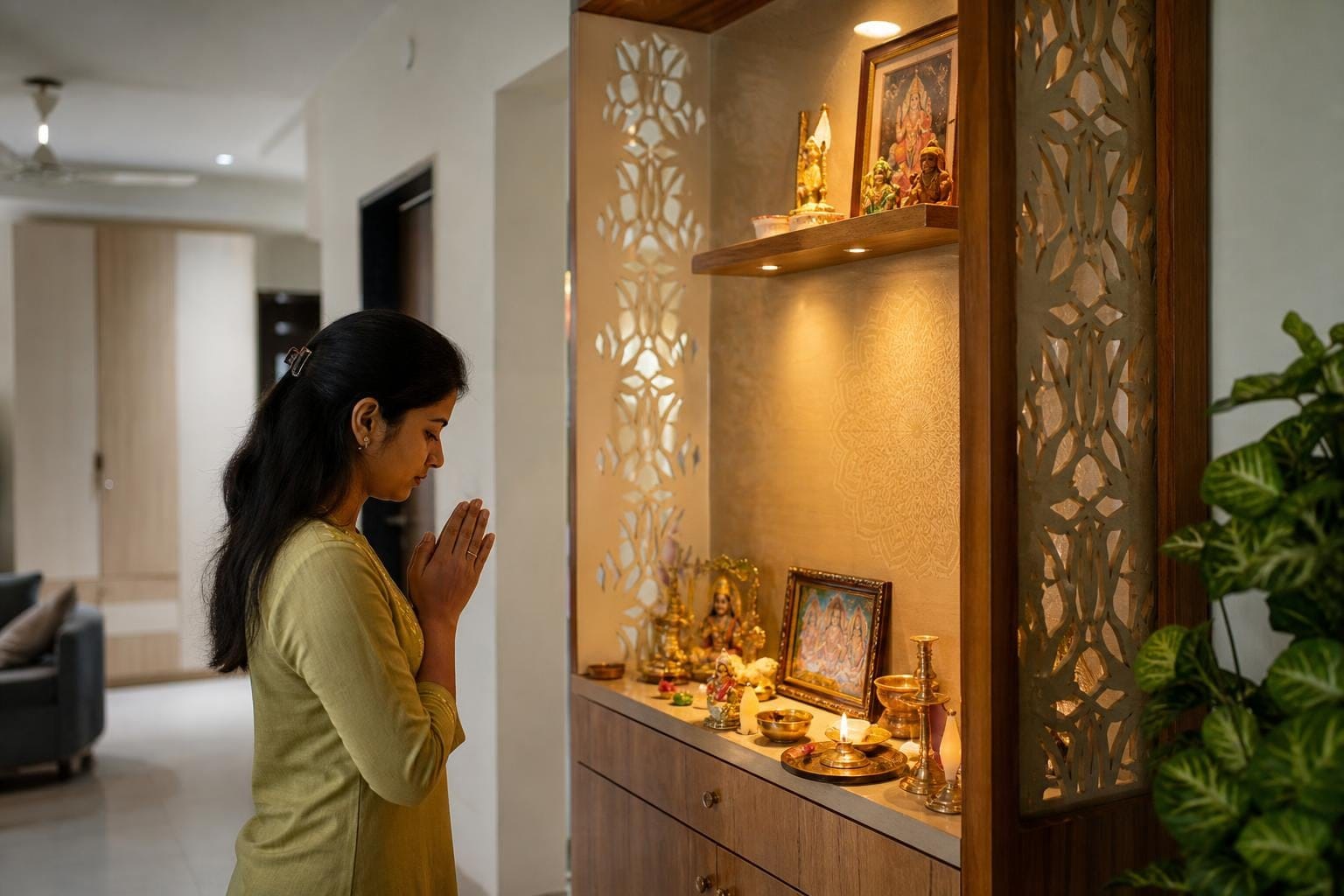
A jaali backdrop behind your marble mandir adds intricate geometric or floral detail without overwhelming the space. Light filters through the lattice pattern and casts decorative shadows on surrounding walls, creating a meditative atmosphere that shifts with the time of day.
Key details:
Placement: Jaali panels are typically positioned at the back or sides of the mandir to allow air and light to pass through, keeping the space visually open and fresh.
Material options: The jaali itself can be marble (for a unified look), MDF with CNC cutting (budget option), or even brass for a contrasting accent.
Price range: ₹45,000–₹1,20,000 depending on material and complexity.
Tradeoffs:
Jaali panels catch incense smoke and oil residue. Budget for more frequent cleaning.
Very intricate patterns are fragile in marble, so the lattice thickness matters.
Requires adequate wall depth if the jaali is backlit.
5. Marble + Fluted Panel Combination
Best for: 2026 trend-forward homeowners, modern apartments
A marble mandir paired with fluted panels brings texture and depth to an otherwise smooth surface. The vertical grooves of fluted panels (in wood, PVC, or WPC) flanking a marble altar create a contemporary look that still respects traditional aesthetics.
Key details:
Combination approach: Central marble mandir with fluted panels on either side, or fluted panels as the full backdrop with a marble shelf and idol platform in front.
Price range: ₹40,000–₹1,00,000 depending on panel material and marble grade.
Current trend: Fluted panels in warm walnut or cream tones paired with white marble are dominating 2026 pooja room designs.
For a full rundown on panel materials, costs, and durability, check our guide on wall panelling options.
Tradeoffs:
PVC fluted panels can look plasticky if you go with a budget grade. WPC or solid wood panels hold up better visually.
The fluted surface needs regular dusting, especially near incense.
6. Marble + Wood Combination Mandir
Best for: Mid-range budgets, warm-toned interiors
A blend of marble and wood gives your mandir both the spiritual gravitas of stone and the warmth of natural timber. The most common approach: a wooden framework (teak or walnut) with a marble top/platform where the idols sit.
Key details:
Budget-friendly route: If a full marble mandir is beyond budget, consider just a marble countertop on a wooden structure. It’s low-maintenance where it matters most (the worship surface) while keeping costs accessible.
Wood recommendation: Teak is ideal. In humid climates like Bangalore, the wooden framework should use BWP-grade (boiling water proof) plywood for any structural components. MDF will swell and degrade within a couple of monsoon seasons. Learn why BWP plywood matters for moisture-prone areas.
Price range: ₹30,000–₹90,000.
Tradeoffs:
Wood components need termite treatment and periodic polishing.
The visual contrast between marble and wood can feel disjointed if the tones aren’t carefully matched.
Heavier than a pure wood mandir but lighter than a full marble one.
7. Coloured/Dual-Tone Marble Mandir
Best for: Homeowners wanting alternatives to classic white
Not every home mandir design in marble needs to be white. Coloured marble mandirs are gaining serious traction in 2026. Shades like beige, green onyx, and soft rose bring warmth and character while maintaining the calm, sacred atmosphere a pooja space demands.
Key details:
Popular combinations: Beige marble body with white marble idol platform. Green onyx accents on a white marble base. Dual-tone (cream and grey) for contemporary interiors.
Price range: ₹35,000–₹1,10,000. Onyx and rare coloured marbles cost more than standard white.
Vastu note: Light yellows and off-whites are considered Vastu-friendly for pooja spaces. Dark-coloured marble (black, deep brown) is generally avoided.
Tradeoffs:
Coloured marble can show stains differently, some hide kumkum marks better, others show water spots more.
Matching replacement pieces later is harder with coloured marble compared to white.
8. Marble Mandir with Integrated Storage
Best for: Families with daily rituals needing organized worship essentials
Practical design gets overlooked in most marble mandir inspiration galleries. A temple with integrated storage has become one of the smartest choices in 2026. Drawers beneath the platform store incense, wicks, camphor, and small utensils, while side cabinets keep prayer books and brass items neat.
Key details:
Storage elements: Pull-out drawers below the mandir platform, closed side cabinets, a small shelf for daily-use items (diya, matchbox, agarbatti holder).
Combination: Marble altar and idol platform with wooden storage units below (teak or plywood with laminate finish).
Price range: ₹50,000–₹1,40,000 depending on storage complexity and marble grade.
Tradeoffs:
Drawers add depth, so this isn’t ideal for very narrow spaces.
Wooden storage components need moisture-resistant treatment, especially in apartment pooja rooms with limited ventilation.
More moving parts mean more maintenance long-term.
9. Corner Marble Mandir (Space-Saving)
Best for: Small apartments without a dedicated pooja room
A corner marble mandir is the go-to for people who don’t have a separate worship space. It tucks into an otherwise unused corner of the living room, kitchen, or hallway, using a triangular or L-shaped marble platform design.
Key details:
Typical size: 15–24 inches on each side of the corner, 12–18 inches deep.
Price range: ₹20,000–₹60,000.
Vastu compliance: If your apartment’s northeast corner aligns with a living area or kitchen, a corner mandir placed there satisfies Vastu requirements without needing a dedicated room.
Tradeoffs:
Limited idol space; typically fits 2–3 small deities.
Corner placement sometimes gets less natural light, so plan for a small overhead spot or LED strip.
Not suited for elaborate daily rituals involving many items.
10. Full Marble Pooja Room Design
Best for: Luxury villas and large apartments with dedicated pooja rooms
When you have the space and budget, an all-marble pooja room creates a visually cohesive, serene worship environment. The altar, walls, and flooring all use the same marble tone, giving the room a unified, premium look that feels like stepping into a private temple.
Key details:
Scope: Marble flooring, marble wall cladding, marble altar with carved detailing, marble frame for the doorway.
Price range: ₹2,00,000–₹5,00,000+ depending on room size, marble grade, and customization.
Marble type: Italian Statuario for a contemporary minimalist look, or Makrana for a traditional feel.
This is where coordinating with a single design team adds the most value. The marble sourcing, false ceiling design, lighting layout, ventilation, and door design all need to work together. Getting these elements from separate vendors without coordination almost guarantees visual mismatches and budget overruns.
👉 For a breakdown of what full-home interiors cost in Bangalore, including pooja rooms, see our interior design cost guide.
Tradeoffs:
Longest lead time of any option (8–12 weeks when you factor in marble sourcing, fabrication, and installation).
Highest cost by a significant margin.
Marble flooring can be slippery, especially when wet from abhishekam rituals. Consider a honed (matte) finish instead of polished for the floor.
11. South Indian Temple-Style Marble Mandir
Best for: Families with South Indian cultural roots, villas
This design features a gopuram-style spire (shikhara) on top, with two separate platforms allowing placement of primary and secondary deities. The proportions and detailing reference Dravidian temple architecture, scaled down for home use.
Key details:
Defining feature: The pointed shikhara spire is the signature element. It can be a single spire or a tiered composition.
Marble type: Makrana White (AAA grade) for the best carving detail. The spire’s complexity demands dense marble that holds fine edges.
Price range: ₹80,000–₹2,50,000 depending on spire complexity and overall height.
Tradeoffs:
Requires significant ceiling height (at least 8–9 feet clear) to look proportionate.
Difficult to wall-mount due to weight and top-heaviness.
Hand-carving the spire is the most labour-intensive (and expensive) part of the design.
12. Marble + Granite Combination Mandir
Best for: Cost-conscious homeowners wanting a full stone look
Combining marble and granite is a smart compromise. Granite reduces overall material cost, making larger mandir designs more affordable without sacrificing the stone aesthetic. The typical approach: marble for the idol platform, upper section, and visible faces; granite for the base, back panel, and structural elements.
Key details:
Why it works: Granite is harder, cheaper, and more stain-resistant than marble, making it ideal for the base where oil, water, and kumkum accumulate.
Price range: ₹25,000–₹80,000, significantly less than an equivalent all-marble design.
Colour pairing: Black granite base with white marble top is the most popular combination.
Tradeoffs:
The visual difference between marble and granite is noticeable up close; the transition needs clean detailing.
Granite is harder to carve with fine detail, so ornate designs are limited to the marble portions.
Not considered as “premium” as a full marble mandir for those who prioritize that aesthetic.
Marble Type Guide: Makrana vs. Vietnamese vs. Italian
Most articles on home mandir design in marble treat all white marble as identical. It’s not. The grade you choose affects durability, carving quality, and long-term maintenance, so this distinction matters.
Attribute | Makrana White (Indian) | Vietnamese White | Italian (Statuario/Carrara) |
|---|---|---|---|
Origin | Rajasthan, India | Vietnam | Northern Italy |
Calcium carbonate | ~98% (highest purity) | Lower density | Fine-grained, slightly softer |
Durability | Highest hardness, best weather resistance | Less dense, more susceptible to wear | Softer, more prone to etching |
Best for | Traditional mandirs, heirloom pieces | Smaller idols, budget-friendly contemporary units | Contemporary look with minimal carving |
Cost | Mid-premium (locally sourced advantage) | Budget to mid-range | Premium to luxury |
Carving quality | Exceptional hand-carving capability | Typically machine-finished | Both hand and machine |
The key data point: Research on stone weathering found that Makrana marble outperformed Italian and Greek marbles in weather resistance testing, having a smaller grain boundary area per unit volume. This makes Makrana less susceptible to water penetration, a directly relevant advantage for Bangalore’s monsoon humidity and for pooja rooms where water-based rituals are common.
Hand-Carved vs. CNC Machine-Carved
This distinction gets ignored by most marble mandir guides, but it’s one of the biggest quality indicators. Hand-carved marble panels have slight natural variations that give each piece character and depth. CNC machine-carved panels are uniform and precise but can look flat and lifeless by comparison.
For traditional designs (Rajasthani, South Indian temple style), hand-carving is worth the premium. For modern, geometric designs where clean lines matter, CNC is perfectly fine and often preferred.
Marble vs. Wood Mandir: Which Should You Choose?
Factor | Marble | Wood (Teak) |
|---|---|---|
Look | Royal, spiritual, sleek | Warm, inviting, natural |
Durability | Resistant to pests and moisture; can chip | Extremely durable in teak; needs termite treatment |
Maintenance | Needs regular sealing; prone to discolouration | Easier daily care but needs periodic polishing |
Cost | More expensive (material + cutting + weight) | More affordable options available |
Weight | Very heavy, permanent placement | Lighter, movable |
Humidity | No warping, no termites, no cracking | Susceptible to warping in humid climates |
The verdict: For humidity-prone cities like Bangalore, Hyderabad, Chennai, and Mumbai, marble wins on practical grounds. Wooden mandirs in poorly ventilated apartments can warp within a few monsoon cycles. Practitioners on Reddit and home improvement forums frequently report warping issues with sheesham and MDF-based mandirs in coastal and humid climates, while marble mandirs hold up indefinitely.
If you prefer warmth and a lower price point, and your home has good ventilation, teak remains a solid choice. The marble-and-wood combination (Design #6 above) gives you both.
Vastu Guidelines for Marble Mandir Placement
Every top-ranking page on home mandir design marble covers Vastu, and for good reason: most Indian homeowners factor Vastu into pooja room decisions. Here are the rules that matter.
Direction:
The most auspicious direction is the northeast (Ishan Kona). If that’s not available in your floor plan, east or north directions are also favourable.
Avoid placing the mandir directly facing the main door.
Windows or doors in the pooja room should ideally face north or east.
Placement rules:
Never place a mandir in a bedroom, bathroom, or under a staircase.
The mandir should be at a height, preferably on a raised platform. Idols should be kept at least one inch away from walls.
Material guidance:
White or light-yellow marble is considered ideal for worship rooms.
Natural materials like marble and wood are auspicious. Avoid glass or plastic.
Material choice itself doesn’t directly affect Vastu compliance. Vastu focuses on direction, cleanliness, and energy flow. But natural, spiritually resonant materials like marble support positive energy in the space.
For a comprehensive overview of Vastu principles for home interiors, including room-by-room guidance, that resource covers what this section can only summarize.
Marble Mandir Pricing Guide (2026)
Here’s a consolidated pricing view based on current market data:
Category | Price Range (₹) | What’s Included |
|---|---|---|
Compact wall-mounted | 15,000–45,000 | Basic marble unit, standard finish |
Wall-mounted with jaali doors | 23,000–65,000 | Carved doors, installation hardware |
Floor-standing (3–5 ft) | 60,000–1,80,000 | Carved details, raised platform |
Full marble pooja room | 2,00,000–5,00,000+ | Wall cladding, flooring, altar, ceiling coordination |
Custom luxury installation | 5,00,000+ | Bespoke design, premium marble grade, full room |
What drives cost up:
Makrana AAA grade vs. Vietnamese standard
Hand-carving vs. CNC
Size and height (bigger = exponentially heavier = more material + structural support)
Backlit LED integration
Integrated storage
What keeps costs down:
Vietnamese or domestic marble (non-Makrana)
CNC carving for geometric patterns
Marble-and-wood or marble-and-granite combinations
Standard sizing (avoiding fully custom dimensions)
The coordination advantage: When a marble mandir is designed as part of a full-home interior project rather than purchased standalone, the design team coordinates marble sourcing, false ceiling planning, lighting wiring, and carpentry as one scope. This eliminates the mismatch problems that happen when you buy a standalone marble temple and then try to retrofit it into a space designed separately.
Maintenance Tips for Marble Mandirs
Marble is durable but not maintenance-free, especially in an active worship environment where incense, oil, kumkum, and haldi are used daily.
Daily care:
Wipe down with a soft cloth and mild detergent after puja to prevent soot buildup from agarbatti and diya.
Never use abrasive pads or scouring powders.
Stain prevention:
Kumkum, haldi, and oil are the biggest staining risks. Clean spills promptly with a pH-neutral stone cleaner. The Natural Stone Institute recommends pH-neutral cleaners and appropriate sealing to prolong marble’s finish.
Never use acidic agents like lemon juice or vinegar on marble. They etch the surface permanently.
Sealing:
Apply a marble sealant every 6–12 months depending on usage intensity. This creates a barrier against moisture and discolouration.
For mandirs where abhishekam (water rituals) is performed, seal more frequently.
Ventilation:
Ensure proper airflow in the pooja room to prevent moisture buildup from incense smoke and oil lamps. A small exhaust fan or window makes a meaningful difference, especially in enclosed apartments.
How to Integrate a Marble Mandir into Your Home’s Interior Design
Most marble mandir buying guides treat the temple as a standalone purchase: pick a design from a catalogue, place the order, and figure out where to put it. That approach creates problems.
The mandir’s marble tone should coordinate with your flooring and wall palette. A warm beige Makrana mandir against cool grey wall paint creates a visual clash that no amount of lighting fixes. The false ceiling above the mandir needs structural planning from day one, especially if you want cove lighting or recessed spotlights. And if you’re combining marble with wood, the wooden framework needs to be specified for humidity resistance (BWP-grade plywood, not MDF) at the design stage.
This is where 3D visualizations add real value. Seeing your marble mandir in the context of the actual room, with the right wall colours, flooring, ceiling design, and lighting, before committing to an expensive custom marble piece prevents costly rework.
The difference between a marble mandir that looks “placed” and one that looks “designed” comes down to integration: coordinated materials, planned lighting, and a single team accountable for the entire result.
👉 If you’re designing a full home and want the pooja room to feel part of a cohesive interior, explore our complete pooja room guide for planning guidance.
FAQ
Which marble is best for a home mandir?
Makrana White (AAA grade) is the best choice for traditional mandirs. It has the highest calcium carbonate content (~98%), exceptional carving capability, and superior weather resistance. For modern, minimalist designs with less carving, Italian Statuario works well but costs more. Vietnamese white marble is a solid budget option for smaller units.
What does a marble mandir cost in India in 2026?
Prices range from ₹15,000 for a compact wall-mounted unit to ₹5,00,000+ for a fully customized luxury pooja room with wall cladding and marble flooring. A typical floor-standing marble mandir (3–5 ft tall) costs between ₹60,000 and ₹1,80,000 depending on marble grade, carving detail, and size.
Is a marble mandir Vastu-compliant?
Yes. Marble is considered an auspicious natural material for worship spaces under Vastu guidelines. White or light-yellow marble is specifically recommended. The key Vastu factors are placement direction (northeast is ideal, followed by east or north), height (raised platform), and keeping idols at least one inch from walls.
Can a marble mandir be wall-mounted in an apartment?
Yes, but wall load capacity is critical. Solid brick or concrete walls handle the weight well. Hollow partition walls (common in newer high-rise apartments) typically need steel reinforcement before mounting. Installation reinforcement adds ₹3,000–₹8,000 to the total cost.
How do I maintain a marble mandir?
Use a soft cloth with a pH-neutral cleaner for daily wipe-downs. Clean kumkum, haldi, and oil spills immediately to prevent staining. Never use lemon juice, vinegar, or abrasive cleaners. Apply a marble sealant every 6–12 months. Ensure good ventilation in the pooja room to prevent moisture buildup from incense and oil lamps.
Marble vs. wood mandir: which is better?
Marble wins for durability and humidity resistance, making it the stronger choice in monsoon-prone cities. Wood (especially teak) wins for warmth, portability, and affordability. A marble-and-wood combination offers the best of both. In humid apartments without strong ventilation, marble is the safer long-term investment.
How long does a custom marble mandir take to deliver?
Handcrafted marble mandirs take approximately 3–5 weeks to manufacture. Add another 1–2 weeks for shipping and installation, depending on your location and design complexity. For a full marble pooja room, expect 8–12 weeks including design, sourcing, fabrication, and on-site installation.
What’s the difference between hand-carved and CNC marble mandirs?
Hand-carved marble mandirs have natural variations that give each panel depth and character. CNC (machine-carved) mandirs are uniform and precise but can appear flat. For traditional designs with intricate floral motifs and temple spires, hand-carving is worth the extra cost. For modern geometric patterns, CNC delivers clean, consistent results.