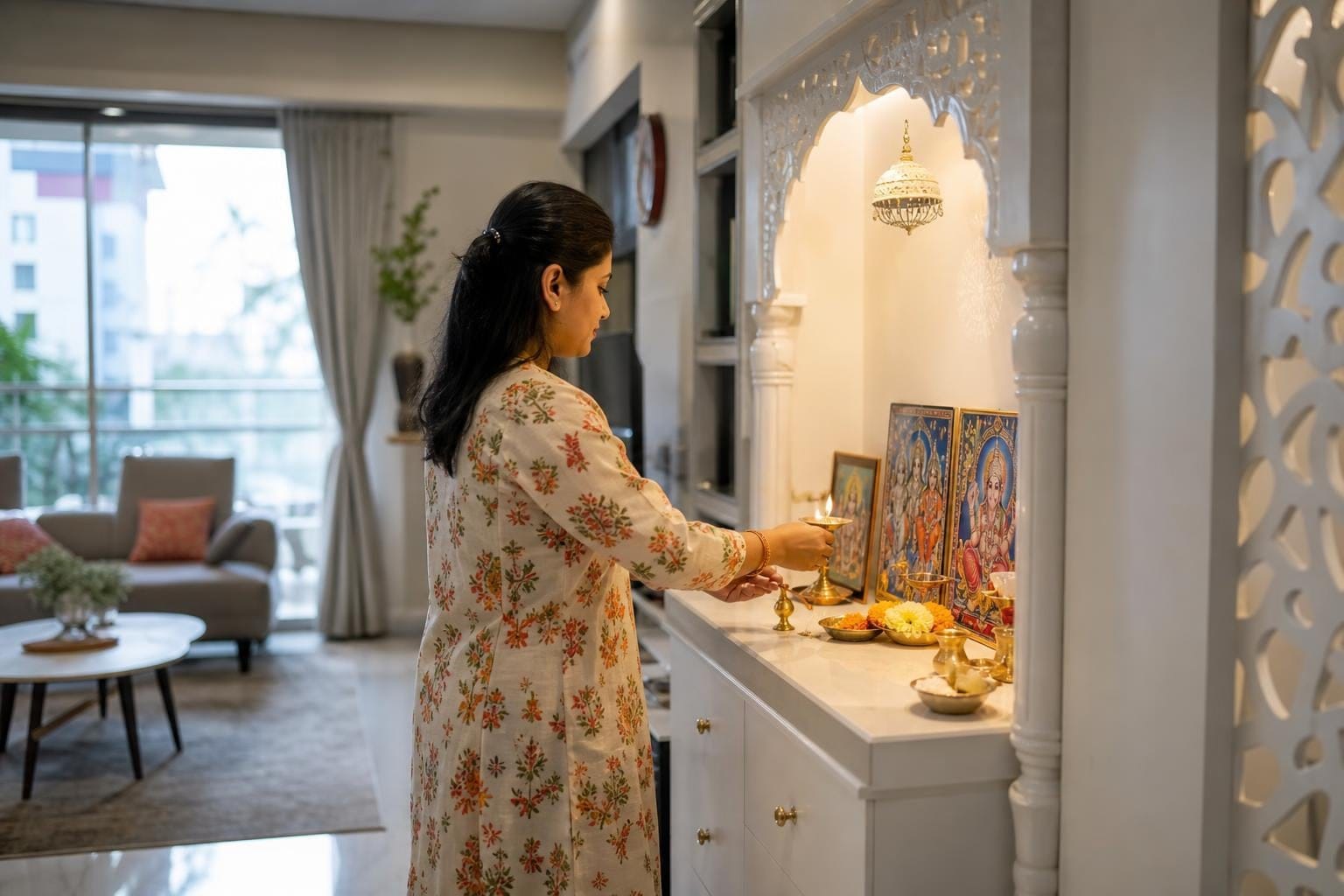
Mandir Room Design in Home: 15 Ideas, Costs & Vastu (2026)
TL;DR
The best mandir room design in home depends on three things: your available space, your material choice, and Vastu compliance. For compact Bangalore apartments, wall-mounted Corian or niche-built mandirs offer the best balance of durability and aesthetics, starting around ₹16,500. For villas, dedicated pooja rooms with carved wood doors or floor-to-ceiling temple designs create a stunning spiritual anchor. This guide covers 15 design styles with honest cost ranges, a material comparison table, ventilation advice no one else talks about, and practical tips for briefing your interior designer.
Planning a full pooja room as part of your home interiors? Start with our pooja room design guide for a deeper look at layout and execution.
Why Your Mandir Room Design Matters More Than You Think
The pooja room is the one space in an Indian home that must serve both soul and style. It handles daily rituals, holiday gatherings, and quiet personal prayer, often all in the same week. A 2025 survey by Home Décor India found that 68% of respondents felt measurably calmer after updating their mandir space. And from a practical standpoint, Vastu-compliant pooja rooms reportedly boost resale value by up to 15%.
Yet most online guides dump 500 images on a page and leave you to figure out the rest. They skip the questions that actually keep homeowners up at night: Which material survives daily agarbatti smoke without yellowing? What does a custom mandir room cost in 2026? Will MDF swell in Bangalore’s monsoon humidity?
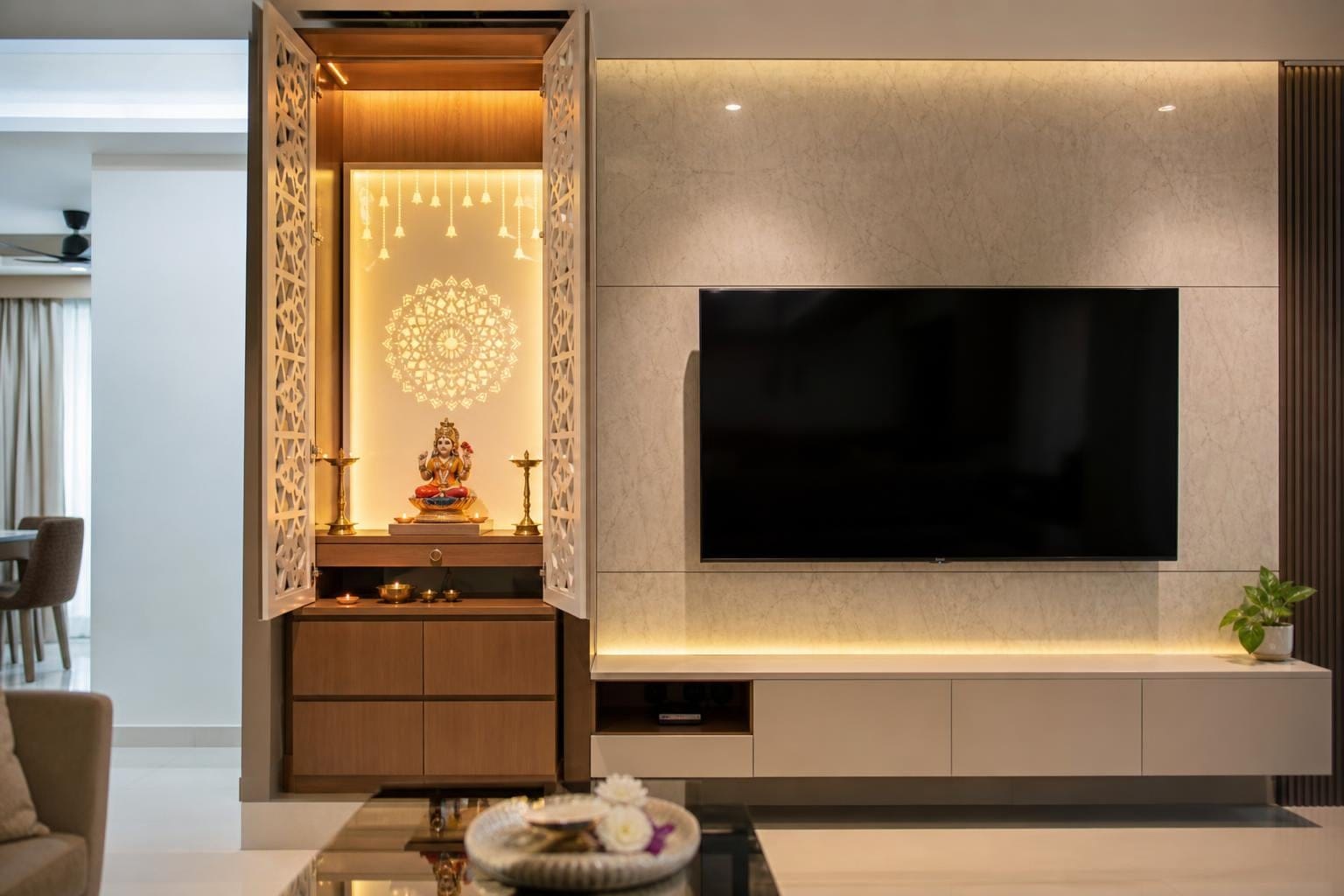
This article answers all of that. Each of the 15 mandir room design ideas below includes the design concept, ideal use case, materials, approximate cost, Vastu compatibility, and a candid “watch out” note.
Quick-Reference: Vastu Placement Rules for Mandir Rooms
Before choosing a design style, get the placement right. These are the consolidated Vastu guidelines that apply across every mandir room design in home:
- Best location: Northeast corner (Ishan Kona) maximizes positive energy flow. North or east walls are acceptable alternatives.
- Facing direction: Idols should face east or west. The worshipper should face east or north during prayer.
- Avoid: Bedroom walls, areas directly under a staircase, and south-facing placements.
- Room shape: Square or rectangular rooms are considered auspicious.
- Colors: Light, calming tones like white, cream, or light yellow.
- Doors: Vastu recommends two doors or shutters on the mandir unit.
- Ceiling: A gopura or pyramid-shaped ceiling is said to concentrate positive energy.
For a more detailed room-by-room breakdown, our Vastu for home interiors guide covers how these principles apply across your entire floor plan.
At-a-Glance: Material Comparison Table for Mandir Room Design
This is the comparison most guides skip entirely. Save this before making any material decision.
| Material | Best For | Durability | Maintenance | Cost Range | Humidity Resistance |
|---|---|---|---|---|---|
| Teak/Sheesham Wood | Traditional carved mandirs, villas | High (with treatment) | Medium (annual oiling) | ₹45,000 to ₹2,75,000 | Moderate |
| Corian (Solid Surface) | Modern apartments, backlit designs | Very High | Very Low | ₹16,500 to ₹2,50,000+ | Excellent (non-porous) |
| Marble | Grand luxury pooja rooms | Very High | High (stains from ghee/haldi) | ₹15,000 to ₹65,000+ | Poor (porous) |
| BWP Plywood + Laminate | Custom built-in units | High | Low | ₹30,000 to ₹1,00,000 | Excellent |
| MDF / HDHMR | Budget wall-mounted units | Moderate | Low | ₹7,000 to ₹30,000 | Poor (MDF) / Moderate (HDHMR) |
Key takeaway: Wood gives you warmth and tradition but warps in humidity. Marble looks royal but stains permanently from ghee and haldi. Corian is roughly 35 to 40% cheaper over a 10-year ownership window because it needs almost no maintenance and holds its dimensions across temperature swings. For built-in units, BWP plywood is the baseline, not MDF, especially in cities with monsoon exposure.
Understanding why BWP plywood matters for wet and semi-wet zones applies directly to mandir rooms that face regular cleaning and diya heat.
At-a-Glance: Cost Comparison by Mandir Type
| Mandir Type | Approximate Cost Range (2026) |
|---|---|
| Ready-made freestanding mandir (basic) | ₹7,000 to ₹25,000 |
| Ready-made Sheesham wood mandir (premium) | ₹45,000 to ₹2,75,000 |
| Modular wall-mounted unit | ₹22,000 to ₹50,000 |
| Custom built-in pooja unit (plywood + laminate) | ₹30,000 to ₹1,00,000 |
| Corian mandir (wall-mounted to luxury) | ₹16,500 to ₹2,50,000+ |
| Marble mandir (freestanding) | ₹15,000 to ₹65,000+ |
| Dedicated pooja room (full interior fit-out) | ₹1,50,000 to ₹5,00,000+ |
For a broader understanding of how mandir room costs fit into full-home budgets, our Bangalore interior design cost guide breaks down pricing by room type and scope.
15 Mandir Room Design Ideas for Indian Homes
1. Dedicated Pooja Room with Carved Wooden Double Doors
Best for: 3BHK apartments or villas with a separate room allocated for prayer.
This is the gold standard of mandir room design in home. A dedicated room with double-shutter carved wooden doors, typically teak or sheesham, creates a sacred threshold. The doors open fully during prayers and close neatly afterward, keeping the space private and dust-free. Lattice or jaali patterns on the shutters allow visibility and airflow even when shut.
- Materials: Teak or sheesham wood for doors, BWP plywood for internal shelving, marble or granite platform for idols
- Cost range: ₹1,50,000 to ₹5,00,000+ (full room fit-out)
- Vastu compatibility: Excellent. Place the room in the northeast corner with doors opening outward to the east or north.
- Watch out: Wood warps in high humidity. In Bangalore, where monsoon RH hits 70 to 90%, insist on kiln-dried teak and annual oiling. Fine carvings chip over time if the wood isn’t properly seasoned.
Practitioners on Reddit frequently mention that local carpenters favor solid plywood for shelves bearing brass idols and lamps (often 15 to 30 kg combined weight), since MDF’s screw-holding capacity isn’t reliable enough for that load.
2. Wall-Mounted Floating Mandir
Best for: 1BHK and 2BHK apartments where floor space is precious.
A floating modern mandir keeps the floor visible, making even a compact hallway feel less crowded. Mounted at eye level on the living room or dining area wall, this design works as both a functional prayer space and a clean design accent.
- Materials: HDHMR or BWR plywood with laminate/veneer finish, or Corian for a sleeker look
- Cost range: ₹7,000 to ₹30,000 (MDF/HDHMR); ₹16,500 to ₹30,000 (Corian)
- Vastu compatibility: Good. Mount on the northeast or east wall, ensuring the deity faces west.
- Watch out: MDF swells 10 to 20% in high humidity. If you’re in Bangalore, Pune, or any monsoon-prone city, HDHMR is the practical minimum. Ask your carpenter or modular vendor specifically, because MDF is often substituted silently for HDHMR since it’s cheaper and smoother.
A slim floating wooden shelf illuminated by warm LED strips that mimic diya flames saves floor space and creates a beautiful floating illusion in the evening.
3. CNC Jaali Partition Mandir
Best for: Open-plan living rooms where you want the mandir visible but architecturally separated.
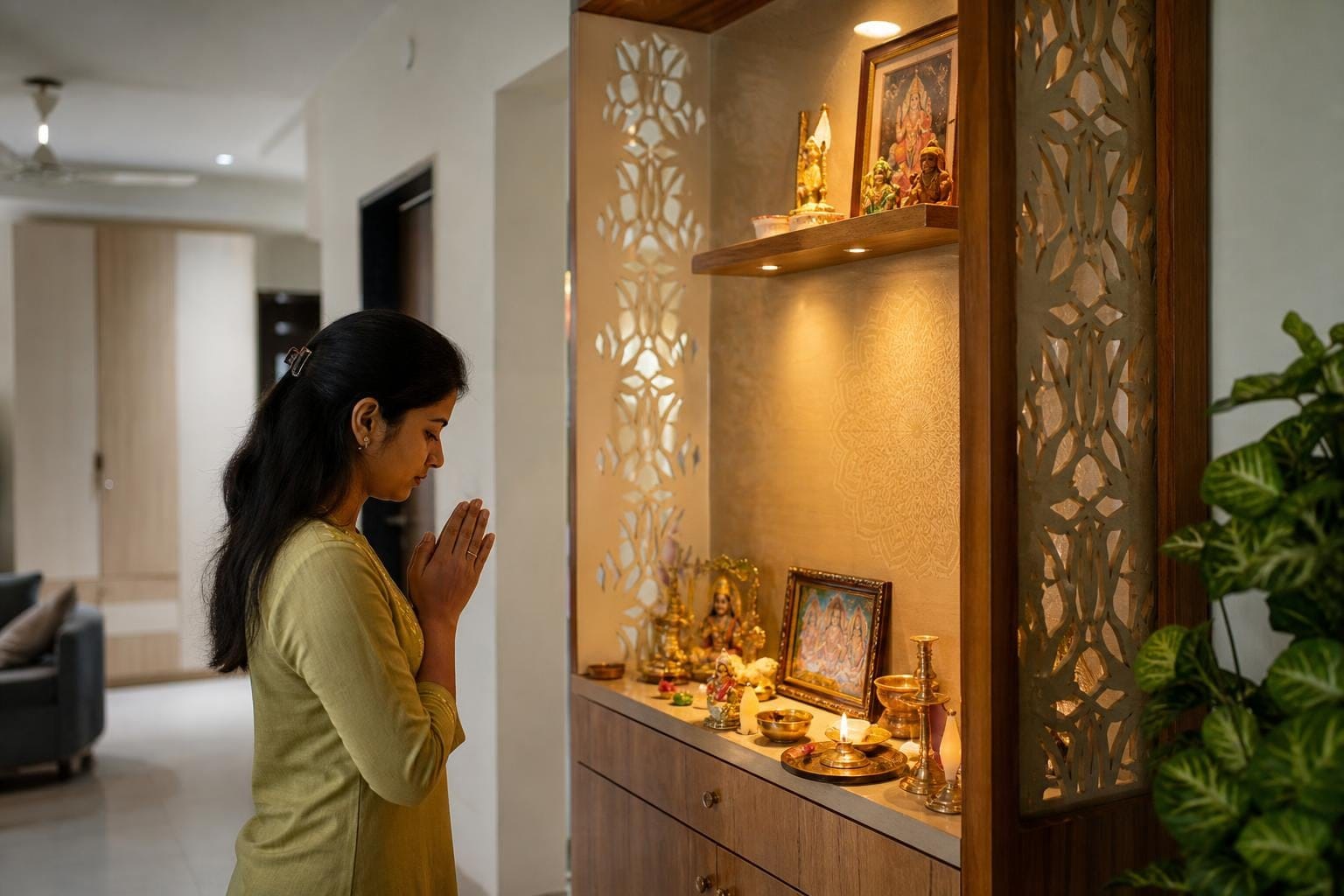
Laser-cut jaali panels in MDF or Corian create a semi-transparent partition between the living area and a dedicated prayer zone. Brass accents, a marble backdrop, and warm integrated lighting complete the look. This is one of the strongest mandir room design trends in 2026.
- Materials: CNC-cut MDF or Corian panels, brass inlays, marble or onyx back panel
- Cost range: ₹60,000 to ₹1,50,000 depending on panel size and material
- Vastu compatibility: Excellent if the partition creates a northeast-facing prayer zone.
- Watch out: MDF jaali panels are delicate at thin cuts (under 3mm). Corian holds precision down to 0.5mm, making it better for intricate patterns. Dust accumulates in jaali grooves, so factor in cleaning access.
For ideas on integrating a jaali partition into your living room layout, it helps to plan the mandir zone alongside your furniture arrangement from the start.
4. Backlit Marble Panel Mandir
Best for: Luxury apartments and villas where the mandir is a design centerpiece.
A single slab of Italian or Makrana marble, backlit with warm LEDs, creates a luminous backdrop for your deities. The veining in the marble catches the light differently throughout the day, giving the space a living, evolving quality. Pair it with a darker wood or metal frame for contrast.
- Materials: Marble slab (8 to 12mm thick for backlighting), LED strip or panel behind, wood or metal frame
- Cost range: ₹40,000 to ₹1,50,000+ depending on marble type and size
- Vastu compatibility: Good. Lighter marble colors (white, cream) align with Vastu color recommendations.
- Watch out: Traditional marble is naturally porous. Over time, ghee, oil, and haldi seep into the stone, causing permanent yellowing and dark stains. Apply a professional sealant before installation and reapply every 12 to 18 months.
For backdrop options beyond marble, explore wall texture finishes that pair well with mandir zones.
5. Corian Mandir with 3D LED Backlighting
Best for: Modern apartments where durability and low maintenance are top priorities.
Corian is the modern alternative to marble and wood for Indian pooja rooms. It’s non-porous (meaning it doesn’t absorb oil, ghee, or water), stain-resistant, lightweight, and can be CNC-carved into intricate jhaali patterns. With LED backlighting behind a 3D-carved Corian panel, you get the spiritual warmth of a traditional mandir without any of the maintenance headaches.
- Materials: Corian solid surface, LED panel, stainless steel or brass frame
- Cost range: Compact wall-mounted ₹16,500 to ₹30,000; mid-size with jhaali and LED ₹60,000 to ₹1,00,000; premium 3D backlit ₹1,00,000 to ₹1,50,000; luxury custom ₹1,50,000 to ₹2,50,000+
- Vastu compatibility: Excellent. Available in Vastu-friendly light colors.
- Watch out: Quality varies dramatically between fabricators. Insist on branded Corian (not generic “solid surface”) and check edge-joining quality. Poorly bonded joints show visible seam lines.
6. Corner Mandir Unit
Best for: Any home where a dedicated room isn’t possible but you have an unused corner in the living room or dining area.
Corner units transform dead angles into functional prayer spaces. They’re compact yet hold everything you need: a deity platform, diya tray, storage for agarbatti, and sometimes a small drawer for pooja samagri.
- Materials: BWR plywood with laminate, veneer, or PU finish
- Cost range: ₹15,000 to ₹45,000
- Vastu compatibility: Good if the corner is in the northeast. If your northeast corner isn’t available, east or north corners are acceptable.
- Watch out: Corner units often get squeezed for depth. Ensure the platform is deep enough (minimum 10 inches) to safely hold lamps and idols without items tipping off the edge.
7. Living Room Integrated Mandir
Best for: Open-plan homes where the pooja area should feel like a natural part of the family space, not an afterthought.
The mandir room design is now being embraced as a focal point in the living room, creating an inclusive space that invites peace and positivity into everyday life. Think of it as a feature wall, not a hidden nook. A beautifully designed mandir unit flanked by bookshelves, a TV unit, or display niches integrates the sacred and the everyday seamlessly.
- Materials: Matches living room material palette (wood veneer, lacquer, Corian accents)
- Cost range: ₹40,000 to ₹1,20,000 (as part of a living room wall unit)
- Vastu compatibility: Good, provided the mandir section sits on the northeast or east portion of the wall.
- Watch out: Incense smoke will stain adjacent surfaces over time. Use a PU-coated back panel behind the diya area, and keep the mandir section slightly recessed from surrounding units to contain smoke residue.
8. Niche / Alcove Built-In Mandir
Best for: New construction or major renovations where you can carve out wall depth during civil work.
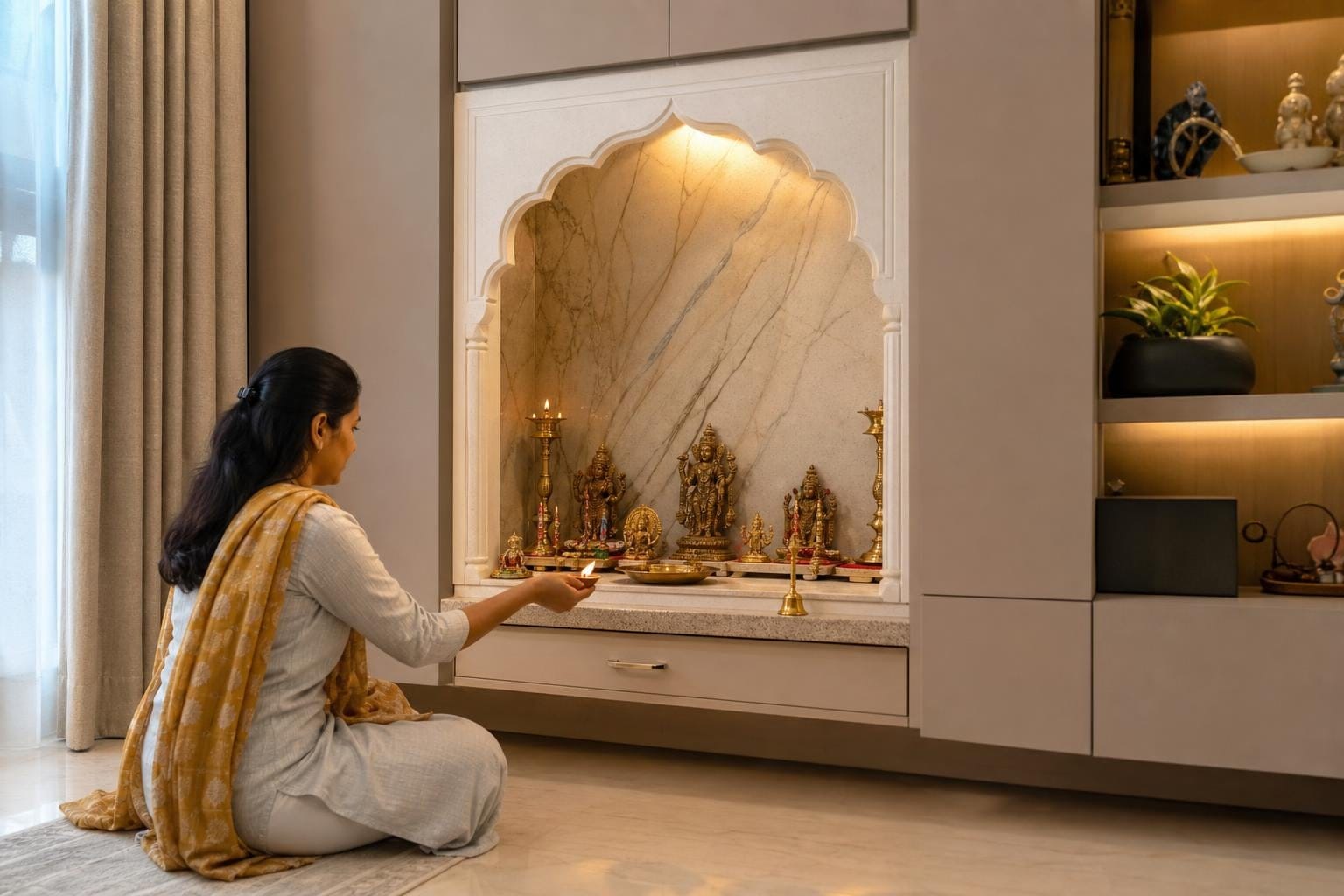
A recessed niche in the wall creates a dedicated altar without occupying any floor space. Add a backlit panel behind the deity for a warm, divine glow. The niche edges can be finished with stone, wood, or brass trim.
- Materials: Civil construction (niche), BWP plywood internal shelving, backlit marble or Corian panel
- Cost range: ₹25,000 to ₹80,000 (excluding civil work)
- Vastu compatibility: Excellent if built into the northeast wall.
- Watch out: The niche must be planned during the civil/structural phase. Retrofitting a niche into a load-bearing wall is expensive and sometimes impossible. Coordinate with your architect early.
9. Under-Staircase Pooja Nook
Best for: Villas and duplexes with internal staircases.
The space beneath a staircase transforms into a sheltered prayer nook with the right lighting and a custom-built mandir unit. It’s a popular choice because it uses otherwise wasted space.
- Materials: BWP plywood frame, marble or granite platform, LED lighting
- Cost range: ₹30,000 to ₹75,000
- Vastu compatibility: Controversial. Vastu texts consider the space beneath a staircase inauspicious, saying it creates a feeling of heaviness unsuitable for prayer. Many modern practitioners disagree and use this space successfully. This is a personal choice, but be aware of the traditional stance.
- Watch out: Staircase areas tend to be dark and poorly ventilated. Plan for adequate lighting and at minimum a small exhaust vent if you burn agarbatti regularly.
10. Cabinet / Concealed Mandir
Best for: Rented apartments or homes where the mandir needs to disappear when not in use.
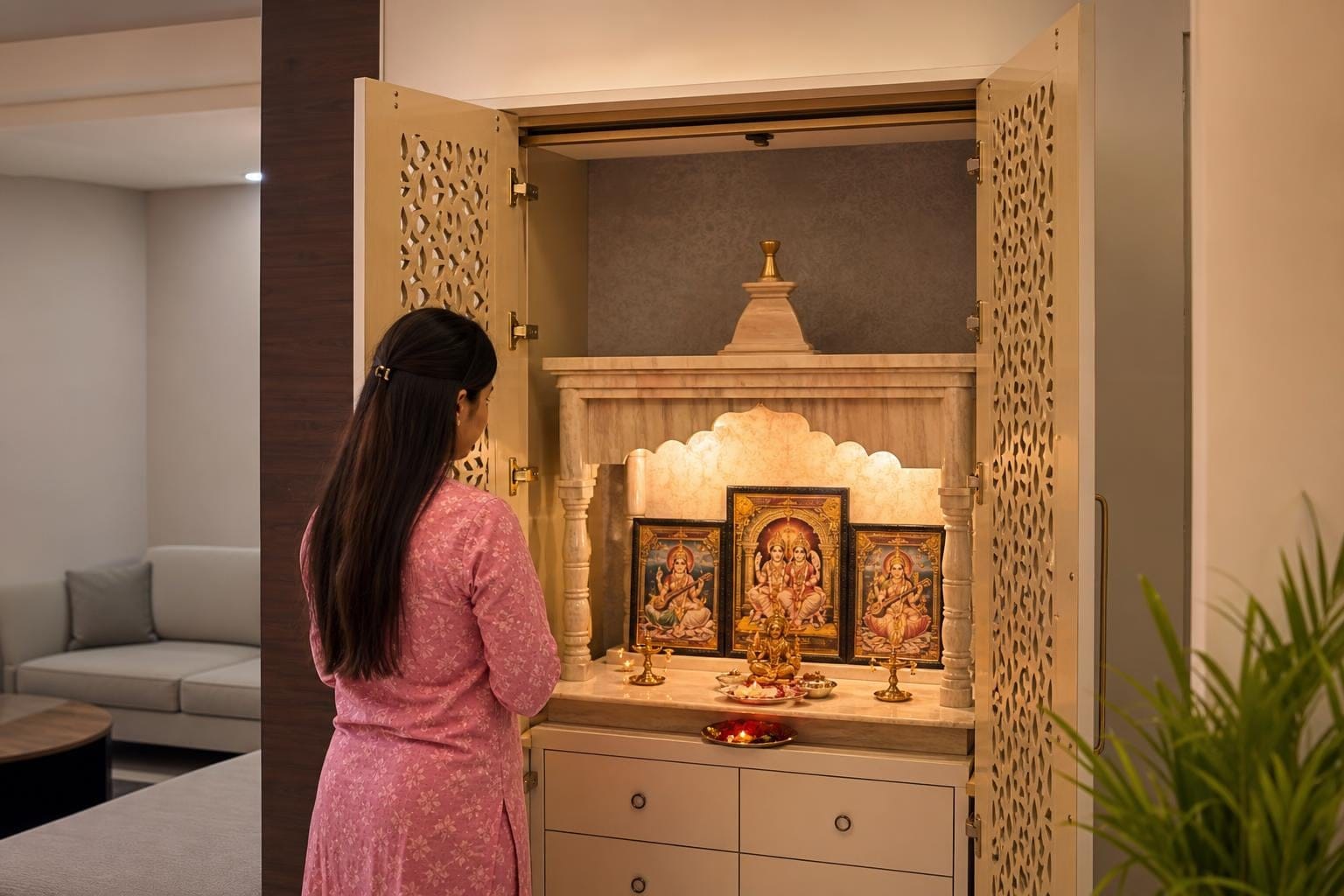
A tall wooden cabinet opens to reveal a fully equipped pooja space. When closed, it blends with your living room furniture seamlessly. Some versions use bi-fold doors, others use sliding shutters.
- Materials: BWR or BWP plywood, veneer or lacquer finish, soft-close hinges
- Cost range: ₹35,000 to ₹90,000
- Vastu compatibility: Acceptable. The key is that doors must have double shutters per Vastu guidelines.
- Watch out: Enclosed cabinets trap incense smoke and heat. Either add a small ventilation cutout at the back panel or avoid burning agarbatti inside the closed cabinet entirely. Soft-close hinges are not optional here. Slamming cabinet doors near brass idols causes vibration damage over time.
The door mechanics parallel wardrobe design choices. Our sliding vs. hinged wardrobe comparison covers how these hardware decisions play out long-term.
11. Dual-Tone Minimal Shelf Mandir
Best for: Young homeowners or couples who prefer contemporary aesthetics.
Newer mandir spaces are becoming quieter visually. Less carving, fewer heavy borders, with the focus shifted towards light, proportion, and how naturally the unit fits into the room. A dual-tone shelf (white and wood, or grey and gold) with clean lines and a single backlit panel is the 2026 distillation of this trend.
- Materials: PU-finished plywood or Corian, brass or gold-toned metal accents
- Cost range: ₹12,000 to ₹40,000
- Vastu compatibility: Good. Minimalism doesn’t conflict with Vastu as long as placement and direction are correct.
- Watch out: Minimalist designs offer fewer storage nooks. Plan separate storage nearby for pooja supplies if the mandir itself is deliberately sparse.
12. Floor-to-Ceiling South Indian Temple-Style Room
Best for: Villas and large homes with strong traditional preferences, especially families from Tamil Nadu, Karnataka, or Andhra Pradesh.
Intricate bold wood carvings and brass items define this mandir room design in home. A floor-to-ceiling wooden frame with jaali detail, carved pillars, a gopura-shaped ceiling, and a granite platform creates the feel of stepping into a miniature temple. This is the most immersive design on this list.
- Materials: Teak or rosewood frame, carved pillars, brass lamps and accents, granite platform, gopura false ceiling
- Cost range: ₹2,50,000 to ₹5,00,000+
- Vastu compatibility: Excellent. The gopura ceiling shape is specifically recommended in Vastu texts for concentrating positive energy.
- Watch out: This design demands a room of at least 5 ft wide by 7 ft deep. It’s not feasible in compact apartments. The carved wood needs termite treatment (termite-proof plywood costs 10 to 15% more than regular grades) and periodic maintenance.
If you’re considering a gopura ceiling element, our false ceiling design guide covers pyramid and cove ceiling options with cost breakdowns.
13. Glass and Metal Contemporary Mandir
Best for: Ultra-modern homes with industrial or contemporary interior themes.
A glass shelf mandir with a brushed metal frame (stainless steel, brass, or black iron) suits homes where traditional wood or marble would clash with the existing design language. Tempered glass keeps the look light and transparent.
- Materials: Tempered glass shelves, powder-coated or brushed metal frame, LED accent lighting
- Cost range: ₹15,000 to ₹50,000
- Vastu compatibility: Acceptable. No Vastu restriction on glass, but light colors and warm lighting help maintain a sacred ambiance.
- Watch out: Glass needs frequent cleaning (fingerprints, water marks from abhishekam). Avoid placing heavy brass idols on unsupported glass spans wider than 18 inches. Ask for 10mm or 12mm tempered glass, not standard 6mm.
14. Fluted Panel Mandir with Brass Accents
Best for: Homes already using fluted or ribbed wall paneling as an interior design element.
This design extends your home’s existing fluted panel aesthetic into the mandir zone. Vertical fluted panels in wood or PVC form the backdrop, with a floating shelf and brass deity frame mounted in front. The ribbed texture adds depth without ornate carving.
- Materials: WPC or solid wood fluted panels, brass accent frame, floating shelf in matching veneer
- Cost range: ₹20,000 to ₹60,000
- Vastu compatibility: Good. Vertical lines are considered auspicious in many traditional interpretations.
- Watch out: PVC fluted panels near diyas can be a fire risk. Maintain at least 12 inches of clearance between any flame and PVC surfaces, or use solid wood panels in the immediate diya zone.
For a broader look at panel options, our wall panelling guide compares wood, PVC, and 3D panel types across cost and durability.
15. Pooja Room as Foyer Focal Point
Best for: Homes with a dedicated entrance foyer or lobby area.
Placing the mandir as the first thing you see when entering the home is both spiritually meaningful and architecturally bold. A backlit niche or a freestanding Corian mandir in the foyer greets every visitor with a sense of peace. This works particularly well in Bangalore apartments where the foyer opens toward the northeast.
- Materials: Corian or marble backlit panel, teak or veneer frame, stone flooring
- Cost range: ₹40,000 to ₹1,20,000
- Vastu compatibility: Excellent if the foyer is in the northeast or east zone of the home.
- Watch out: Foyers are high-traffic areas. Choose durable, easy-to-clean materials. Avoid placing fragile items on platforms that guests might accidentally bump while removing shoes.
Practical Construction Guide: What Survives Real Indian Conditions
Material Selection for Bangalore and Humid Climates
Bangalore’s monsoon humidity (70 to 90% RH) is the silent enemy of pooja room furniture. Here’s what that means in practice:
- BWP plywood is the baseline for built-in mandir units. Its phenolic glue lines resist moisture far better than the urea-formaldehyde in MDF. BWP typically costs 30 to 50% more than BWR and 60 to 80% more than MR-grade plywood for the same thickness, but the longevity difference is dramatic.
- MDF swells 10 to 20% in sustained humidity. If your mandir is near a window or an attached kitchen, MDF will fail within 2 to 3 monsoons.
- HDHMR is the practical middle ground for cities like Bangalore, Pune, and Hyderabad, where conditions are moderate overall but monsoon spikes are real.
- Corian holds its dimensions across temperature and humidity swings, making it the most predictable material for long-term mandir installations.
With good-quality plywood and proper finishing, mandir furniture can last 10 to 15 years or more. Cutting corners on material grade is the single most common mistake people make.
Ventilation and Smoke Management (The Section No One Writes)
This is the biggest blind spot in mandir room design in home. Every ranking guide ignores it, and every homeowner discovers it too late.
In enclosed pooja rooms, poor ventilation leaves smoke marks on lighter walls surprisingly fast, sometimes within weeks of regular agarbatti use. The smoke generated from incense burning is also a health concern when ventilation is inadequate, affecting air quality for elderly family members who spend more time in prayer.
Practical solutions:
- Include a small window or ventilation louver in any dedicated pooja room.
- CNC jaali doors and panels allow airflow while maintaining visual privacy, a functional reason for jaali, not just an aesthetic one.
- For fully enclosed rooms, install a small exhaust fan on a low setting.
- Use warm LEDs instead of multiple oil lamps for daily use. Reserve diyas for festivals and special occasions. This reduces particulate matter significantly.
- Apply a PU-coated or washable wall finish behind the diya and agarbatti area. Regular paint will discolor.
- Reinforce areas that hold brass idols, lamps, and heavy decor, and create a designated heat-safe zone for diya and incense placement.
Good ventilation also prevents heat buildup, especially important if diyas are lit regularly. Practitioners in online forums report that enclosed rooms without airflow can reach uncomfortable temperatures during extended family prayer sessions.
Lighting That Actually Works
Lighting is the most underrated element in any interior, and mandir rooms are no exception. Warm LED lighting (2700K to 3000K) works dramatically better for mandir spaces than bright white LEDs. White light can feel clinical and harsh in a prayer setting.
- Backlit panels (marble, Corian, or onyx) create dramatic depth and are the single strongest mandir lighting trend in 2026.
- Under-shelf LED strips pointing downward highlight the deity without glare.
- Avoid exposed bulbs or tube lights. Concealed cove lighting around the mandir frame adds ambiance without visual noise.
Storage You’ll Thank Yourself For
Build in at least one drawer or pull-out tray for pooja samagri (agarbatti, kumkum, camphor, matchboxes, small oil bottles). A separate compartment for cleaning cloths keeps daily maintenance simple. For larger mandirs, dedicate a lower cabinet section for festival-specific items.
How to Brief Your Interior Designer for a Mandir Room
Most homeowners walk into a design consultation with a Pinterest board and a vague budget. For a mandir room, you need to be more specific. Here’s what to communicate:
-
Specify the plywood grade. BWR minimum for wall-mounted units, BWP for any dedicated room or built-in. If your designer pushes back, ask why, and don’t accept MDF as a substitute without understanding the humidity implications.
-
Request a 3D visualization before execution. Mandir rooms involve intricate detail, and what looks good on a flat drawing often reads differently in three dimensions. Understanding how 3D visualizations help can save you from costly mid-project changes.
-
Discuss ventilation from day one. If the design is an enclosed room, ask where the airflow comes from. If the answer is “the door,” that’s insufficient for regular incense use.
-
Ask about hardware. Soft-close hinges for mandir doors, ball-bearing drawer slides for storage, and concealed brackets for floating units. Cheap hardware fails first.
-
Get the material BOQ (Bill of Quantities) upfront. This prevents material substitutions during execution. Know exactly what grade of plywood, what thickness of Corian, and what brand of hardware you’re paying for.
-
Size guidelines to communicate: A separate pooja room should ideally be 5 ft wide and 7 ft deep. For compact apartments, a wall unit between 1.5 ft and 3 ft wide works. A small mandir can fit in a 2×2 ft space if designed smartly.
Bangalore-Specific Considerations for Mandir Room Design
Bangalore apartments deserve their own section because the constraints are specific:
- Monsoon humidity means BWR plywood is the absolute minimum, BWP is preferred, and MDF should be avoided for any mandir near windows or exterior walls.
- Multigenerational living is common. The pooja room needs to accommodate daily use by elders, which means platform heights, storage accessibility, and lighting should account for older users.
- Most 2BHK and 3BHK apartments in areas like JP Nagar, HSR Layout, Whitefield, and Koramangala have compact floor plans. Wall-mounted and niche designs are the most practical mandir room design choice in these homes.
- Builder-provided pooja niches (common in projects by Adarsh, Nambiar, and similar developers) are often generic and undersized. Custom upgrades to these niches, adding better lighting, proper material finishes, and adequate storage, transform them completely.
- What actually works in most Bangalore apartments is a pooja unit in the living room placed along the northeast wall, or a dedicated niche or wall unit instead of a closed room.
Common Mistakes to Avoid
Before finalizing your mandir room design in home, sidestep these frequent errors:
- Choosing MDF for humid locations. It’s cheaper and smoother, but it swells. Period.
- Ignoring incense smoke damage. Your ₹2 lakh white marble backdrop will yellow in months without a sealant and ventilation plan.
- Skipping edge sealing. Exposed plywood edges absorb moisture and attract termites. Every edge must be sealed, no exceptions.
- Using white LED lights. They kill the ambiance. Warm LEDs (2700K to 3000K) create the right mood.
- Not planning for weight. Brass idols and lamps are heavy. Shelves need reinforcement, and wall mounts need proper wall plugs rated for the load.
For a broader list of pitfalls, these interior design mistakes apply across every room but are especially painful in a space as visible and emotionally important as the mandir.
FAQ
What is the ideal size for a pooja room at home?
If you have space for a separate room, design it at 5 ft wide and 7 ft deep. For apartments, a wall-mounted or niche unit between 1.5 ft and 3 ft wide is practical. Even a 2×2 ft space can hold a well-designed compact mandir. Corian mandir sizes range from 1.5 ft × 2 ft for studio apartments to 4 ft × 7 ft for villa installations.
Which direction should a mandir face as per Vastu?
The ideal placement is the northeast corner of the home (Ishan Kona). The deity should face east or west, and the worshipper should face east or north during prayer. Avoid placing the mandir on a wall shared with a bedroom or in the south direction.
What is the best material for a mandir in a humid climate?
Corian is the strongest choice for humid cities like Bangalore, Chennai, or Mumbai. It’s non-porous, doesn’t absorb moisture, and needs almost no maintenance. For built-in units, BWP plywood with proper edge sealing is the durable alternative. Avoid untreated MDF in any location with sustained humidity above 60% RH.
How much does a custom mandir room design cost in India?
Costs vary widely. A basic ready-made freestanding mandir starts around ₹7,000. A modular wall-mounted unit runs ₹22,000 to ₹50,000. A full custom pooja room fit-out with premium materials ranges from ₹1,50,000 to ₹5,00,000+. Corian mandirs offer an excellent mid-range option at ₹16,500 to ₹2,50,000 depending on size and complexity.
Can I place a mandir in the living room?
Yes. In fact, for most urban apartments without a separate pooja room, a living room mandir on the northeast wall is the most Vastu-compliant and practical solution. Wall-mounted units, corner mandirs, and integrated wall units all work well in living rooms.
Is the under-staircase space good for a mandir?
This is contested. Vastu texts consider the space beneath a staircase inauspicious for prayer, saying it creates heaviness. However, many modern homeowners and designers use this space successfully with good lighting and ventilation. It’s a personal and cultural decision.
How do I protect my marble mandir from ghee and haldi stains?
Marble is naturally porous and will absorb oils over time. Apply a professional stone sealant before first use and reapply every 12 to 18 months. For daily protection, place a small brass or stainless steel tray under diya and abhishekam areas to catch drips. Alternatively, consider Corian, which is non-porous and doesn’t stain at all.
How long does a well-built mandir last?
With good-quality plywood (BWP grade) and proper finishing, including edge sealing and termite treatment, a mandir unit can easily last 10 to 15 years or more. Termite-proof plywood costs 10 to 15% more than regular plywood, but the protection is worth it for a piece of furniture that stays in your home for decades.
Designing a mandir room that lasts is about more than aesthetics. It’s about choosing the right material for your city’s climate, planning for ventilation, getting the Vastu basics right, and knowing exactly what to ask for when you sit down with your designer.
If you’re planning a mandir room as part of a larger home interior project in Bangalore, explore our pooja room interior design guide for a detailed walkthrough of what the process looks like from concept to installation.