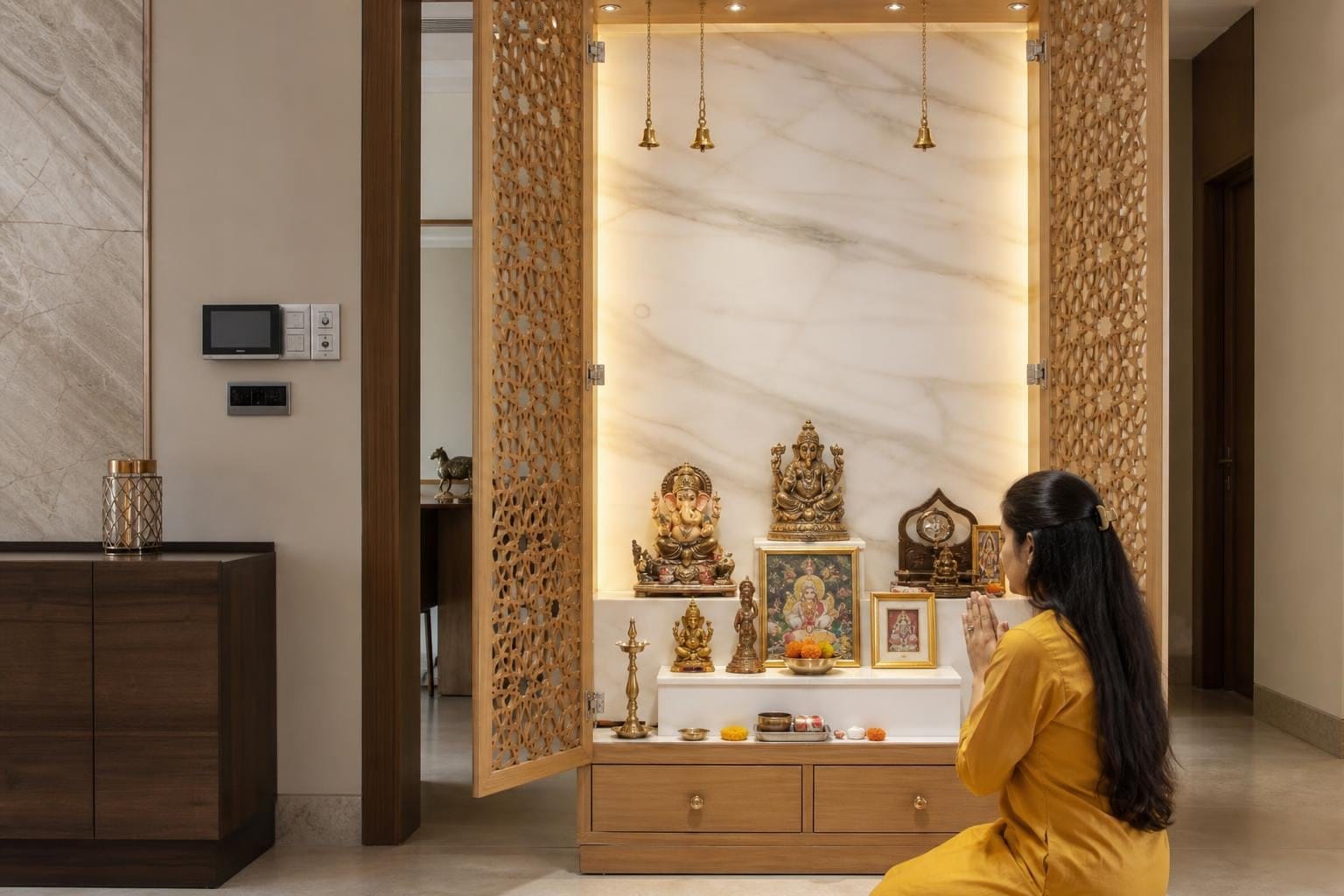
Elegant Pooja Room Designs 2026: Styles, Materials & Vastu
TL;DR
Elegant pooja room designs balance quality materials, thoughtful lighting, and Vastu compliance rather than excessive ornamentation. This glossary covers every term you need to know, from CNC jali panels and backlit onyx walls to BWP plywood and construction hardware, along with cost benchmarks for 2026. Bangalore homeowners face unique challenges like monsoon humidity and compact apartment layouts that make material and ventilation choices especially critical. Use this as your reference guide before speaking with a designer.
A pooja room is one of the few spaces in a home that serves both an emotional and a daily functional purpose. You pray there every morning. You light incense, oil lamps, and camphor. You place fresh flowers near idols. And then you close the door and expect the space to look pristine for years.
That combination of daily ritual use and high aesthetic expectation is exactly what makes designing a pooja room harder than most people expect. The phrase “elegant pooja room designs” gets searched thousands of times each month, but most results offer image galleries with little explanation of the vocabulary behind the designs. This glossary fixes that.
Whether you are renovating a 2BHK in Whitefield or building out a villa in JP Nagar, the terms below will help you communicate precisely with your interior designer, evaluate material quotes with confidence, and avoid mistakes that show up six months after installation.
Planning a pooja room for your Bangalore home? Our pooja room interior design guide walks you through the full process from concept to execution.
What Makes a Pooja Room Design “Elegant”
Elegance is not the same as ornate. A heavily carved teak mandir with gold paint can look stunning or it can look cluttered, depending on proportions, lighting, and the surrounding space. In 2026, the strongest design direction is restraint balanced with tradition. The idols, bells, and diyas remain central, but the difference lies in how they are presented: clean, organized, and thoughtfully arranged.
Three things consistently separate elegant pooja room designs from ordinary ones:
Material quality over decorative quantity. A single slab of backlit marble does more than a dozen decorative elements fighting for attention. The material itself becomes the design statement.
Lighting that creates atmosphere. The right warm glow behind an idol shelf transforms a storage niche into a sacred space. Bad lighting, particularly harsh cool-white LEDs, undoes even expensive design work.
Vastu harmony without compromise. Placement in the northeast corner, proper idol orientation, and a low or domed ceiling aren’t just tradition. They create a spatial logic that feels intentional, and that intentionality reads as elegance.
Bangalore apartments add specific constraints. Layouts are compact (most pooja spaces are 3×2 to 5×7 feet). Monsoon humidity runs from June through October, which punishes untreated wood and porous stone. Many families are multigenerational, so the pooja room needs to serve different prayer practices simultaneously.
Design Styles Glossary: Types of Elegant Pooja Room Designs
Backlit Onyx / Stone Wall
A translucent stone panel (typically onyx or alabaster) mounted 1 to 1.5 inches away from LED strip lights. The light passes through the stone, creating a luminous, almost ethereal backdrop behind the deity. This works exceptionally well in modern homes that lean toward statement interiors. It is expensive (the onyx slab alone can run ₹3,000 to ₹8,000 per square foot) but delivers dramatic impact with zero maintenance beyond occasional dusting.
Best for: Premium apartments and villas where one wall can be dedicated to the pooja backdrop.
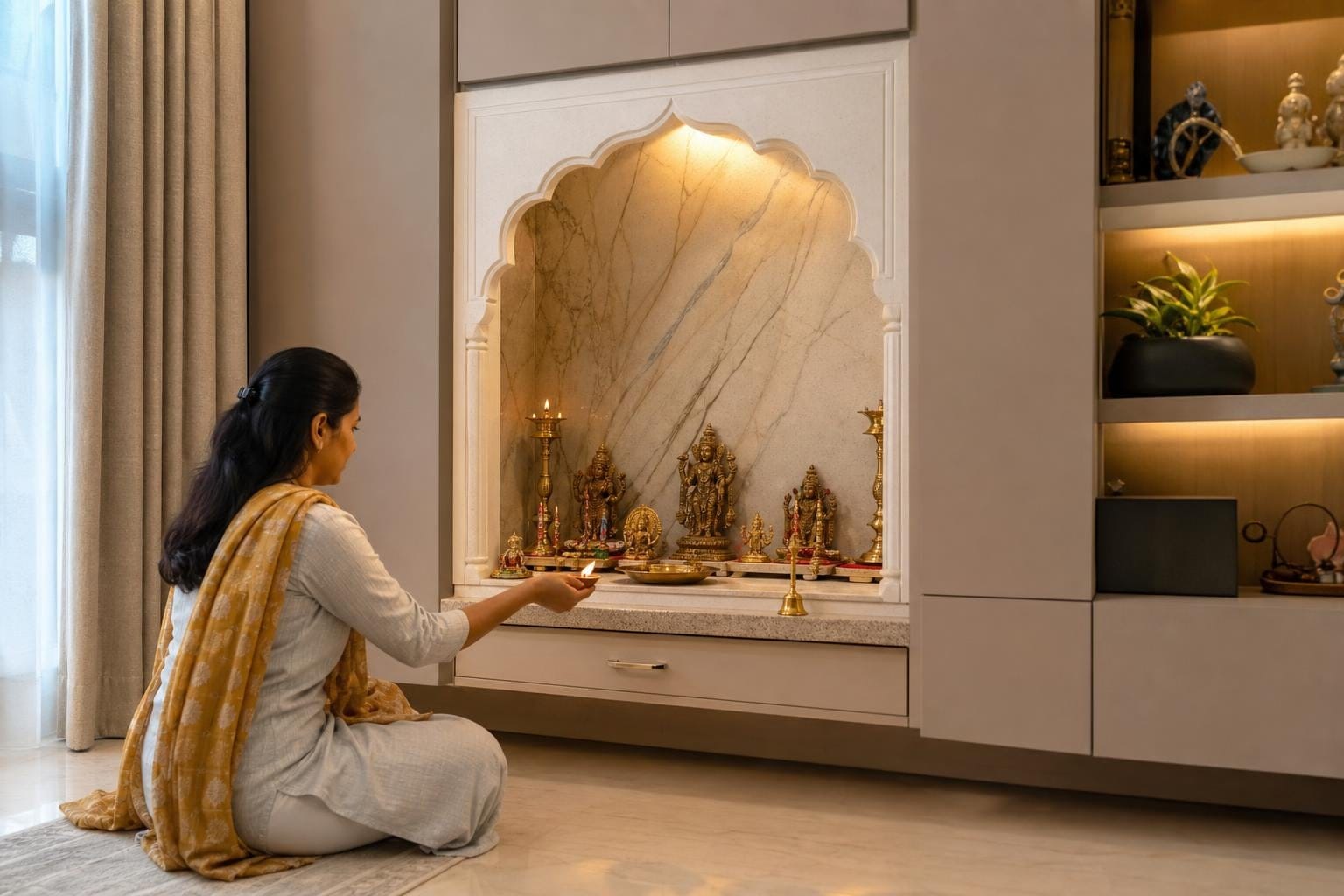
Built-in Niche Mandir
A recessed alcove carved into the wall during construction or renovation, fitted with shelves, lighting, and sometimes a decorative frame or arch. The niche approach keeps the pooja unit flush with the wall surface, saving floor space and creating a clean, integrated look. Practitioners on home design forums frequently recommend this style for 2BHK apartments where every square foot counts.
Best for: New construction or major renovations where wall modification is possible.
CNC Jali Panel Design
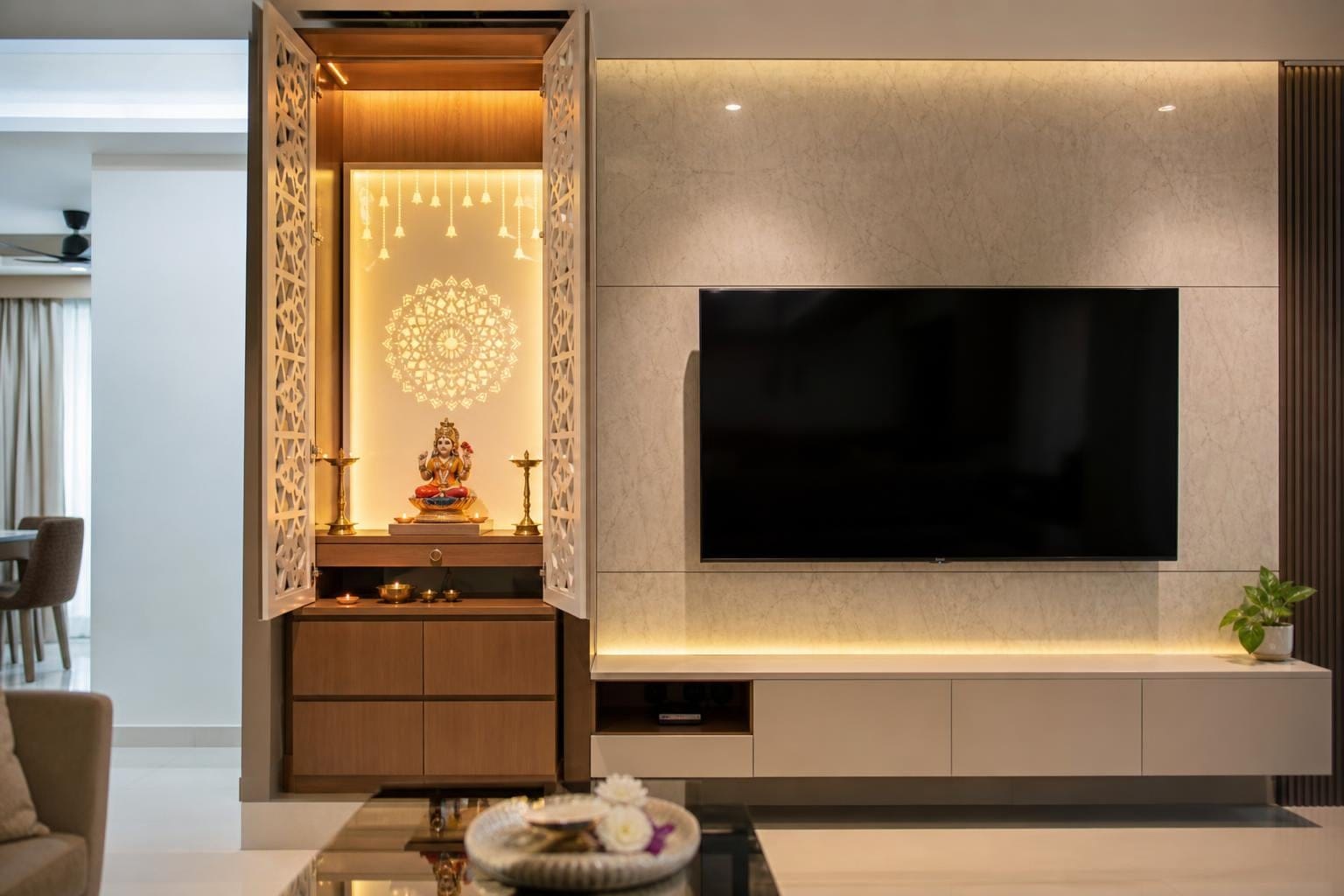
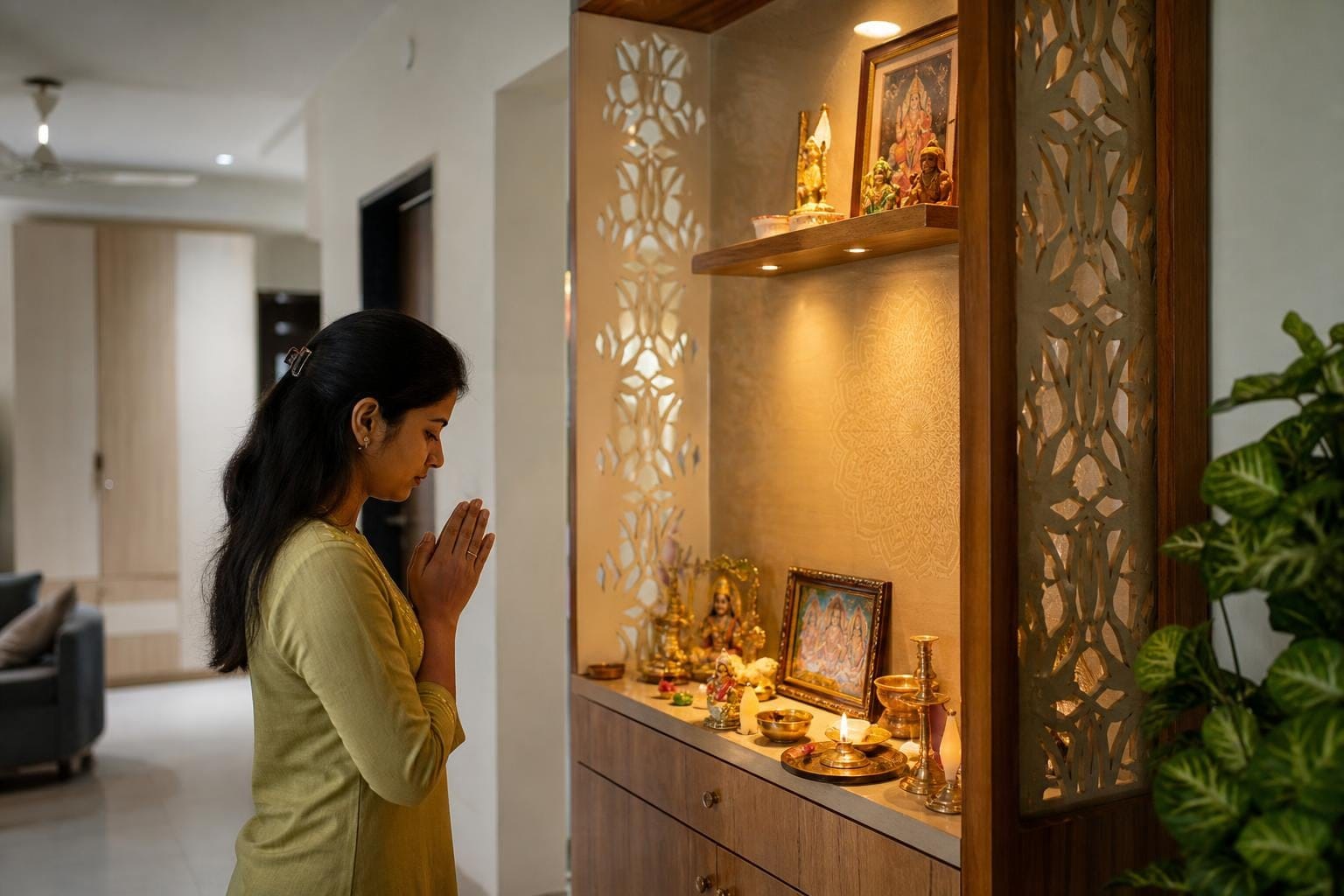
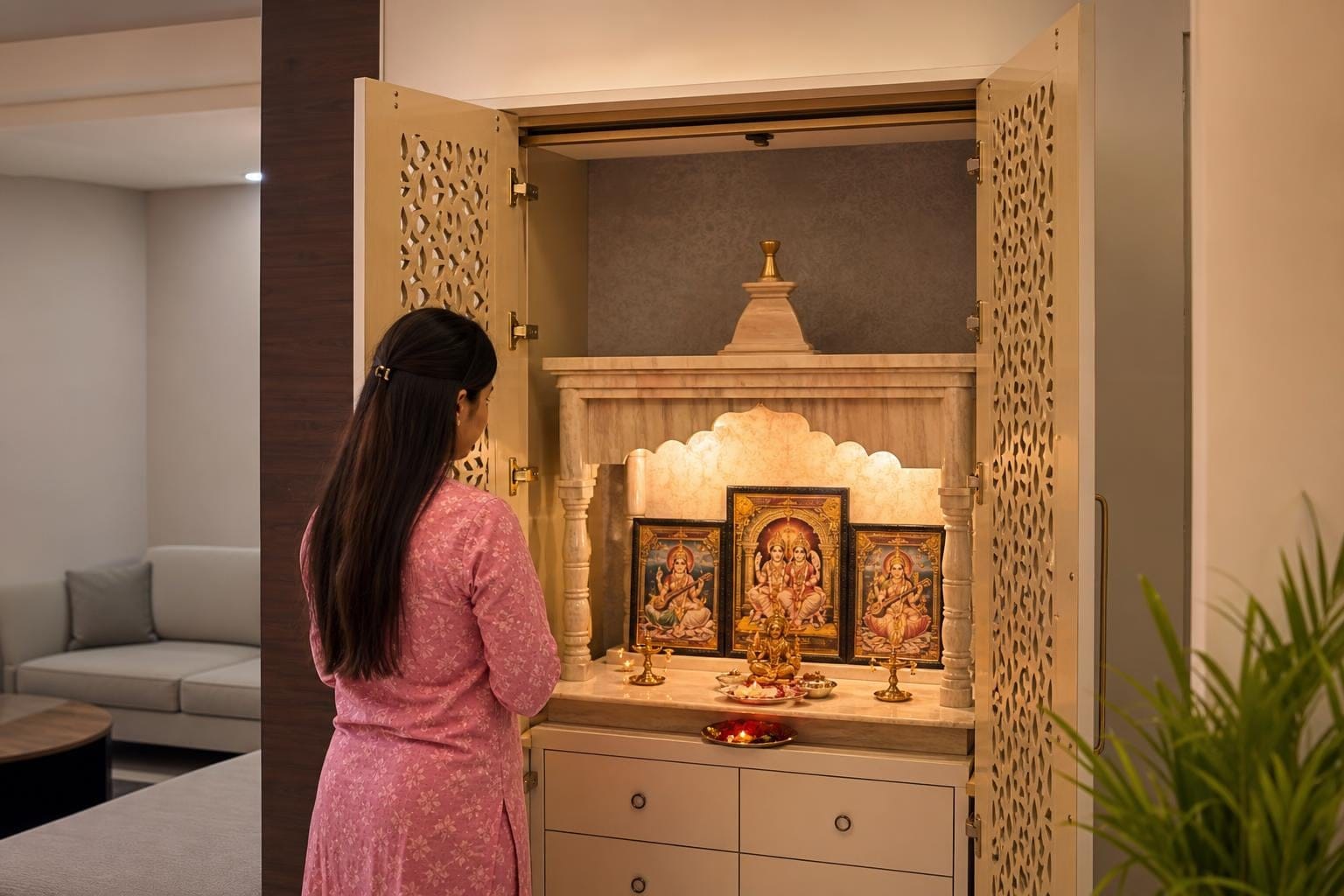
Computer Numerical Control cutting uses a computer-controlled machine to carve intricate patterns into wood, MDF, or acrylic panels. CNC jali designs for mandirs commonly feature religious symbols (Om, Ganesh, lotus, diya shapes) and geometric motifs. These panels often replace solid shutters so the pooja space does not feel closed off while still maintaining a defined boundary.
MDF jali pricing ranges from ₹90 to ₹450 per square foot depending on thickness and pattern complexity. CNC jali in solid wood costs significantly more but offers superior longevity.
Best for: Creating decorative screens, door panels, or partition walls in apartments of any size.
Concealed / Modular Pooja Box
A compact unit that closes neatly after prayers, sometimes disguised within a wall panel, TV unit, or wardrobe system. Modular pooja boxes work well in studio apartments and multipurpose spaces where the mandir shares room with storage or work desks. The modular approach, similar to modular kitchen cabinetry, uses standardized components (push-to-open doors, pull-out trays, concealed hinges) that can be factory-made and assembled on site.
Best for: Compact homes, rented apartments, and households preferring minimalism.
Courtyard-Style Mandir
An open-to-sky or semi-open design that brings nature into the spiritual space. Greenery, natural stone flooring, and sometimes a small water feature surround the mandir. This style draws from traditional South Indian temple courtyards and requires either a balcony, terrace, or internal courtyard.
Best for: Villas and independent homes with outdoor or semi-outdoor space.
Dome / Gopuram Ceiling
Inspired by temple architecture, this ceiling treatment adds a miniature dome, pyramid, or stepped gopuram above the pooja area. Intricately designed domes with concealed cove lighting create what many describe as a celestial atmosphere. Vastu guidelines actually recommend a low ceiling with a pyramid-shaped roof for pooja rooms, stating it maximizes positive vibrations and creates symmetry.
For full ceiling options including cost tiers, see our false ceiling design guide.
Best for: Dedicated pooja rooms with at least 8 feet of ceiling height.
Floating / Wall-Mounted Unit
A pooja shelf or cabinet mounted directly to the wall with concealed brackets, leaving the floor space free below. This is the most common solution for modern Bangalore apartments. A compact wall-mounted unit can fit within 2×3 feet, while still holding idols, a lamp, and basic accessories. Modular pooja shelf pricing in Bangalore sits around ₹1,200 per square foot as of mid-2026.
Best for: 1BHK and 2BHK apartments, hallway niches, and kitchen-adjacent walls.
Glass-Enclosed Sanctuary
Frosted, etched, or patterned glass panels define the pooja space while allowing natural light to flow through. Glass enclosures are popular in open-plan apartments where the pooja room needs visual separation from the living room without creating a heavy partition. Toughened glass (minimum 10mm) is recommended for panels larger than 4 square feet.
Best for: Open-plan layouts, living room integration, and contemporary interiors.
Marble Platform Mandir
White marble (often Makrana or Italian Statuario) used for the idol platform, backdrop wall, or both. Marble reflects light softly and feels cool to the touch, which many homeowners find appropriate for a spiritual space. Marble jali designs with subtle floral patterns or religious motifs add texture without overwhelming the clean surface.
Best for: Traditional and transitional designs across all home sizes.
Partition Pooja Room (Living Room Integration)
A pooja zone separated from the living room using a decorative partition rather than a full wall. The partition might be a CNC jali screen, a wooden lattice, a glass panel, or a combination. This approach works when there is no separate room available for prayers and the household wants something more defined than a simple shelf.
Best for: Living-dining combined layouts and 2BHK apartments.
South Indian Carved Wooden Mandir
A traditional freestanding or wall-fixed mandir carved in teak, rosewood, or sheesham, often featuring pillars, arches, and deity figures drawn from Dravidian temple design. These mandirs represent the most ornate end of elegant pooja room designs, and the craftsmanship justifies the cost. Expect ₹45,000 to ₹95,000 or more for a quality carved teak unit with brass accents.
Best for: Families with strong traditional preferences and dedicated pooja rooms.
Temple-Style Standalone Mandir
A self-contained structure that replicates the proportions of a small temple, complete with a stepped base, pillared frame, and dome or shikhara top. Unlike built-in options, this unit can be moved. It occupies floor space (typically 3×2 to 4×3 feet) and works best when the room can accommodate it without crowding.
Best for: Villas and large apartments with a dedicated pooja room of at least 5×7 feet.
Materials Glossary
Choosing materials is the single most consequential decision in pooja room design. The wrong material in a humid Bangalore apartment will warp, stain, or peel within a year. The right material will look better with age.
Solid Wood (Teak, Rosewood, Sheesham)
The traditional choice for carved mandirs. Teak is naturally resistant to termites and moisture, but it still needs periodic polishing to handle Bangalore’s monsoon humidity. Rosewood has a rich grain but is expensive and increasingly restricted. Sheesham offers a budget alternative with decent durability.
Price anchor: ₹45,000 to ₹95,000+ for a carved teak pooja door alone.
Engineered Wood / Plywood
The workhorse material for modern pooja cabinetry. The critical distinction here is between standard commercial plywood and BWP (Boiling Water Proof) or marine-grade plywood. In Bangalore’s humid conditions, BWP plywood prevents the swelling and delamination that destroys standard plywood during monsoon months. Paired with a laminate or veneer finish, engineered wood offers the best balance of durability and cost for Indian conditions.
Price anchor: Significantly less than solid wood; modular pooja units starting around ₹1,200/sq ft in Bangalore.
MDF (Medium Density Fiberboard)
The go-to material for CNC jali panels because it machines cleanly without splintering. MDF takes paint well and produces sharp, intricate patterns. However, MDF absorbs moisture aggressively. In a poorly ventilated pooja room with daily incense and oil lamps, MDF panels can swell at the edges within months. Sealed edges and proper ventilation are non-negotiable if you use MDF in Bangalore.
Price anchor: ₹90 to ₹450 per square foot for CNC-cut jali panels.
Marble (Makrana, Italian)
White Makrana marble is a classic material for pooja room design due to its durability and soft light reflection. Italian marble (Statuario, Carrara) offers bolder veining for a more contemporary look. Marble is easy to maintain with regular wiping but can stain from turmeric, kumkum, and oil if not sealed properly.
Corian / Solid Surface
A non-porous, seamless material that can be laser-cut into jali patterns or formed into curved shapes. Corian resists moisture and stains, making it practical for daily-use pooja rooms. The seamless joints eliminate places for soot and oil to accumulate.
Glass (Frosted, Etched, Toughened)
Frosted and etched glass add visual softness while allowing light to pass through. Toughened glass (tempered) is mandatory for structural panels. One maintenance reality that forum practitioners consistently flag: oil fumes and smoke from daily rituals create a sticky residue on glass surfaces that requires frequent cleaning to prevent buildup.
Brass and Copper Accessories
Traditional materials for bells, lamp holders, door handles, and decorative elements. Brass tarnishes with exposure to incense smoke and needs regular polishing. Many designers now use brass-coated stainless steel for lower maintenance while preserving the traditional look.
Acrylic
A lightweight, smooth-finish material that can be laser-cut into intricate jali designs. Available in a range of colors including gold, white, and translucent options. Acrylic works well for backlit panels because it transmits light evenly.
PVC
The most budget-friendly and moisture-resistant option for pooja room doors and panels. PVC doors range from ₹1,500 to ₹7,000 with 7 to 10 years of durability and minimal maintenance. The trade-off is that PVC looks and feels like plastic, which undermines the “elegant” aesthetic unless combined thoughtfully with other materials.
Natural Stone (Granite, Slate)
Used primarily for flooring and base platforms. Granite is virtually indestructible and easy to clean. Slate adds a textured, earthy quality. Both handle humidity without issue. For backdrop options, see our guide to wall texture designs.
Vastu Terms for Pooja Room Design
Vastu Shastra governs pooja room placement in the majority of Indian homes, and understanding its key terms prevents costly repositioning later. For a complete room-by-room breakdown, explore our full Vastu guide for home interiors.
Ishan Kona (Northeast Corner)
The northeast corner of the home is considered the most sacred direction and the ideal location for a prayer room. This position is believed to receive the first rays of the sun, charging the space with positive energy.
Idol Facing Direction
Idols should face east or west. The devotee should face east or north while praying. This means the idol shelf is placed against the west or south wall of the pooja room.
Gopura / Pyramid Ceiling Shape
Vastu recommends a low ceiling with a pyramid-shaped or stepped gopura form for pooja rooms. The tapered shape is said to channel energy upward and create symmetry in the space.
Pooja Room Dimensions
Recommended Vastu-compliant dimensions start at 5 by 7 feet for a dedicated room. The maximum recommended size is 9 by 9 feet. If the pooja area is elevated, the steps leading up should be in odd numbers (1, 3, 5).
Threshold (Doorway Energy Boundary)
A small step or threshold at the pooja room entrance marks the transition from secular to sacred space. This is both a Vastu element and a practical barrier that prevents water, dust, and foot traffic from entering the prayer area.
Do-Not-Place Zones
Avoid placing pooja units under staircases, adjacent to or sharing a wall with bathrooms, or directly above or below a toilet on another floor. These placements are considered inauspicious in Vastu and are among the most common mistakes in apartment layouts.
Color Guidance
Light, calming colors are preferred: white, cream, light yellow, and pastel shades. Dark or bold colors are generally avoided in the pooja room itself, though 2026 trends show growing use of sage green with white and warm neutrals with gold accents as acceptable contemporary choices.
Lighting Vocabulary
Lighting is the most underrated element in elegant pooja room designs. The right light turns a wooden shelf into a sanctum. The wrong light makes even expensive materials look flat.
Backlighting
LED strips mounted behind a marble slab, onyx panel, or idol shelf to create a halo or glow effect. The light source is hidden, and the material becomes luminous. Warm white LED strips behind the deity shelf create what designers call a “divine aura.” The recommended standoff distance between the light strip and the surface is 1 to 1.5 inches for even light distribution.
Cove Lighting
LED strips concealed within a recessed ceiling ledge (cove), casting indirect light upward or downward. Cove lighting works beautifully in gopuram and dome ceilings, where the reflected light softens the entire room. For more on how lighting transforms a space, our guide on lighting in interior design covers the fundamentals.
Spotlighting
Small, focused beams directed at specific elements: the main idol, a brass bell, a carved panel. Spotlights add drama and hierarchy, drawing the eye to the most important elements. Recommended illumination for accent lighting in a pooja room is 150 to 300 lux (per IES guidelines).
Color Temperature
Measured in Kelvin (K). Warm white (2700 to 3000K) is the standard recommendation for pooja rooms because it mimics the golden glow of a diya flame. Cool white (5000K+) creates a clinical feel that disrupts the calm of the space. Practitioners on YouTube design walkthroughs consistently advise against cool white LEDs in prayer spaces.
CRI (Color Rendering Index)
A measure of how accurately a light source reveals the true colors of objects. A CRI of 90 or higher is recommended for pooja rooms so that the colors of idols, flowers, and fabrics appear rich and natural rather than washed out. Most cheap LED strips score CRI 70 to 80, which is fine for a wardrobe interior but insufficient for a pooja room.
Dimmable / Motion-Sensor LED Strips
A growing 2026 trend. Dimmable strips allow you to set bright light during morning prayers and a soft glow for evening meditation. Motion-sensor strips illuminate automatically when you approach, which is practical for early-morning routines.
Door Design Types and Pricing
The pooja room door opens and closes every day, sometimes multiple times. Hardware quality matters here more than in most other doors in the home.
CNC Jali Door
A wood or MDF door with CNC-cut patterns (Om, lotus, geometric designs) that allow air circulation and visual connection. This is the most popular door type for elegant pooja room designs in apartments. MDF versions start around ₹12,000; solid wood versions with brass inlay can reach ₹60,000+.
Lattice / Jaali Door
Traditional hand-carved or machine-cut lattice work, typically in teak or rosewood. The lattice pattern allows ventilation, which is critical for managing incense smoke. More expensive than CNC jali due to the labor involved in traditional carving.
Sliding Door
A track-mounted door that slides parallel to the wall instead of swinging open. Ideal for tight spaces where a swinging door would block a corridor or bump into furniture. Soft-close hardware prevents the door from slamming.
Double Shutter
Two door panels that open outward or fold inward. Double shutters create a grand entrance effect and are common in dedicated pooja rooms. They require strong hinges (commercial-grade, ball-bearing type) because the daily open-close cycle puts significant stress on the pivot points.
Arched Wooden Door (Gopuram-Inspired)
A door with a curved or pointed arch at the top, echoing temple entrance architecture. The arch is typically non-structural (decorative framing above a standard rectangular door frame) and works well with South Indian carved wooden mandirs.
Frosted Glass with Wood Frame
A contemporary option that allows light to pass while maintaining privacy. The glass is set within a wooden or aluminum frame. Etched designs (deities, floral patterns) add a decorative element without reducing light transmission.
Overall door price range: ₹1,500 (basic PVC) to ₹95,000 (carved teak with brass), with most mid-range options falling between ₹15,000 and ₹45,000.
Storage and Functional Terms
A well-designed pooja room has a place for everything: daily essentials, seasonal items, and overflow. Here are the functional terms you will encounter.
Pull-Out Tray
A shallow tray on drawer slides that pulls out from under the idol shelf. Used for daily pooja essentials (matchbox, incense holder, kumkum, camphor). Soft-close slides prevent jarring stops.
Concealed Drawer
A hidden drawer behind a panel that matches the surrounding surface, with no visible handle. Push-to-open mechanisms are common. These drawers store items you do not want visible (extra incense packs, cleaning cloths, spare wicks).
Push-to-Open Cabinet
A door or panel that opens with a gentle push, eliminating the need for handles that can disrupt a minimalist facade. The same mechanism used in modern kitchen cabinetry applies directly to pooja units.
Open Display Shelf
An exposed shelf for displaying idols, framed photos of deities, and decorative items. The shelf should be deep enough (8 to 12 inches) to hold standard idol sizes without risk of tipping.
Tiered Idol Platform
A stepped platform that creates height variation among idols, placing the primary deity at the highest point. Typically three tiers, built from marble, stone, or engineered wood with a finished surface. Vastu suggests the primary idol should be at eye level or slightly above when seated.
Construction Quality Terms Every Client Should Know
This section covers the vocabulary that separates a pooja unit lasting 15 years from one that starts failing in 15 months. None of the competing pooja room design articles discuss this, but it is arguably the most important section in this glossary.
BWP (Boiling Water Proof) Plywood
Plywood manufactured with phenolic resin that withstands prolonged moisture exposure without delamination. In Bangalore, where relative humidity regularly exceeds 80% during monsoon months, BWP plywood is not a luxury upgrade. It is the baseline for any cabinetry in moisture-prone areas. Standard commercial plywood (MR grade) will swell, warp, and separate at the edges in these conditions.
Marine-Grade Plywood
A step above BWP, made with higher-grade adhesives and more uniform core veneers. Originally designed for boat building, marine-grade plywood is virtually impervious to moisture. It costs more but is recommended for pooja rooms with daily water use (abhishekam rituals) or rooms without air conditioning.
Edge Banding / Sealed Edges
A thin strip of laminate, PVC, or veneer applied to the exposed edges of plywood or MDF panels. Unsealed edges absorb moisture and emit formaldehyde. In a pooja room context, sealed edges prevent humidity from entering the board substrate and also stop incense smoke residue from penetrating raw surfaces.
Commercial-Grade Hinges (Soft-Close, Ball-Bearing)
Hinges rated for 50,000+ open-close cycles, featuring ball-bearing mechanisms for smooth movement and integrated soft-close dampers that prevent slamming. A pooja room door opens and closes at least twice daily, totaling over 700 cycles per year. Standard economy hinges wear out in 3 to 5 years; commercial-grade hinges from brands like Hettich or Blum last 15+ years.
Reinforced Shutter Framing
Internal framework within a door panel (typically a wooden battens grid) that prevents the panel from sagging or bowing over time. Without reinforced framing, large MDF or plywood shutters (especially CNC jali doors with material removed by cutting) will warp under their own weight within 2 to 3 years.
Understanding these construction terms helps you ask the right questions when reviewing a quote. For more on what interior design services include and how to evaluate a scope of work, that guide breaks down the full investment.
Maintenance Terms and Practical Realities
Most articles about elegant pooja room designs skip maintenance entirely. That is a disservice because the daily rituals of Indian prayer, lighting incense, oil lamps, and camphor, along with using turmeric and kumkum, create specific cleaning and material challenges.
Soot Management and Ventilation
Smoke from diyas and incense sticks needs proper airflow. Without it, the room accumulates a greasy film of soot on every surface. Indian homes often have smaller rooms, closed windows during AC use or monsoon, and daily incense use, sometimes multiple times. A window, air vent, or even a simple exhaust fan improves air circulation dramatically. This is a detail that many design plans miss entirely.
Oil Residue on Brass and Glass
Oil lamps produce fine droplets that settle on nearby surfaces. On glass, this creates a sticky layer that attracts dust. On brass, it accelerates tarnishing. The practical solution: smooth-finish materials are easier to clean than porous or textured ones. A weekly wipe with a mild degreaser keeps glass and brass surfaces clear.
Humidity Damage on Untreated Wood
In Bangalore’s monsoon season, untreated wood absorbs moisture and expands, then contracts during the dry months. This cycle cracks finishes, loosens joints, and warps panels. Teak resists this better than most woods, but even teak benefits from a sealed polyurethane finish. MDF without sealed edges is the most vulnerable material in humid conditions.
Choosing Maintenance-Friendly Materials
Materials with smooth, non-porous finishes, such as laminate, Corian, polished marble, and sealed wood, perform best in daily-use pooja rooms. Untreated wood, raw MDF, fabric linings, and porous stone (like unsealed sandstone) make maintenance harder over time and should be avoided in rooms with active daily rituals. Understanding common interior design mistakes helps you sidestep choices that look good initially but deteriorate quickly.
Cost Glossary
Budget Tiers for Pooja Room Design (2026)
| Tier | Description | Estimated Range |
|---|---|---|
| Basic | Wall-mounted shelf or compact box unit, laminate finish, simple LED strip | ₹18,000 to ₹50,000 |
| Mid-Range | Dedicated corner with CNC jali panels, marble platform, cove lighting, storage | ₹50,000 to ₹1,50,000 |
| Premium | Standalone room with carved wood or stone backdrop, backlit onyx, dome ceiling, custom doors | ₹1,50,000 to ₹5,00,000+ |
Per-Square-Foot vs. Per-Unit Pricing
Modular pooja shelves in Bangalore are typically priced per square foot (around ₹1,200/sq ft as of May 2026). Custom-built pooja rooms are usually quoted as a lump sum based on a Bill of Quantities (BOQ). Make sure you understand which pricing model your designer uses before comparing quotes.
BOQ (Bill of Quantities)
A detailed document listing every material, hardware component, labor item, and finish specified for the project, with quantities and unit costs. A BOQ removes ambiguity. Without one, you cannot compare quotes accurately because you do not know what is included. Ask for a BOQ before approving any pooja room project.
Modular vs. Custom Pricing
“Modular” means factory-produced components assembled on site, similar to modular kitchens. Modular units are faster to install and more predictable in cost. “Custom” means built entirely on site or in a workshop to unique specifications. Custom work costs more and takes longer but allows designs (like a gopuram ceiling with integrated marble panels) that modular systems cannot achieve.
For complete cost breakdowns across room types in Bangalore, see our interior design cost guide.
2026 Trend Signals for Elegant Pooja Rooms
Color combinations gaining traction: Warm neutrals with gold accents, sage green paired with white, charcoal and brass, and terracotta with natural wood. These palettes work because they feel grounded without being dark.
Technology integration: Motion-based and dimmable LED strips are replacing fixed lighting. The ability to adjust brightness for morning prayers versus evening meditation adds both function and ambience.
Sustainable materials: A growing number of homeowners are choosing reclaimed wood, bamboo, natural stone, and non-toxic paints. This is not just an environmental choice. It often results in more unique and characterful pooja rooms compared to standardized manufactured panels.
Laser-cut motifs as partitions: CNC jali panels featuring Om, lotus, swastik, or geometric designs are increasingly used as room dividers rather than just door panels, blurring the line between functional separation and decorative art.
Compact multifunctional designs: Wall-mounted mandirs that combine idol display, storage shelves, and integrated lighting in a minimal layout continue to dominate apartment design. The trend reflects a practical reality: most Bangalore apartments simply do not have space for a standalone mandir.
Seeing Your Design Before It Is Built
One consistent risk with elegant pooja room designs is that they involve materials and details that are expensive to redo. A CNC jali pattern cut into the wrong panel cannot be uncut. A marble slab ordered in the wrong dimension is wasted. A gopuram ceiling installed at the wrong height will look out of proportion.
3D visualizations solve this problem. A realistic 3D render lets you see the completed pooja room before a single piece of material is ordered. You can evaluate proportions, test lighting positions, compare material finishes, and refine the design through iterations that cost nothing compared to on-site rework.
Frequently Asked Questions
What is the ideal size for a pooja room in a Bangalore apartment?
A compact wall-mounted unit fits within 2×3 feet. A dedicated pooja room should be at least 5×7 feet per Vastu guidelines, with 9×9 feet as the practical maximum. Most 2BHK and 3BHK apartments in Bangalore accommodate a 4×6 foot pooja room comfortably.
Which material is best for pooja rooms in humid climates like Bangalore?
BWP (Boiling Water Proof) plywood with a laminate or veneer finish offers the best balance of durability and cost. For premium builds, marine-grade plywood or Corian provides superior moisture resistance. Avoid untreated MDF and raw wood in non-air-conditioned pooja rooms during Bangalore’s monsoon season.
How much does an elegant pooja room design cost in 2026?
Basic wall-mounted units start at ₹18,000 to ₹50,000. Mid-range designs with CNC jali panels, marble, and custom lighting fall between ₹50,000 and ₹1,50,000. Premium standalone pooja rooms with carved wood, backlit onyx, and dome ceilings can exceed ₹5,00,000.
Does the pooja room need ventilation?
Yes, and this is one of the most overlooked design details. Daily incense and diya use produces smoke that coats surfaces with sticky soot if there is no airflow. A window, air vent, or exhaust fan is strongly recommended for any pooja room with regular ritual use.
What is CNC jali and why is it popular for pooja rooms?
CNC jali is a decorative panel made by using a computer-controlled machine to cut intricate patterns into wood, MDF, or acrylic. It is popular because it adds visual richness while allowing ventilation and light to pass through, creating elegant pooja room designs that feel open rather than boxed in.
Should I choose modular or custom for my pooja room?
Modular pooja units are faster to install, more predictable in cost, and work well for standard designs. Custom builds are better for unique requirements like gopuram ceilings, integrated marble backdrops, or non-standard room shapes. If your budget allows and the design is complex, custom is worth the extra time and investment.
What lighting color temperature works best for a pooja room?
Warm white LEDs at 2700 to 3000K with a Color Rendering Index (CRI) of 90 or higher. This temperature mimics the golden glow of a traditional oil lamp and renders the colors of idols and flowers accurately. Avoid cool white LEDs (5000K+), which create a harsh, clinical feel.
Can I integrate a pooja space into my living room without it looking out of place?
Yes. A partition pooja room using CNC jali screens, frosted glass panels, or a built-in niche creates a defined sacred space within an open-plan living room. The key is consistent material language: if your living room uses walnut tones and brass accents, carry those into the pooja partition for a cohesive look.
Ready to design a pooja room that balances tradition, craftsmanship, and Bangalore’s practical realities? Start with our pooja room interior design guide for the full planning walkthrough, or explore our interior design cost guide for Bangalore to understand budgets before your first consultation.