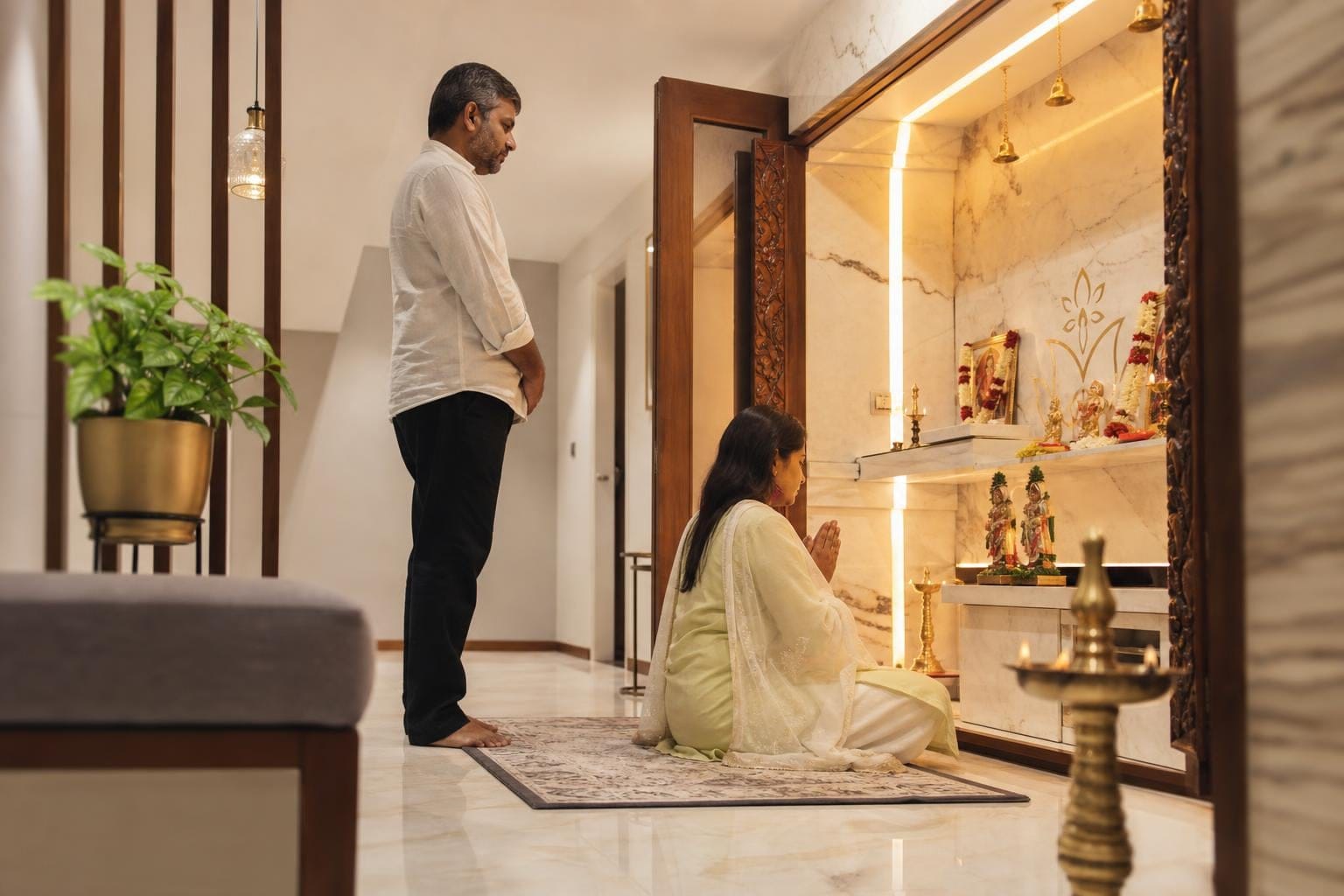
Pooja Room Price in Bangalore 2026: Cost Tiers & Guide
TL;DR
Pooja room prices in Bangalore range from ₹3,000 for a prefab wall-mounted shelf to ₹5,00,000+ for a dedicated room with marble cladding and carved teak doors. The biggest cost driver most people miss is material grade, where the difference between basic MR plywood (₹80/sq ft) and marine-grade BWP plywood (₹250/sq ft) is 3x, and the cheaper option will fail in Bangalore’s monsoon humidity within 2-3 years. For most apartments, a well-designed custom pooja unit lands between ₹25,000 and ₹75,000.
If you’re budgeting for interiors in a Bangalore apartment or villa, the pooja room is one of those line items that catches people off guard. It seems simple, a small sacred corner, but the price range is enormous. A basic cabinet from an e-commerce site might cost ₹9,999. A dedicated pooja room with Makrana marble and hand-carved teak doors can push past ₹5 lakhs.
This guide breaks down every factor that determines pooja room price in Bangalore: the tiers, the materials, the components, the hidden costs, and the Bangalore-specific considerations that national guides consistently ignore.
Planning your full home interior? Our interior design cost guide covers room-by-room budgets for Bangalore apartments.
Quick Reference: Pooja Room Price Tiers in Bangalore
Before getting into details, here’s the summary table. Find your tier, then read the relevant sections below.
| Tier | Price Range | What You Get |
|---|---|---|
| Readymade / Prefab | ₹3,000 – ₹10,000 | Pre-assembled wall-mounted cabinet in engineered wood |
| Budget Custom | ₹18,000 – ₹50,000 | Wall-mounted unit with laminate/plywood finish, basic LED strip |
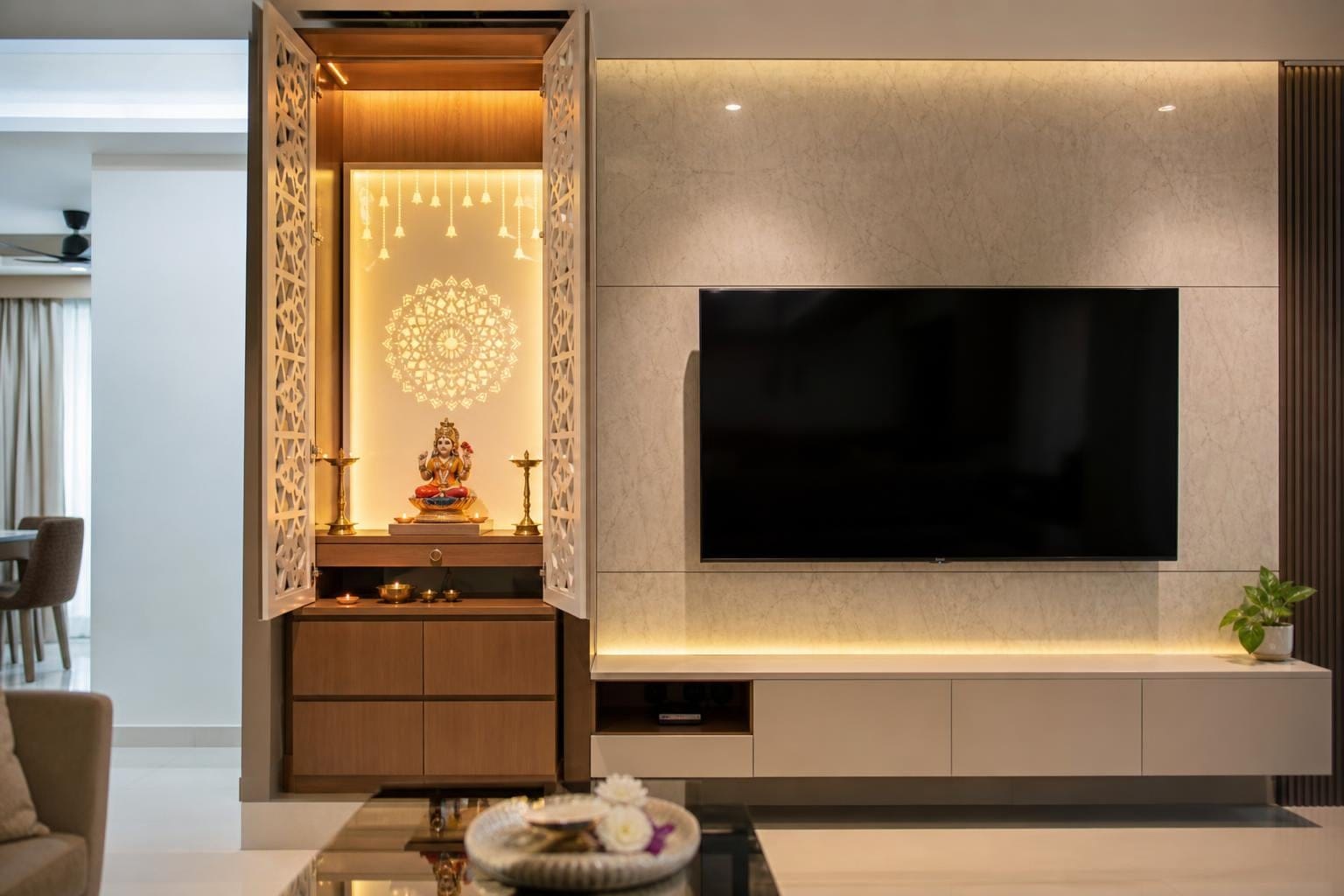
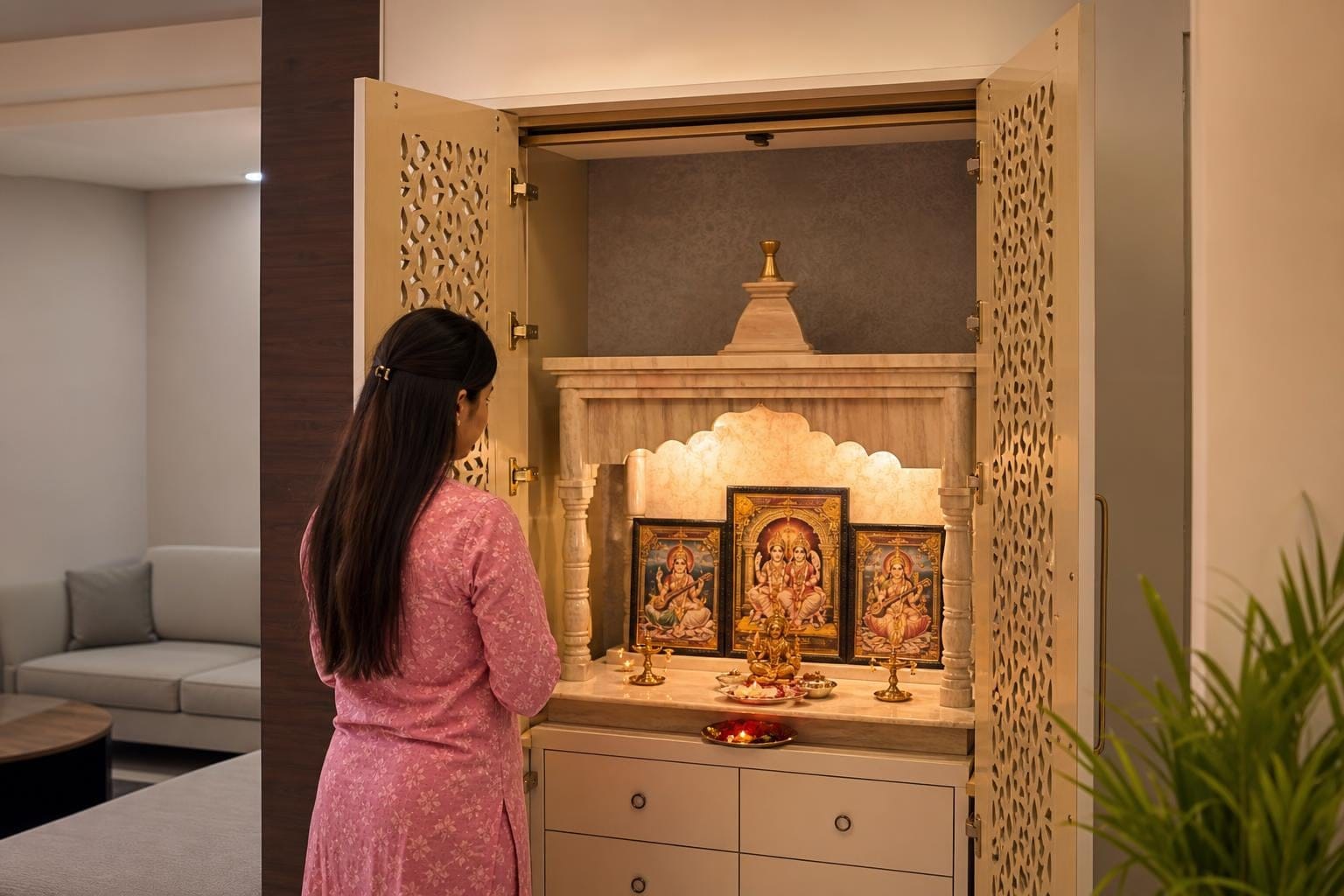
| Mid-Range Custom | ₹50,000 – ₹1,50,000 | Dedicated corner with CNC jali doors, marble platform, storage drawers, integrated lighting |
| Premium / Luxury | ₹1,50,000 – ₹5,00,000+ | Standalone room with solid wood carving, marble cladding, backlit panels, brass detailing |
Glossary Section A: Price Tiers Defined
Readymade / Prefab Pooja Unit (₹3,000 – ₹10,000)
A pre-assembled temple cabinet, typically engineered wood with a walnut or honey finish, shipped flat-packed or ready-to-install. WoodenStreet, for example, offers home temples in Bangalore starting at ₹9,999 for a basic engineered wood model, going up to ₹59,999 for sheesham wood with cane and fluted glass doors.
Best for: Renters, temporary setups, or anyone who needs portability. These units mount on a wall or sit on a shelf. No carpenter needed.
Limitations: Limited customization. The materials won’t hold up to heavy ritual use (milk/water offerings, daily incense) without additional protection.
Budget Custom Pooja Room (₹18,000 – ₹50,000)
This is where most Bangalore apartment owners start. A wall-mounted pooja cupboard that takes up no floor space can be built for around ₹22,000. A bamboo screen design with a simple niche runs about ₹18,000. Add storage compartments and a laminate finish, and you’re looking at ₹30,000 to ₹50,000.
Livspace’s starting price for pooja units in June 2026 sits at approximately ₹18,000–₹22,000 for basic models with storage, while mid-range options reach ₹30,000–₹50,000.
Best for: 2BHK apartments where floor space is tight. A compact pooja setup fits within 2×3 feet.
What’s included: Plywood or MDF carcass, laminate finish, one or two shelves, basic LED warm light, simple shutter (usually hinged or folding).
Mid-Range Custom Pooja Room (₹50,000 – ₹1,50,000)
This is the sweet spot for Bangalore homeowners who want something that looks intentional and crafted. A traditional pooja room with an intricate door design costs around ₹50,000. At the higher end, you get CNC jali doors, a marble base platform, storage drawers for pooja items, and a properly designed lighting system.
Best for: 3BHK apartments and independent houses where the pooja area gets a dedicated corner or alcove, typically 3×4 feet or larger.
What’s included: BWR or BWP plywood carcass, veneer or PU paint finish, CNC-cut jali panels, marble or granite platform, warm LED lighting (2700–3000K), and installation.
Premium / Luxury Pooja Room (₹1,50,000 – ₹5,00,000+)
At this level, you’re building a dedicated room or an elaborate installation that serves as an architectural feature. Think full marble cladding, hand-carved teak doors, backlit onyx or resin panels, brass accents, and custom-designed storage for specific ritual items.
Large floor-standing mandirs alone start from ₹2,00,000 and climb significantly from there. In Bangalore, fully customized designs including lighting, storage, and high-end finishes regularly cost upwards of ₹1.5–2 lakhs, with premium projects crossing ₹5 lakhs.
Best for: Villas, 4BHK apartments, and families where daily worship is central to household life. A full pooja room should be at least 5×7 feet according to Vastu principles, so two or three people can worship comfortably.
What’s included: Solid teak or rosewood frame, marble wall cladding, carved jali doors, dedicated electrical circuit for lighting, sometimes a small ventilation system, brass or copper fixtures, and professional installation.
For a detailed look at how pooja room budgets fit into full-home interior costs, especially alongside kitchens and wardrobes, that guide has room-by-room breakdowns.
Glossary Section B: Material & Grade Terms (With Per-Sq-Ft Costs)
Material selection is the single biggest hidden cost driver in pooja room pricing. The difference between the cheapest and most expensive option for the same design can be 5x or more. And in Bangalore’s climate, choosing the wrong material isn’t just a cost issue, it’s a durability disaster.
BWP (Boiling Water Proof) Plywood
Cost: ₹150–₹250 per sq ft
BWP plywood meets the IS 710 marine-grade standard. It’s the right choice for any pooja unit near a window, attached to a kitchen wall, or in a home without year-round air conditioning. Bangalore’s monsoon humidity (70–90% RH) causes moisture to penetrate plywood edges, leading to swelling and delamination. BWP adhesive handles this.
One critical point from Bangalore interior practitioners: “premium ply” means nothing on a quote. “Century Sainik 16mm BWP” means something. Always demand brand-level specs in writing. This protects you from grade substitutions, which are common.
To understand why BWP plywood matters, especially in wet-adjacent areas, that deep dive covers the technical differences.
BWR (Boiling Water Resistant) Plywood
Cost: ₹85–₹140 per sq ft
A step below BWP. Suitable for pooja rooms that are fully interior with no moisture exposure. One thing national guides miss: BWR plywood prices run 10–20% higher in South India compared to North Indian markets.
MR (Moisture Resistant) Plywood
Cost: ₹80–₹120 per sq ft
Interior-only grade. Not all “plywood” is waterproof. MR grade fails in humidity. If your pooja room is near an open window or shares a wall with a bathroom, MR plywood will show damage within 2–3 years in Bangalore conditions.
MDF (Medium Density Fibreboard)
Cost: ₹90–₹450 per sq ft (varies widely by thickness and finish)
MDF gives a perfectly smooth surface for laminate finishes and is the most budget-friendly option for CNC jali patterns. Choose MDF only if the space is fully air-conditioned and dry. Avoid MDF if the pooja room is near a kitchen, bathroom, or receives direct airflow from windows during monsoon.
HDHMR (High Density High Moisture Resistant)
Cost: Positioned between MDF and BWR plywood
Engineered for higher density with better moisture resistance than standard MDF. Products like Action Tesa HDHMR resist termites and handle Bangalore’s humidity swings better. Good for shutter panels where you want the smoothness of MDF with improved durability.
For deeper comparisons between these board types and their hardware, our cabinet materials guide covers everything from plywood grades to hinge specifications.
Solid Wood: Teak, Sheesham, Rosewood, Mango Wood
| Wood | Starting Price | Notes |
|---|---|---|
| Teak | ₹50,000+ for pooja units | Natural oil content resists termites and humidity; stable grain prevents warping |
| Sheesham | ₹25,000+ | Classic choice; good durability at lower cost than teak |
| Rosewood | ₹40,000+ | Beautiful grain; increasingly expensive due to scarcity |
| Mango Wood | ₹15,000+ | Budget-friendly solid wood; requires proper treatment |
Teak, sheesham, and engineered wood all withstand Bangalore’s humidity well. Teak stands out because its natural oil content provides built-in protection against both termites and moisture, and its grain structure remains stable through temperature and humidity changes.
Marble
Cost: ₹2,000–₹8,000+ per sq ft
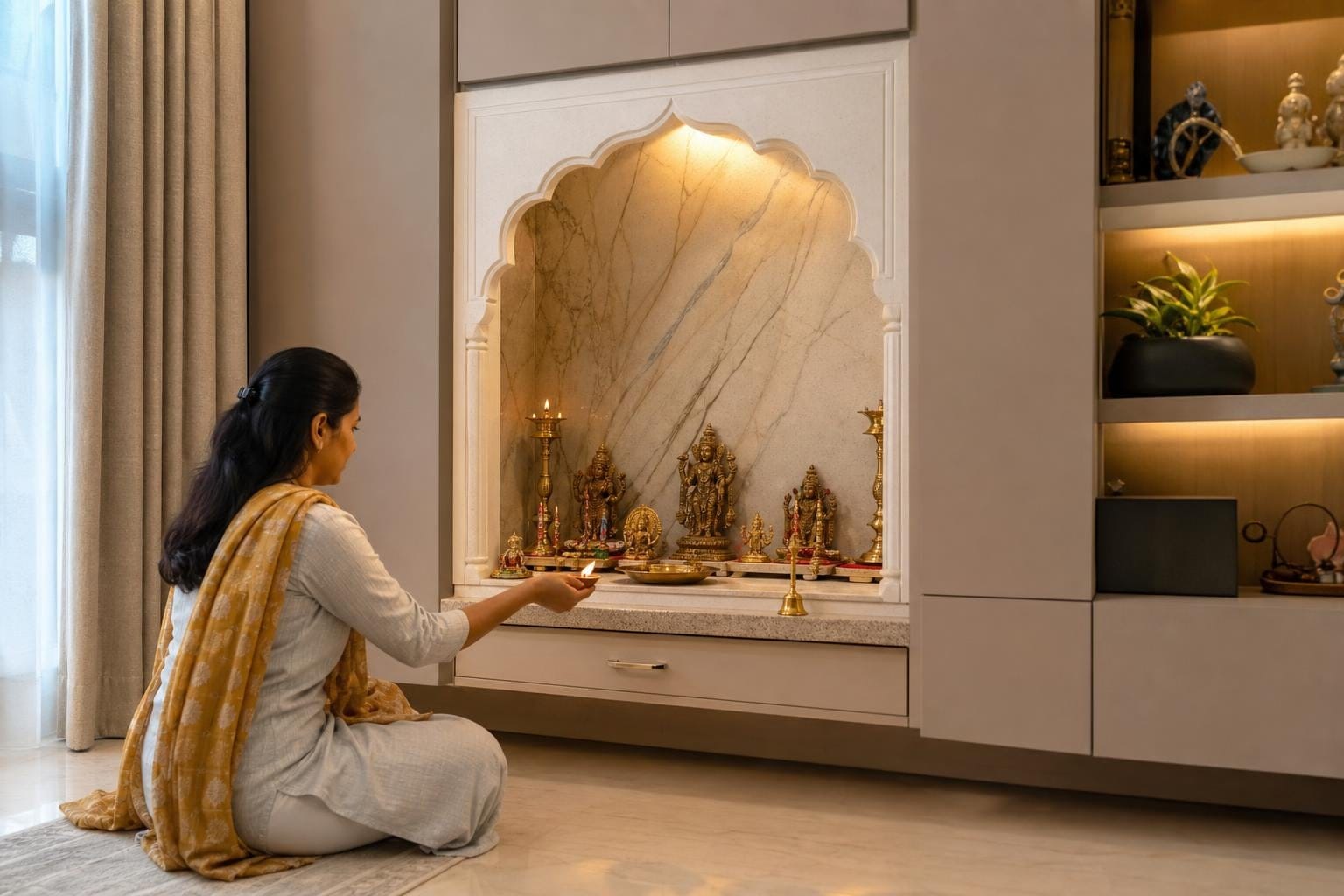
The cost varies enormously by grade. Makrana marble (the premium Indian white) sits at the top. Vietnam White and engineered marble options bring costs down. Carving adds 15–25% to the per-sq-ft price. A basic marble wall unit runs ₹15,000–₹45,000, while full marble pooja room designs can reach into lakhs.
CNC Jali Panels
CNC (Computer Numerical Control) cut lattice panels are one of the most popular design elements for Bangalore pooja rooms. Jali work can be executed on solid wood, marble, MDF, copper, or steel, depending on your design and budget. MDF jali panels start at ₹90 per sq ft, making them the most accessible option.
Laminate Finishes
High-pressure laminates in wood textures offer affordability starting at ₹8,000 for a complete pooja unit surface. For backdrop panels, wall panelling options like fluted and 3D panels are frequently used and add visual depth without the cost of solid wood.
Glossary Section C: Design Format Terms
Wall-Mounted Mandir
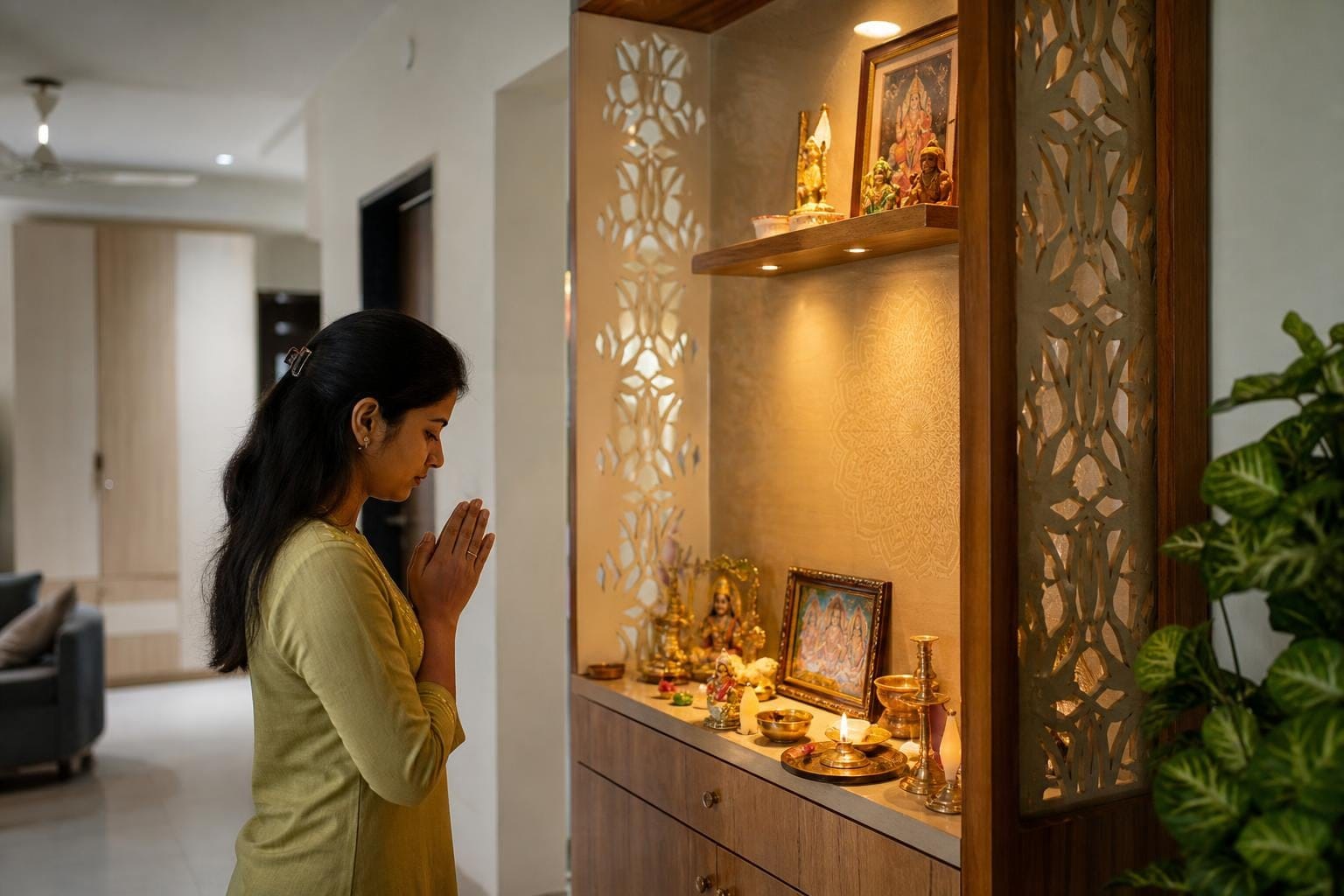
A floating unit fixed to the wall. Takes up zero floor space, making it the default for Bangalore’s 2BHK and 3BHK apartments. In Bangalore, the cost of a wall-mounted mandir starts at ₹25,000. In most apartments, practical solutions include placing a pooja unit along the northeast wall of the living room.
For insights on integrating pooja units into living spaces, the living room design guide covers layout strategies for multi-function rooms.
Freestanding Mandir
A floor-standing temple with a base cabinet. Offers more storage and visual presence than wall-mounted options. Classic sheesham and mango wood freestanding temples start around ₹25,000, while premium teak designs range from ₹50,000 to ₹1,20,000.
Niche / Alcove Unit
Built into an existing wall recess. This is increasingly common in Bangalore apartments where builders provide a pre-cut niche. In one Bangalore apartment, a practitioner described a pooja area built into the living room wall where laser-cut doors allowed warm backlighting to glow through the pattern, a stunning effect that cost less than a standalone room.
Modular Pooja Unit
Factory-made components assembled on-site. Faster delivery (typically 2–3 weeks vs. 4–6 weeks for fully custom). A modular pooja unit can be completed for around ₹30,000. The trade-off is less customization in dimensions and detailing.
Modular pooja units on IndiaMART Bangalore are listed between ₹700 and ₹1,200 per sq ft.
Folding / Portable Mandir
Designed for renters or those who relocate frequently. Pre-assembled wall-mounted pooja cabinets in this category cost ₹3,000–₹10,000 and are easy to disassemble and move.
Dedicated Pooja Room
A fully enclosed room with its own door, lighting, ventilation, and sometimes a small window. This is the premium option and requires a minimum of 5×7 feet per Vastu guidelines. In BTM Layout and similar Bangalore neighborhoods, clients have used sliding frosted glass screens to create privacy for pooja rooms that open into living areas.
The choice between sliding and hinged doors affects both cost and space efficiency. Our sliding vs. hinged door comparison covers the practical differences.
Glossary Section D: Component-Level Costs
This is where budget-conscious homeowners get real clarity. Nobody else breaks these out individually, but knowing each component’s cost helps you prioritize.
Pooja Room Doors
| Door Type | Price Range | Notes |
|---|---|---|
| Teak carved door (32mm) | ₹16,000–₹16,200/piece | Bangalore suppliers list these with bell cutting patterns |
| CNC jali door (add-on) | ₹8,000–₹20,000 | MDF or wood; price depends on pattern complexity |
| Sliding frosted glass | ₹12,000–₹25,000 | Popular in compact apartments |
| Simple laminate shutter | ₹3,000–₹8,000 | Budget option; hinged or bi-fold |
Antique Burma teak doors are listed at ₹16,200 per piece on Bangalore supplier platforms.
Backdrop / Backlit Panel
Backlit panels (using onyx, resin, or acrylic with LED strips behind) are the single most impactful visual upgrade. Budget ₹8,000–₹30,000 depending on material and size. For a detailed look at false ceiling and cove lighting costs, which often integrate with pooja room lighting design, that guide has relevant pricing.
LED Lighting System
Cost: ₹6,000–₹20,000
Quality LEDs, drivers, dimmers, and concealed wiring make up this cost. Warm LEDs (2700–3000K) with high CRI (90+) are recommended because they honor the natural colors of idols and flowers. The Illuminating Engineering Society suggests 150–300 lux for decorative accent lighting, which is the right range for a pooja room.
Marble Platform / Cladding
A marble platform (the base where idols sit) typically costs ₹5,000–₹15,000 depending on size and marble grade. Full wall cladding pushes into ₹30,000–₹80,000+ territory.
Storage Drawers
₹3,000–₹10,000 for a set of pull-out drawers below the main platform. Essential for storing pooja items, incense, camphor, and oil lamps.
Installation & Reinforcement
Cost: ₹3,000–₹8,000
This is critical for wall-mounted marble units. Marble is heavy. Without proper wall reinforcement (anchor bolts, support brackets), you risk a dangerous failure. Never skip this line item.
Glossary Section E: Vastu Compliance Terms
About 60% of Bangalore clients prioritize Vastu when designing their pooja room. It’s not just a preference, it directly impacts cost.
Northeast (Ishaan Kona) Placement
The ideal mandir direction according to Vastu is the northeast corner. East or north directions are also considered auspicious. This requirement sometimes forces layout changes in apartments where the northeast corner is occupied by a bathroom or balcony, compounding the expense.
Minimum Dimensions
A pooja room should be at least 5×7 feet per Vastu guidelines to accommodate two or three people during worship. For wall-mounted units in compact apartments, a 2×3 foot space works but won’t meet strict Vastu dimensions.
Placement Restrictions
Avoid placing pooja units near bathrooms, under staircases, or facing south. In many Bangalore apartments, these constraints eliminate the most convenient locations and push the pooja unit to a less obvious spot, sometimes requiring additional construction.
Cost Impact of Vastu Compliance
Vastu compliance adds 5–15% to the overall pooja room cost. This premium comes from layout adjustments, possible plumbing or electrical rerouting, and sometimes the need to create a new niche in a specific wall. No competing guide quantifies this, but it’s a real budget factor.
For a comprehensive look at Vastu guidelines for interiors, including room-by-room placement rules, that resource covers the full picture.
Glossary Section F: Hidden Cost Terms
These are the costs that don’t appear in the initial quote but show up during or after the project.
GST (18%)
Most pooja room quotes exclude GST. An ₹80,000 quote becomes ₹94,400 after tax. Always confirm whether the quoted price is inclusive or exclusive of 18% GST before signing.
Electrical Work
If your pooja niche doesn’t already have a power point, running a new electrical line for LED lighting costs ₹2,000–₹5,000 depending on the distance from the nearest junction box.
Marble Sealing
Marble is porous. Pooja units endure spills from milk and holy water offerings, incense ash, and oil from lamps. Without proper sealing (₹1,500–₹4,000 initially, then re-application every 1–2 years), stains become permanent. The Natural Stone Institute recommends pH-neutral cleaners, soft cloths, and prompt wipe-downs of oil and ash.
Material Grade Substitutions
This is the most common issue in Bangalore interior projects. A quote says “premium ply” but doesn’t specify the ISI grade or brand. During execution, a lower grade gets used. The difference between MR and BWP plywood is invisible to the eye but catastrophic for longevity.
Always get the exact brand, grade, and ISI standard in writing. “Century Club Prime BWP IS 710” is a specification. “Best quality marine ply” is marketing.
Understanding interior design warranties and what they actually cover protects you from these substitution risks.
Maintenance Costs (Ongoing)
Dust weekly with microfiber. Avoid harsh chemical cleaners. During Bangalore’s monsoon months, drop camphor tablets or silica gel packets in storage drawers to absorb excess moisture. If you have a marble pooja room, consider running a small dehumidifier during peak humidity months (July–September).
Bangalore-Specific Factors That Affect Pooja Room Price
Monsoon Humidity
This is the most under-covered angle in every national guide. Bangalore’s monsoon humidity hits 70–90% RH, and that moisture reaches pooja shelves through open windows, attached kitchen ventilation, and even wall seepage in older buildings.
The practical impact: MR plywood and standard MDF will swell, warp, or delaminate. BWP plywood and solid teak are the safe choices. This isn’t optional. It’s structural.
Apartment Constraints
Most Bangalore apartments (Whitefield, HSR Layout, JP Nagar, Koramangala, Electronic City) don’t have a pre-designated pooja room. The builder might provide a small niche, but more often you’re carving out space from the living room or a passage. A dedicated niche or wall unit replaces the closed room concept. A quiet corner away from heavy foot traffic works best.
South India Price Premium
BWR plywood costs 10–20% more in South India compared to North Indian markets. This is a supply chain reality that affects every Bangalore project. Factor it into any budget you calculate using national average prices.
How to Budget Your Pooja Room in Bangalore
A practical framework:
As a percentage of total interior budget: Pooja rooms typically account for 3–5% of a full-home interior project. For a 3BHK with a ₹25 lakh interior budget, that’s ₹75,000–₹1,25,000 for the pooja room.
By apartment type:
- 2BHK: Wall-mounted unit, ₹20,000–₹50,000
- 3BHK: Dedicated corner or niche, ₹50,000–₹1,50,000
- Villa / 4BHK: Dedicated room, ₹1,50,000–₹5,00,000+
Budget allocation within the pooja room:
- Carcass and structure: 35–40%
- Doors and jali work: 20–25%
- Lighting: 10–15%
- Platform and cladding: 15–20%
- Installation and electrical: 5–10%
If you’re planning a full home interior in Bangalore and want every room budgeted with the same level of detail, from modular kitchen costs to bedroom wardrobes, working with a studio that provides transparent specs and documented BOQs makes a measurable difference.
Explore the complete pooja room design guide for design inspiration and layout ideas tailored to Bangalore homes.
Frequently Asked Questions
What is the cheapest way to build a pooja room in Bangalore?
A pre-assembled wall-mounted pooja cabinet costs ₹3,000–₹10,000 and needs no carpenter. For a slightly better finish, a budget custom wall unit with laminate and basic LED lighting runs ₹18,000–₹22,000. High-pressure laminates in wood textures bring finished costs down to ₹8,000 for a basic surface.
How much does a marble pooja room cost in Bangalore?
A basic marble wall unit costs ₹15,000–₹45,000. Adding carved jali doors pushes it to ₹25,000–₹65,000. Full marble cladding for a dedicated pooja room ranges from ₹1,00,000 to ₹3,00,000+ depending on marble grade. Makrana marble sits at the top end (₹6,000–₹8,000+ per sq ft), while Vietnam White and engineered marble options cost significantly less.
What material is best for pooja rooms in Bangalore’s humidity?
BWP (marine-grade) plywood and solid teak are the safest choices. BWP meets the IS 710 standard and handles monsoon moisture without delamination. Teak’s natural oil content protects against both termites and humidity. Avoid standard MDF and MR plywood in any pooja room that’s near a window or kitchen.
Does Vastu compliance increase pooja room cost?
Yes, by approximately 5–15%. The northeast placement requirement sometimes forces layout changes, electrical rerouting, or new wall construction. About 60% of Bangalore clients prioritize Vastu, making this a standard consideration rather than an exception.
Custom vs. readymade pooja unit: which saves more?
Readymade saves money upfront (₹3,000–₹60,000 range) and delivers faster. Custom costs more (₹18,000–₹5,00,000+) but fits your exact space, uses humidity-appropriate materials, and can integrate lighting and storage precisely. “Custom” doesn’t always mean expensive. A ₹30,000 modular pooja unit with laminate finish can look beautiful. The premium comes from material grade, carving complexity, and lighting, not from the custom vs. readymade choice itself.
How long does it take to build a custom pooja room in Bangalore?
Modular units take 2–3 weeks. Fully custom pooja rooms with marble work and carved doors take 4–8 weeks. Add 1–2 weeks if marble is being sourced from Rajasthan (Makrana) rather than local suppliers.
What should I verify in a pooja room quote before signing?
Three things. First, material specs: exact brand, grade, and ISI standard for every board and sheet (not vague terms like “premium ply”). Second, GST inclusion: confirm whether the 18% tax is inside or outside the quoted number. Third, installation and reinforcement charges, especially for wall-mounted marble units where structural support is a safety issue.
How do I maintain a pooja room in Bangalore’s climate?
Dust weekly with a dry microfiber cloth. For marble surfaces, use pH-neutral cleaners and wipe up oil, milk, or ash immediately. During monsoon months (July–September), place camphor tablets or silica gel packets in drawers. If you have a dedicated pooja room with marble, a small dehumidifier prevents long-term moisture damage.