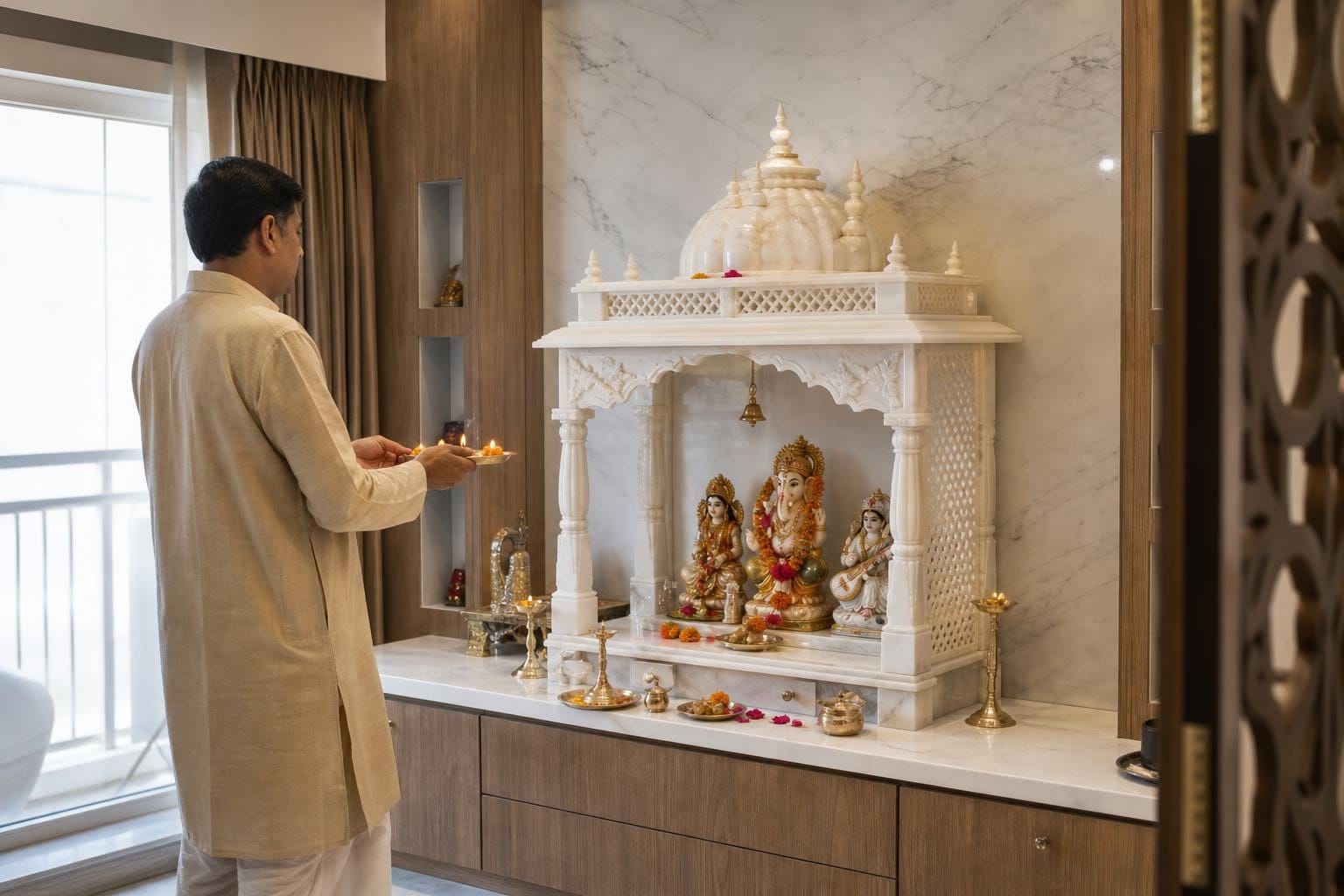
Marble Design for Pooja Room: 13 Ideas, Costs & Vastu 2026
TL;DR
Marble remains the most revered material for pooja rooms in Indian homes, offering timeless beauty and strong Vastu compliance. This guide covers 13 marble pooja room designs (from ₹15,000 wall-mounted units to ₹3L+ temple-style rooms), compares Makrana, Italian, and Vietnam marble with honest pricing, explains when Corian or wood might serve you better, and includes a maintenance protocol tailored for daily rituals with kumkum, haldi, and diyas. If you’re in Bangalore, there’s a dedicated section on monsoon humidity and apartment wall-load considerations that no other guide covers.
Planning your pooja room design? Our pooja room design guide covers layout, placement, and style decisions in detail.
At-a-Glance: 13 Marble Pooja Room Designs Compared
| # | Design Type | Best For | Price Range (INR) | Recommended Marble | Vastu Fit |
|---|---|---|---|---|---|
| 1 | Classic White Makrana | Traditional families, villas | ₹1L–3L+ | Makrana White | Excellent |
| 2 | Backlit Marble Wall Panel | Modern apartments, statement walls | ₹80K–2L+ | Carrara / Onyx | Excellent |
| 3 | Marble Jali Lattice Backdrop | Semi-open rooms, ventilation | ₹70K–1.8L | Makrana / Ambaji | Excellent |
| 4 | Wall-Mounted Compact Mandir | 2BHK apartments, corridors | ₹15K–45K | Vietnam White / P White | Good |
| 5 | Marble + Wood Hybrid | Compact spaces, warm interiors | ₹65K–1.2L | Banswara / Ambaji | Excellent |
| 6 | Temple-Style with Pillars & Dome | Villas, luxury apartments | ₹1.5L–4L+ | Makrana White | Excellent |
| 7 | Marble Flooring + Accent Backdrop | Budget-conscious homeowners | ₹25K–60K | Dungri / P White | Good |
| 8 | Semi-Precious Stone Inlay | Luxury villas, statement rooms | ₹1.5L–5L+ | Makrana / Statuario | Excellent |
| 9 | Coloured/Tinted Marble | Warm interior palettes | ₹60K–1.5L | Onyx / Green marble | Good |
| 10 | Marble with Integrated Storage | Families with daily rituals | ₹70K–1.5L | Vietnam White / Ambaji | Good |
| 11 | Corner Marble Mandir | Open-plan living, small apartments | ₹30K–80K | P White / Vietnam | Good |
| 12 | Marble + Fluted Panel Contemporary | Contemporary apartments | ₹50K–1.2L | Banswara / Carrara | Good |
| 13 | Marble + Glass Fusion | Modern aesthetic, open layouts | ₹60K–1.5L | Statuario / Carrara | Good |
How to Choose the Right Marble for Your Pooja Room
Before picking a design, you need to pick the right stone. This is where most homeowners get stuck, and for good reason. Indian marble prices in 2026 range from ₹40 to ₹500+ per square foot, and Italian imports can push past ₹800 per square foot. The price gap between a Dungri marble slab and a Calacatta slab is enormous, and the difference isn’t always visible to an untrained eye.
Here’s how the main options stack up:
Makrana White Marble is widely considered the best choice for pooja rooms. It’s the same stone used in the Taj Mahal. Known for supreme purity, exceptional durability, and a warm white tone that deepens gracefully with age. Expect ₹150–400 per sq ft. If tradition and Vastu compliance matter most, this is the default recommendation.
Italian Marble (Carrara, Statuario, Calacatta) brings dramatic grey veining and a cooler white base. Pricing runs ₹200–800+ per sq ft. It’s stunning for backlit panels and contemporary designs, but its porosity demands careful sealing, especially in homes where daily rituals involve turmeric and oil.
Vietnam White Marble is gaining popularity for its bright tone and uniform texture. It serves as a more affordable alternative to Makrana, working well in contemporary interiors where you want consistent colour without the natural variation of Indian stone. Mid-range pricing makes it appealing for apartment mandirs.
Budget Indian Marble (Dungri, P White) starts at ₹40–80 per sq ft, making it accessible for accent applications. The veining is less refined, and the surface may require more frequent sealing, but for a marble flooring or countertop accent, it works well.
Polished vs. Honed: A Practical Choice
Most people default to polished marble for the mirror-like shine. But for a pooja room that sees daily use, honed finishes show fewer fingerprints than polished surfaces and hide minor scratches better. The tradeoff is a slightly more matte look. For a mandir that gets touched, wiped, and lived in every day, honed is often the smarter choice. Edge profiling with an eased or half-bullnose treatment also protects against chips, particularly on the altar ledge.
13 Marble Design Ideas for Pooja Room
1. Classic White Makrana Marble Pooja Room
Best for: Traditional families with dedicated pooja rooms in villas or large apartments.
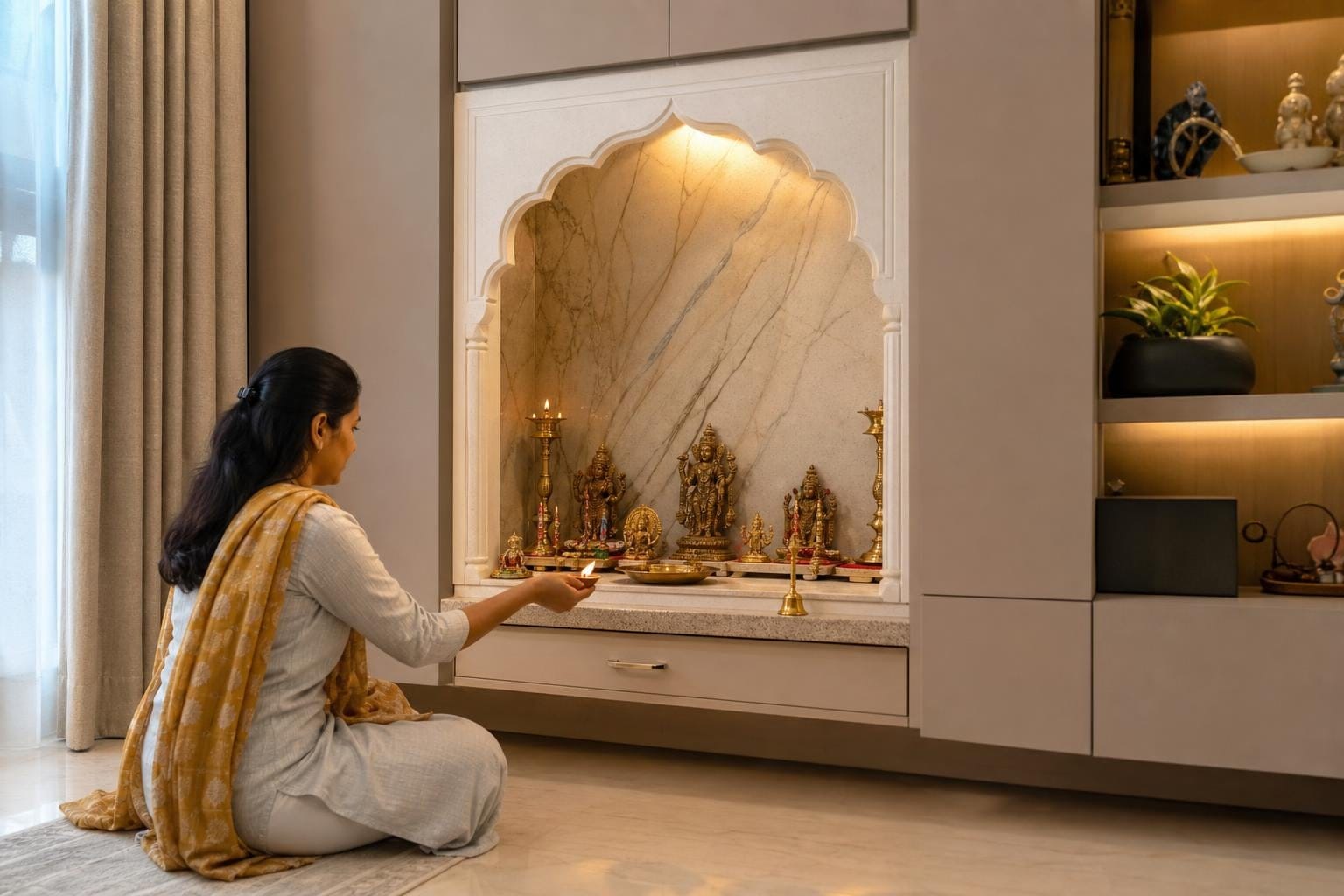
This is the gold standard. Clean lines, smooth surfaces, and the natural warmth of Makrana white marble create a serene ambience that feels timeless rather than trendy. The design typically involves full marble cladding on three walls, a raised marble platform for deities, and a simple carved arch or header above.
- Price range: ₹1L–3L+ for full room treatment, depending on carving complexity and slab grade
- Marble type: Makrana White (₹150–400/sq ft)
- Vastu fit: Excellent. White marble is considered the most auspicious choice per Vastu Shastra
Pro tip: For a 3–5 ft tall freestanding marble mandir, budget ₹60,000–₹1,80,000 depending on carving detail and hardware. A Pune-based manufacturer notes that Makrana remains the top request for “pure white brilliance” in temple-style units.
Tradeoffs: Heavy (needs proper floor support), requires professional installation, and higher cost than all alternatives. Unsuitable for wall mounting without structural reinforcement.
2. Backlit Marble Wall Panel
Best for: Modern apartments seeking a statement wall that doubles as a spiritual focal point.
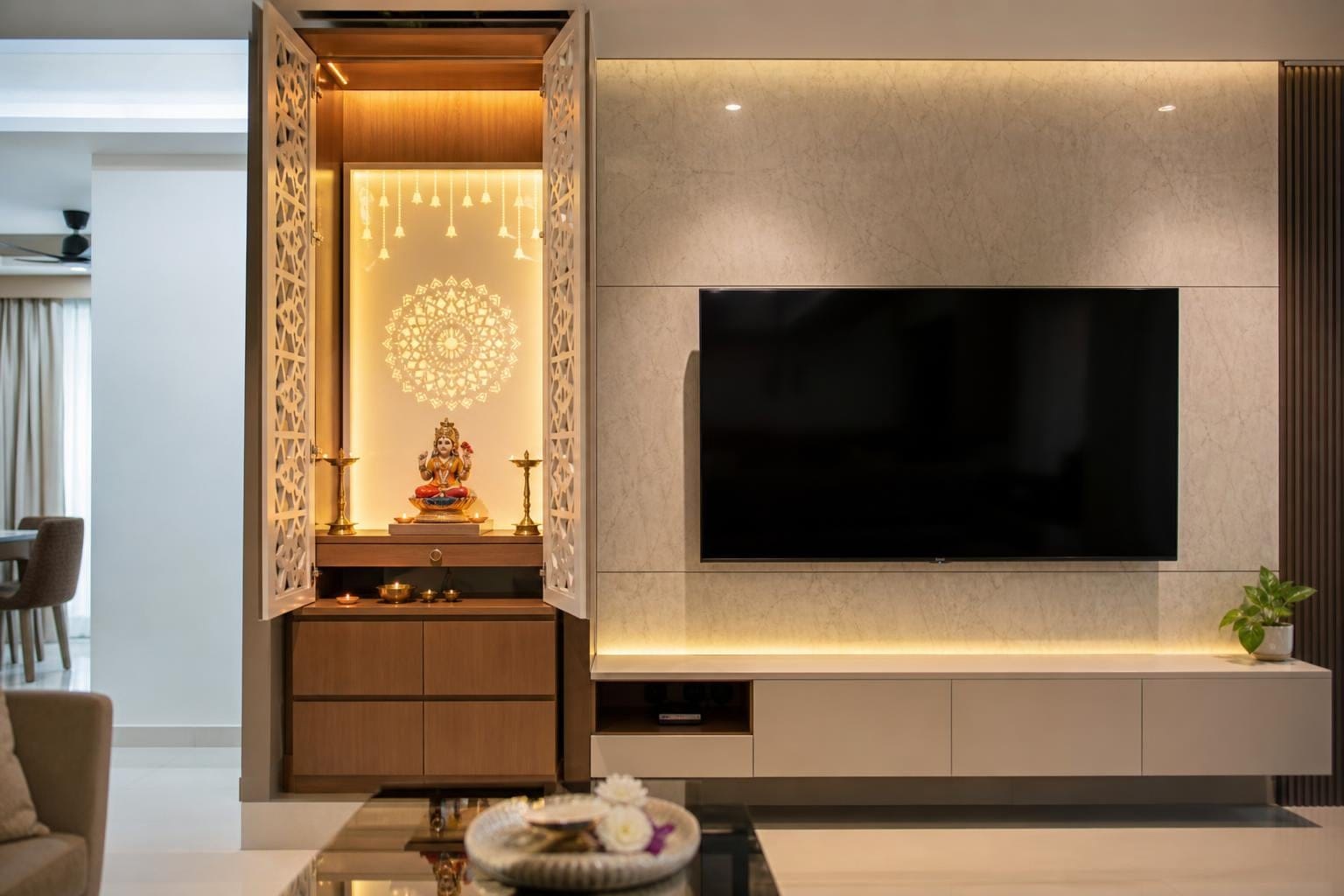
This is the design trend defining 2026. A thin marble panel (or translucent onyx/alabaster) is mounted slightly off the wall with LED strip lights behind it. The result is a divine halo effect that makes the entire wall glow. Backlit onyx or alabaster panels cost ₹3,500–12,000 per sq ft for the panel alone, plus ₹4,000–15,000 for quality LEDs and drivers.
- Price range: ₹80K–2L+ (panel, LEDs, installation). Expect a total uplift of ₹25,000–60,000 on average niches.
- Marble type: Carrara, Onyx, or Alabaster (only certain stones are translucent enough for backlighting)
- Vastu fit: Excellent when using white or cream tones
Pro tip: Warm white LEDs in the 2700–3000K range feel most devotional and flattering against white marble. Combine a 2700K linear under-shelf light with a small 3000K focus downlight above the deity to layer glow and clarity. Our guide on lighting in interior design covers layered lighting principles in detail.
Tradeoffs: Limited to specific stone types. Onyx is fragile and expensive. LED drivers need periodic replacement (every 5–7 years). Electrical work adds to installation complexity.
3. Marble Jali (Lattice) Panel Backdrop
Best for: Semi-open pooja rooms where ventilation and visual connectivity matter.
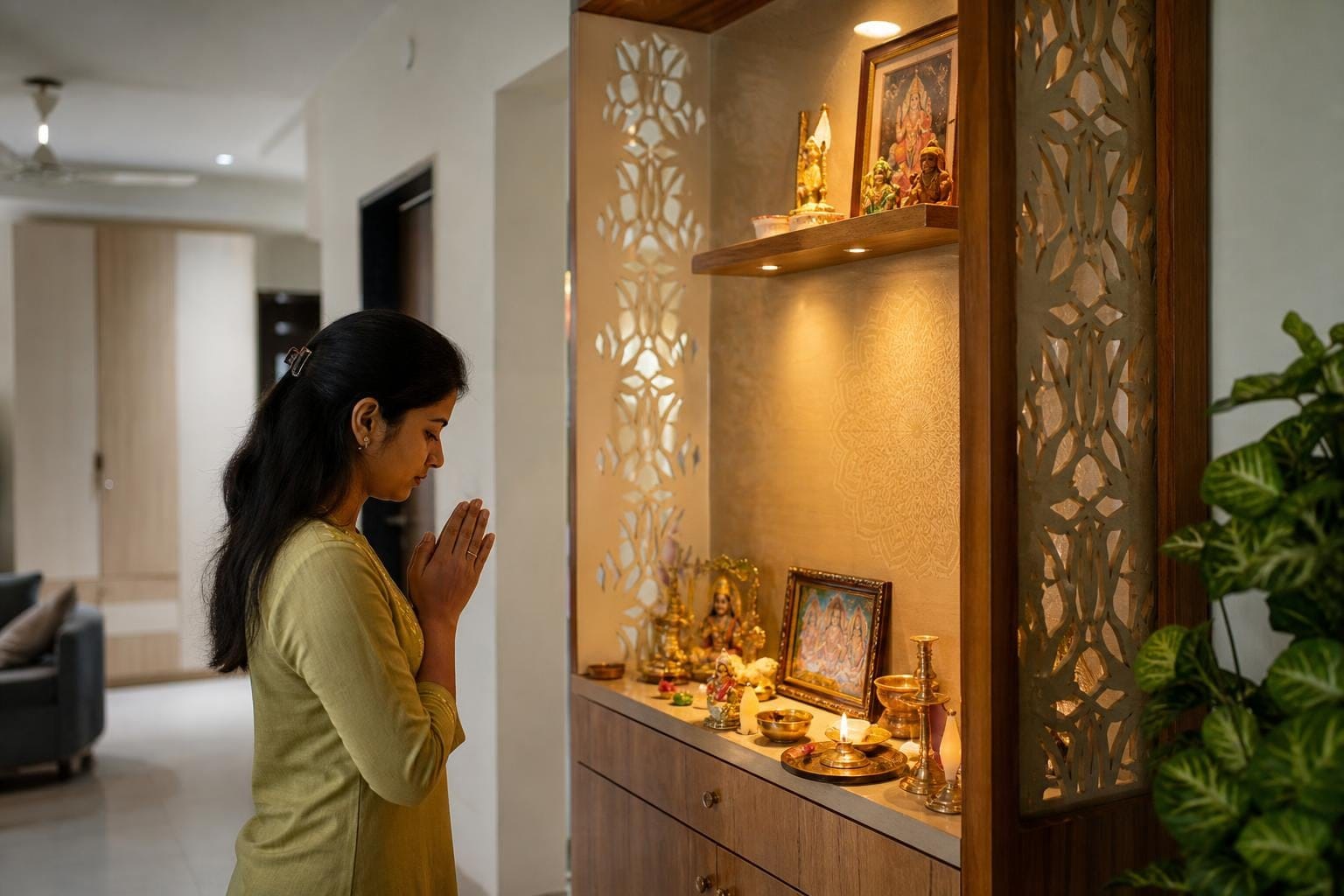
The jali mandir style brings classic Indian craftsmanship into modern homes. Intricate marble lattice panels create a captivating play of light and shadow. Each panel can showcase patterns inspired by nature, geometry, or mythology. When placed against a window or with lighting behind it, the jali becomes a living artwork that shifts throughout the day.
- Price range: ₹70K–1.8L depending on panel size and carving intricacy
- Marble type: Makrana or Ambaji (both carve well)
- Vastu fit: Excellent. Jali panels allow air and light flow, which aligns with Vastu principles for pooja spaces
Pro tip: Carved jali doors alone add ₹8,000–20,000 to any mandir design. Consider combining jali side panels with a solid marble back wall for the best of both worlds: airflow plus a clean backdrop for deity display.
Tradeoffs: Intricate carving is labour-intensive and fragile. Dust accumulates in lattice gaps, requiring careful cleaning. Transport and installation demand experienced stone workers.
4. Wall-Mounted Compact Marble Mandir
Best for: 2BHK apartments, corridor niches, and homes where floor space is precious.
For homes with limited space, a wall-mounted marble pooja mandir is the most practical option. These units save floor space, look elegant, and fit beautifully into modern apartment corridors or living room niches. They can be customised with carvings, small shelves for accessories, and a lipped ledge to prevent items from sliding off.
- Price range: ₹15,000–45,000 for a basic wall-mounted unit
- Marble type: Vietnam White or P White (lighter weight is crucial here)
- Vastu fit: Good, provided the wall faces east or northeast
Pro tip: This is where marble’s weight becomes a genuine concern. Standard partition walls in Bangalore apartments are 4-inch brick or sometimes just gypsum. A full marble slab can weigh 15–25 kg per square foot. Always get a structural assessment before mounting. Using 12–18mm marble panels instead of full slabs reduces weight significantly while maintaining the look.
Tradeoffs: Weight limitations restrict design options. Cannot accommodate large idols. Needs proper wall anchoring (toggle bolts or chemical anchors into concrete, never just drywall screws).
5. Marble + Wood Hybrid Design
Best for: Compact spaces where you want warmth and tradition without an all-marble price tag.
This design combines the richness of wood framing with refined marble accents. A typical setup features a wooden cabinet structure (teak or sheesham) with a marble platform, marble back panel, and possibly a backlit marble inlay showing an Om symbol or lotus motif. The wood offers traditional appeal while the marble introduces a sense of permanence.
- Price range: ₹65,000–₹1.2L depending on timber species, joinery complexity, and stone grade
- Marble type: Banswara or Ambaji (mid-range, pairs well with warm wood tones)
- Vastu fit: Excellent. Both rosewood and marble are considered auspicious per Vastu Shastra
Pro tip: Use soft-close hardware on wooden doors and drawers. The noise of a slamming cabinet door breaks the meditative atmosphere of a pooja space. Commercial-grade hinges from brands like Hettich or Blum make a real difference in daily use. If you’re curious about what BWP-grade plywood means and why it matters for the wooden components, that guide covers it.
Tradeoffs: Wood requires termite treatment (especially in Bangalore’s climate). The two materials expand and contract at different rates, so joinery at wood-marble junctions needs careful engineering. Maintenance is split between two different care routines.
6. Temple-Style Marble Pooja Room with Pillars and Dome
Best for: Villas, luxury apartments with dedicated pooja rooms, and families who want a full temple experience at home.
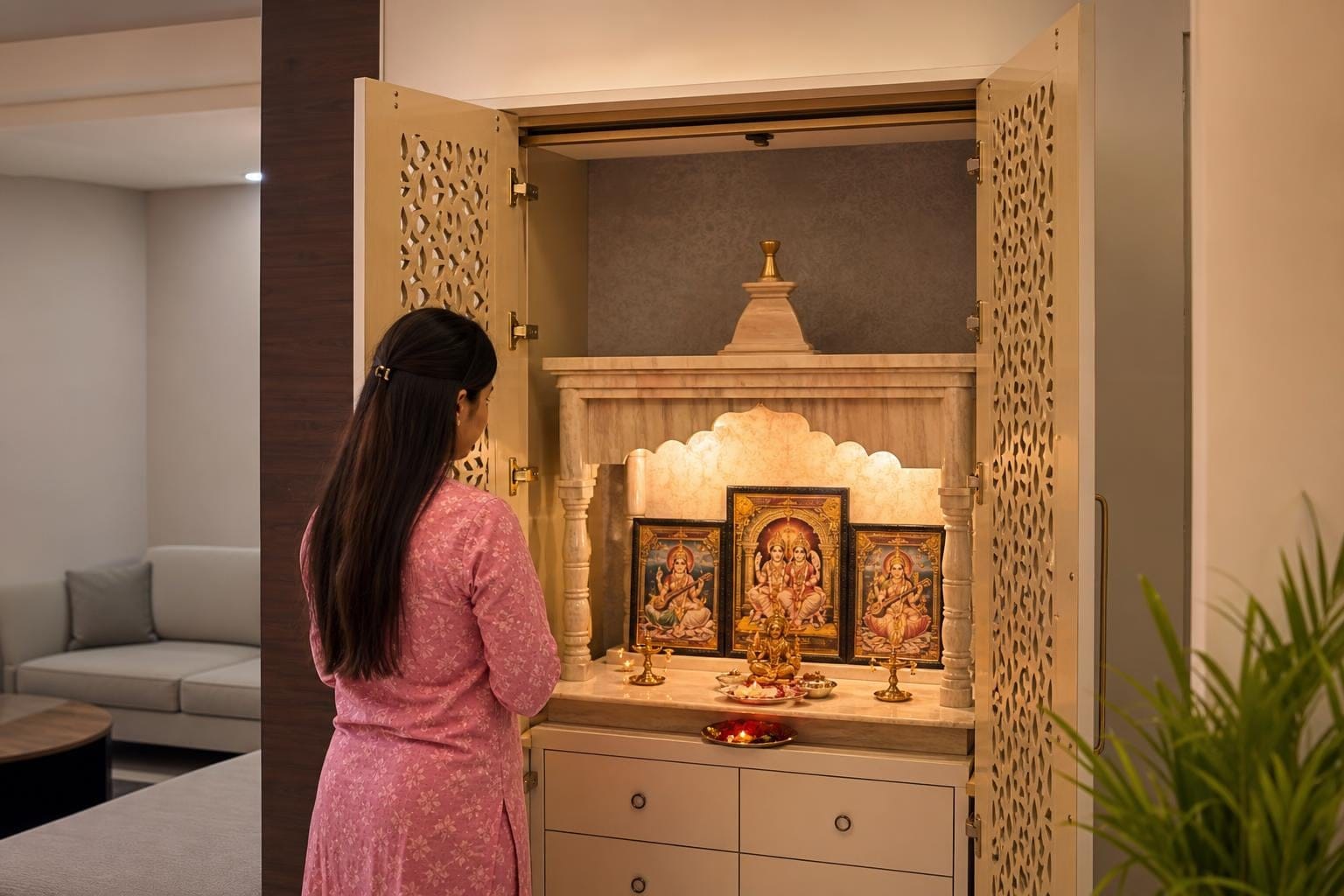
This is the most elaborate marble design for a pooja room. Think carved pillars flanking the entrance, an ornamental dome or shikhara above, intricate floral or paisley motifs across the façade, and a stepped marble platform inside. The effect is walking into a miniature temple. These designs showcase traditional craftsmanship at its finest.
- Price range: ₹1.5L–4L+ (with custom carving, the upper range is essentially unlimited)
- Marble type: Makrana White (the only credible choice for this level of work)
- Vastu fit: Excellent. Every classical element, pillars, dome, raised platform, aligns with traditional Vastu prescriptions
Pro tip: If the room permits it, a false ceiling with cove lighting above the marble dome amplifies the temple atmosphere dramatically. The cove wash on carved stone creates depth that overhead spot lights cannot replicate.
Tradeoffs: Requires a dedicated room (minimum 8×8 ft is recommended by Vastu). Extremely heavy, needs ground-floor or structurally verified placement. Installation takes 3–6 weeks depending on carving complexity. This is a heirloom investment, not something you redesign every few years.
7. Marble Flooring + Accent Backdrop (Budget-Smart)
Best for: Budget-conscious homeowners who want the feel of marble without a full marble mandir.
If your budget doesn’t allow a complete marble overhaul, this approach makes the most of limited funds. Use affordable marble (Dungri or P White at ₹40–80/sq ft) for the pooja room floor, then add a single marble slab as the backdrop behind the deities. Pair this with a painted wall above and a simple wooden or metal shelf, and you have a pooja room that reads as marble at a fraction of the cost.
- Price range: ₹25K–60K (marble flooring + single accent panel)
- Marble type: Dungri or P White for flooring; a slightly better grade for the accent slab
- Vastu fit: Good. White marble flooring in the pooja room is considered extremely auspicious
Pro tip: Invest the savings in proper sealing. A budget marble that’s well-sealed will outlast an expensive marble that’s left unsealed and exposed to ritual spills. The sealing alone can be the difference between a mandir that looks great for decades and one that yellows in two monsoons.
Tradeoffs: The visual impact is more subtle. Budget marble has less consistent veining and may have visible patches. The floor-only approach doesn’t give you the “full marble room” effect that some families want.
8. Marble Mandir with Semi-Precious Stone Inlay
Best for: Luxury villas and homeowners who want their pooja room to be a true artistic centrepiece.
This design borrows from the Pietra Dura tradition (the same technique seen in Mughal-era monuments). Intricate inlays of semi-precious stones, lapis lazuli, malachite, mother of pearl, jasper, are set into white marble to create mesmerizing floral or geometric patterns. The result is a pooja room that’s part spiritual space, part art installation.
- Price range: ₹1.5L–5L+ depending on stone selection and inlay complexity
- Marble type: Makrana or Statuario (white base shows inlay colours best)
- Vastu fit: Excellent, provided the base marble is white or cream
Pro tip: Commission inlay work from artisans in Agra or Rajasthan who specialise in this technique. The skill level varies dramatically, and the quality difference between factory-stamped inlay and hand-set work is immediately visible. Budget 6–10 weeks for custom inlay panels.
Tradeoffs: The highest-cost option on this list. Inlay stones can loosen over time if exposed to temperature swings. Cleaning requires extra care around the inlay borders. Not easily repaired if damaged.
9. Coloured/Tinted Marble Mandir
Best for: Homes with warm interior palettes where stark white marble would feel out of place.
Coloured marble mandirs are an increasingly popular choice in 2026, offering a refreshing alternative to the default white. Shades like beige onyx, soft green (Indian Green marble), and golden honey tones bring warmth and character while maintaining a calm spiritual atmosphere. A beige or cream marble mandir feels particularly inviting in living rooms with earthy colour schemes.
- Price range: ₹60K–1.5L
- Marble type: Onyx (for warm amber), Indian Green (for contrast), Banswara (for soft cream)
- Vastu fit: Good. Light yellow and cream are considered auspicious. Avoid dark shades like black marble, as dark tones are said to absorb light and positive energy
Pro tip: If you choose green or darker marble for accent elements, pair it with a white marble base or platform to maintain Vastu balance. The contrast can be stunning, with green marble pilasters flanking a white marble niche.
Tradeoffs: Coloured marble limits your ability to spot stains early. Onyx is softer and scratches more easily than standard marble. Some coloured varieties are rarer and harder to source in consistent batches.
10. Marble Mandir with Integrated Storage
Best for: Families with daily rituals who need organised access to pooja essentials, books, incense, camphor, extra garlands, and seasonal decorations.
A marble mandir with drawers and closed cabinets below the altar adds beauty and practical utility. The upper section houses the deities on a marble platform, while the lower section (often in matching marble or a marble-fronted wood frame) provides hidden storage. Everything stays neat and accessible without cluttering the sacred space.
- Price range: ₹70K–1.5L
- Marble type: Vietnam White or Ambaji (good balance of cost and appearance)
- Vastu fit: Good. Keep storage below the deity level, never above
Pro tip: Soft-close drawers are essential here. Plan specific compartments: a shallow tray for daily-use items (agarbatti, matchbox, kumkum), a deeper drawer for books, and a cabinet for less-frequently-used items. This level of planning prevents the “everything in one jumbled drawer” problem.
Tradeoffs: Adds weight and depth. The storage section usually requires a wood or plywood substructure clad in marble, so you’re paying for both materials. Deeper units need 18–24 inches of floor depth, which matters in tight apartment layouts.
11. Corner Marble Mandir Design
Best for: Open-plan living rooms, small apartments, and anyone with an underused corner screaming for purpose.
Corners are underused goldmines. A triangular or curved marble top fitted into a corner with a slim lattice screen and brass bells feels intimate and space-smart. The L-shaped footprint uses dead space while granting a surprisingly generous prayer surface. Corners often need less marble cladding area too, which helps control budgets.
- Price range: ₹30K–80K
- Marble type: P White or Vietnam (lighter weight for wall-adjacent placement)
- Vastu fit: Good, especially if the corner falls in the northeast quadrant of the home
Pro tip: A corner mandir works beautifully in open-plan living rooms where a dedicated pooja room isn’t feasible. Add a small pendant light above and the corner becomes a distinct zone without eating into usable floor space.
Tradeoffs: The triangular footprint limits the size of idols you can place. Corner walls sometimes have plumbing or electrical conduits behind them, so verify before drilling. The angled design can be harder to clean in the rear junction.
12. Marble + Fluted Panel Contemporary Design
Best for: Contemporary apartments where texture and depth matter more than ornate carving.
In 2026, texture is trending. A marble altar or back panel paired with fluted wall panels on either side creates a modern pooja unit that respects traditional aesthetics without looking dated. The vertical lines of fluted panels (in wood, PVC, or stone) draw the eye upward, making the space feel taller, while the marble centre holds the spiritual focus.
- Price range: ₹50K–1.2L (marble panel + fluted cladding)
- Marble type: Banswara or Carrara (clean tones that complement panel finishes)
- Vastu fit: Good
Pro tip: Match the fluted panel colour to your overall wall palette and let the marble be the contrasting element. Charcoal-grey fluted panels with a white marble niche create a particularly striking combination for modern interiors.
Tradeoffs: Fluted panels can collect dust in the grooves. The modern aesthetic may feel too “designed” for families who prefer a traditional temple look. PVC panels are affordable but look distinctly different from wood or stone fluting up close.
13. Marble + Glass Fusion
Best for: Modern aesthetic lovers and open pooja spaces that need to feel light and airy.
Glass panels or shelves incorporated inside marble frames create a stunning visual effect while permitting natural light to enter the space. A common execution: a marble back wall with etched glass doors, or a marble platform with tempered glass shelves above for displaying smaller deities and accessories.
- Price range: ₹60K–1.5L
- Marble type: Statuario or Carrara (the cool veining pairs naturally with glass)
- Vastu fit: Good. The transparency of glass supports the open, light-filled quality Vastu encourages
Pro tip: Use toughened (tempered) glass, 8–10mm thick, for all shelves. Frosted glass panels above the marble can serve as a partition between the pooja space and adjacent rooms while still allowing light through.
Tradeoffs: Glass requires frequent cleaning to prevent fingerprint buildup. It amplifies visual clutter (everything on glass shelves is visible). Not ideal for families who prefer enclosed mandirs with doors.
Marble vs. Corian vs. Wood: Which Material Is Right for Your Pooja Room?
This is the question nobody answers honestly, and it deserves a straight answer. Marble is the traditional favourite, but it’s not the best choice for every home.
| Dimension | Natural Marble | Corian (Solid Surface) | Wood |
|---|---|---|---|
| Aesthetic | Royal, natural veining, each slab unique | Sleek, uniform, modern | Warm, carved, ethnic |
| Weight | Very heavy (needs floor/wall reinforcement) | Lightweight (wall-mount friendly) | Medium |
| Stain Resistance | Porous; stains from kumkum/haldi if unsealed | Non-porous, stain-resistant | Absorbs oil if unsealed |
| Maintenance | Seal every 12–18 months, pH-neutral cleaners only | Wipe with damp cloth | Polish regularly, termite treatment |
| Backlighting | Limited (onyx/alabaster only) | Excellent (translucent grades available) | Not suitable |
| Cost Range (unit) | ₹50K–₹3L+ | ₹20K–₹1.5L+ | ₹15K–₹2L+ |
| Vastu Compliance | Highly recommended | Acceptable | Highly recommended |
| Lifespan | Generations (with care) | 30–35 years | Generations (with termite control) |
| Best For | Villas, dedicated rooms, heirloom mandirs | Apartments, modern homes, renters | Traditional interiors |
When Marble Wins
Choose marble if tradition matters most, you have a villa or bungalow with a dedicated pooja room, and you see the mandir as a generational heirloom. The natural veining, the weight, the cool touch of the stone, nothing synthetic replicates this. Marble is also the only material explicitly recommended by multiple Vastu texts alongside rosewood.
When Corian Wins
For modern apartments with daily-use family pooja rooms, Corian is genuinely better on several practical dimensions. It’s stain-resistant, lightweight, and roughly 35–40% cheaper over a 10-year ownership window when you factor in sealing, polishing, and stain removal costs for marble. Minor scratches can be buffed out at home. The surface doesn’t absorb moisture, oil, or incense smoke residue. If you want backlit designs, Corian’s translucent grades outperform marble entirely.
Practitioners on design forums frequently note that clients who switch from marble to Corian in apartments report dramatically lower maintenance frustration, especially in homes where young children help with daily pooja.
When Wood Wins
Wood wins on warmth and carving detail. A sheesham or teak mandir with traditional motifs carries a cultural richness that neither marble nor Corian can match in certain traditional interiors. Wood is also more forgiving during transport and installation. The main enemy is termites, which makes Bangalore’s climate a factor worth considering.
Understanding the full scope of interior design costs helps put these material choices in context with your overall home budget.
Vastu Tips for Marble Pooja Room Design
Vastu compliance is non-negotiable for many Indian families, and marble pooja rooms align well with Vastu principles when designed correctly. Here are the key guidelines:
Direction: The pooja room should ideally be in the northeast (Ishan Kona), which is considered the most sacred direction. East and north are also auspicious. Avoid placing the pooja room in the south direction entirely.
Marble Colour: White or light yellow marble is considered extremely auspicious for pooja rooms. Makrana white is the top recommendation. Light blue and cream are also acceptable. Dark shades like black marble should be avoided for the main structure, as they are believed to absorb light and positive energy.
Idol Placement: Idols should face northeast and be placed at least six inches from the wall. Never place idols directly on the floor; always use a raised marble or wooden platform.
Room Shape and Size: The pooja room should be square or rectangular. A minimum size of 8×8 feet is recommended for a dedicated room.
Doors: Per Vastu, a pooja unit should always have two doors or shutters. This applies to enclosed mandir cabinets as well.
Platform: Use a raised platform in marble or wood. The platform height should be comfortable for sitting prayer (typically 6–9 inches from the floor) or standing access (counter-height at 30–36 inches).
For a comprehensive understanding of how Vastu applies across your entire home, the Vastu for home interiors guide covers room-by-room recommendations.
How to Maintain Your Marble Pooja Room
This is the section most guides skip entirely, and it’s the one that matters most after installation. Marble is porous. It absorbs liquids. In a pooja room where kumkum, haldi, oil, lemon juice, and incense smoke are daily realities, unsealed marble will stain. Period.
Step-by-Step Maintenance Protocol
1. Seal immediately after installation. Apply a breathable penetrating sealer that prevents everyday staining while maintaining the stone’s natural look. The Natural Stone Institute advises sealing porous stones in residential settings to reduce staining and simplify maintenance. Re-seal every 12–18 months.
2. Clean daily with a soft cloth. Use only water and pH-neutral stone cleaners. Avoid acidic cleaners (vinegar, lemon-based products) and chemical-based cleaners, as they cause etching on the marble surface.
3. Wipe ritual spills immediately. Kumkum, turmeric paste, and oil are the biggest stain culprits. Keep a soft damp cloth near the mandir and wipe spills within seconds, not minutes. Once turmeric absorbs into unsealed marble, removal becomes expensive.
4. Use heat-resistant mats under diyas and incense holders. Place brass or copper trays under all flame sources to prevent heat damage and burn marks. Even a small diya left in the same spot daily will eventually leave a permanent ring on marble.
5. For set stains, use a poultice. Mix baking soda with water to form a paste. Apply it to the stain, cover with plastic wrap, and leave for 12–24 hours before rinsing gently. This draws out absorbed pigment without damaging the surface.
6. Annual polish. Apply marble polish every 6 to 12 months for added protection and restored shine.
Bangalore-Specific: Monsoon Humidity and Marble Care
This is something no other marble pooja room guide addresses, and it matters significantly for Bangalore homeowners. Bangalore’s monsoon months bring sustained humidity that affects marble differently than the dry climate of Rajasthan where most marble is quarried and tested.
High humidity can slow the evaporation of spills, giving liquids more time to penetrate the stone. It can also cause moisture to accumulate behind marble cladding on exterior-facing walls, leading to efflorescence (white salt deposits on the surface) over time. The fix is simple but must be planned during installation: ensure BWP-grade (boiling water proof) plywood is used behind any marble wall cladding in Bangalore apartments, and leave a 3–5mm ventilation gap between the plywood backing and the wall. This prevents moisture trapping during the June-September monsoon season.
Sealing schedules should also be tighter in Bangalore. Rather than the standard 18-month interval, consider resealing every 12 months if your pooja room is on an exterior wall or in a poorly ventilated space.
Bangalore Apartment Considerations
If you’re installing a marble design for your pooja room in a Bangalore apartment, three factors need special attention beyond what’s covered for villas and independent homes.
Wall load for mounted mandirs. Most Bangalore high-rises use a combination of reinforced concrete structural walls and 4-inch brick (or AAC block) partition walls. A wall-mounted marble mandir can weigh 40–80 kg depending on size. This is fine on a concrete structural wall with proper chemical anchors, but it’s risky on a partition wall without reinforcement. Always verify wall type before committing to a wall-mounted marble design. Your building’s structural drawings (available from your builder or society office) will show which walls are load-bearing.
Apartment pooja room dimensions. Most 2BHK and 3BHK apartments in Bangalore allocate a niche or small room of 3×3 to 4×5 feet for the pooja space. This rules out temple-style designs with pillars but makes wall-mounted, corner, and compact marble-accent designs highly practical. Designs 4, 7, 11, and 12 from this guide are specifically suited to these dimensions.
Turnkey integration. When marble work is part of a larger apartment interior project, it’s most efficient to handle it within the overall design scope rather than as a standalone installation. This ensures colour coordination, consistent material quality, and proper sequence of work (marble cladding should happen after electrical rough-in but before painting). Studios that handle the end-to-end design process can sequence marble installation correctly within the larger project timeline, avoiding rework.
Frequently Asked Questions
Which marble is best for pooja room?
Makrana White Marble is widely considered the best choice for pooja rooms. It’s renowned for its purity, durability, timeless aesthetic, and high Vastu compliance. For budget-conscious projects, Vietnam White offers a bright, uniform alternative at a lower price point. Italian marbles like Carrara and Statuario work well for contemporary, backlit designs.
How much does a marble pooja room cost?
Costs vary widely. A basic wall-mounted marble mandir starts at ₹15,000–45,000. A mid-range freestanding marble unit with carving runs ₹60,000–1,80,000. A full marble room treatment with premium Makrana stone, carved elements, and accessories can exceed ₹3,00,000. The biggest cost drivers are marble grade, carving complexity, and unit size.
Can marble stain from kumkum and haldi?
Yes. Marble is a natural stone that is porous and will absorb pigmented liquids if unsealed. Kumkum, turmeric, oil, and lemon juice are the most common stain sources in pooja rooms. The solution is a penetrating sealer applied immediately after installation and reapplied every 12–18 months, combined with immediate wiping of any spills.
Is a marble pooja room Vastu-compliant?
Marble is one of the most Vastu-recommended materials for pooja rooms, alongside rosewood. White or light yellow marble is specifically mentioned as auspicious. The key Vastu requirements are location (northeast, east, or north), white or light colours, raised platform, and doors with two shutters.
Can I mount a marble mandir on a partition wall in an apartment?
It depends on the wall type and mandir weight. A compact marble mandir (under 25 kg) can be mounted on a standard brick partition wall with proper chemical anchors and load distribution plates. Heavier units need a concrete structural wall or partition reinforcement. Always get a structural assessment first.
Marble or Corian: which is better for an apartment pooja room?
For apartments with daily-use pooja rooms, Corian offers practical advantages: it’s lighter (making wall mounting easier), stain-resistant, non-porous, and roughly 35–40% cheaper over a 10-year ownership period. Marble wins on natural beauty, Vastu preference, and generational durability. The choice depends on whether you prioritise tradition or low maintenance.
How often should I seal my marble pooja room?
Standard recommendation is every 12–18 months. In humid climates like Bangalore, especially if the pooja room is on an exterior wall, seal every 12 months. Use only penetrating sealers (not topical coatings) that allow the stone to breathe while blocking liquid absorption.
What lighting works best with marble in a pooja room?
Warm white LEDs (2700–3000K) are the most flattering and devotional. For backlit panels, a 2700K linear strip behind the marble creates a soft glow. Add a 3000K focused downlight above the main deity for clarity. Avoid cool white (5000K+) lighting, which makes marble look sterile rather than sacred.
Designing a marble pooja room is one of those decisions where getting the details right, material grade, Vastu alignment, sealing protocol, lighting temperature, separates a space that feels sacred for decades from one that disappoints within a year. If you’re planning a pooja room as part of a larger home interior project in Bangalore, understanding what interior design services include helps ensure the marble work integrates seamlessly with everything around it.