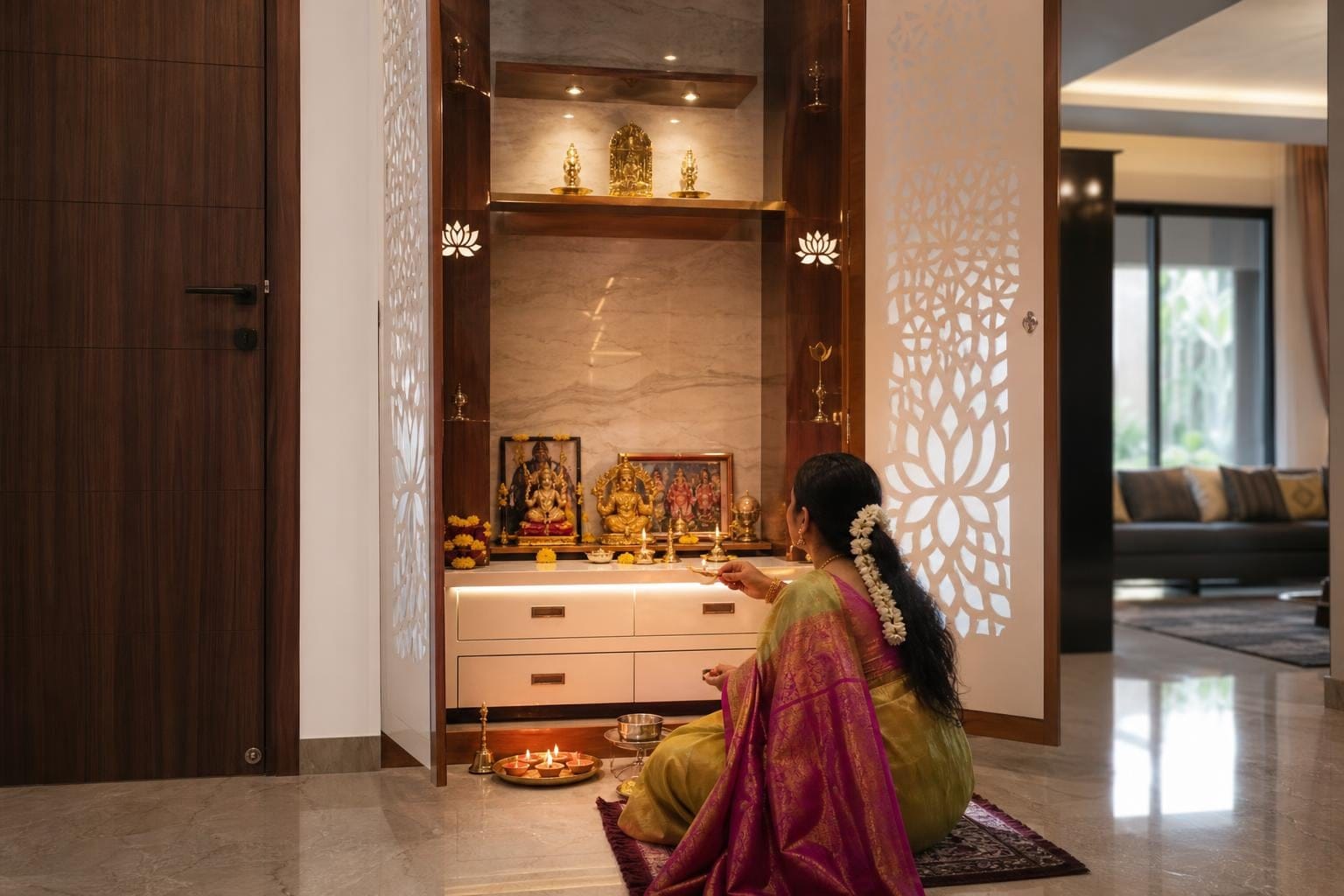
Pooja Room Design and Price in Bangalore (2026 Guide)
TL;DR
Pooja room design and price for premium Bangalore homes ranges from ₹1 lakh for a well-crafted CNC jaali or Corian unit to ₹5 lakh+ for a full marble or temple-style carved installation. The final cost hinges on three factors: design complexity, material selection (BWP plywood, Corian, teak, or marble), and how deeply the pooja room integrates with your home’s overall interior language. This guide covers the designs that matter for Bangalore apartments and villas, with material comparisons, Vastu essentials, and the costly mistakes that even well-budgeted projects make when execution is poor.
Designing the pooja room for your Bangalore apartment or villa? Start with the complete pooja room design guide to understand the full scope before selecting a style and material.
At-a-Glance: Pooja Room Design and Price for Bangalore Homes
Thoughtfully Crafted (₹1,00,000–₹2,00,000)
| # | Design Type | Price Range | Best Material | Best For | Space Needed |
|---|---|---|---|---|---|
| 1 | CNC Jaali Backlit Panel | ₹1,00,000–₹1,80,000 | Hardwood + CNC MDF with LED sheets | Modern 3BHK/4BHK apartments | 3 ft × 4 ft wall |
| 2 | Glass-Enclosed Sanctuary | ₹1,00,000–₹2,00,000 | Toughened glass + hardwood frame | Open-plan apartments (Whitefield, Sarjapur) | 4 ft × 4 ft |
| 3 | Corian/Solid Surface Mandir | ₹1,00,000–₹2,50,000 | Corian (acrylic + mineral) | Daily ritual families in humidity-prone zones | 3 ft × 3 ft+ |
| 4 | Jaali Partition Pooja Room | ₹1,20,000–₹2,00,000 | Hardwood jaali + BWP plywood | Open living-dining layouts in premium apartments | 5 ft × 4 ft |
Premium and Luxury (₹2,00,000+)
| # | Design Type | Price Range | Best Material | Best For | Space Needed |
|---|---|---|---|---|---|
| 1 | Traditional Carved Wooden Room | ₹1,50,000–₹3,50,000+ | Teak or rosewood | Villas, heirloom-quality homes | 5 ft × 7 ft |
| 2 | Temple-Style Dome Ceiling | ₹2,00,000–₹4,50,000+ | Teak + POP/gypsum dome | Villas with dedicated pooja rooms | 6 ft × 6 ft+ |
| 3 | Marble Pooja Room | ₹2,00,000–₹5,00,000+ | Italian/Indian marble | Luxury villas (JP Nagar, Koramangala, Jayanagar) | 5 ft × 7 ft+ |
| 4 | Full Custom Luxury (Turnkey) | ₹1,50,000–₹3,50,000+ | BWP plywood + premium finishes + commercial-grade hardware | Premium apartments, villas across Bangalore | Varies |
This table gives you the quick snapshot. Now, each design broken down with materials, pros, cons, and real pricing context for Bangalore homeowners.
Why Pooja Room Design Deserves the Same Attention as Your Kitchen or Master Bedroom
In a full-home interior project (typically ₹20–₹40 lakh+ for a 3BHK in Bangalore), the pooja room often gets treated as an afterthought, a last-minute addition squeezed into whatever space remains. This is a mistake.
The pooja room is the one space in your home where material quality, craftsmanship, and spatial design converge with deep personal meaning. A kitchen can be functional without being beautiful. A pooja room that feels cheap or poorly built undermines its entire purpose.
For families across Bangalore neighborhoods like Whitefield, HSR Layout, JP Nagar, and Koramangala, the pooja room also has to contend with very specific conditions: monsoon humidity that warps wood and swells MDF, multigenerational use patterns where elderly family members need comfortable access, and open floor plans in modern apartments that demand thoughtful integration rather than awkward partitioning.
This is why pooja room design and price should be planned alongside your home’s overall interior scheme, not bolted on at the end.
Understanding Pooja Room Costs Within a Full-Home Interior Budget
Before diving into individual designs, it helps to understand where the pooja room sits in the overall budget for a Bangalore home interior:
| Home Type | Typical Full Interior Budget | Pooja Room Allocation | Percentage |
|---|---|---|---|
| 2BHK Apartment | ₹20 lakh+ | ₹1,00,000–₹1,50,000 | 5–7% |
| 3BHK Apartment | ₹25 lakh+ | ₹1,25,000–₹2,50,000 | 5–10% |
| Villa / 4BHK+ | ₹30 lakh+ | ₹2,00,000–₹5,00,000+ | 7–12% |
These numbers reflect turnkey execution with proper materials, not off-the-shelf assembled units. When the pooja room is designed as part of the full-home scope, you also gain consistency in material language, hardware quality, and finish tones across every room.
Planning your full-home budget? The interior design cost guide for Bangalore breaks down realistic numbers for every room.
Thoughtfully Crafted Pooja Room Designs (₹1 Lakh–₹2 Lakh)
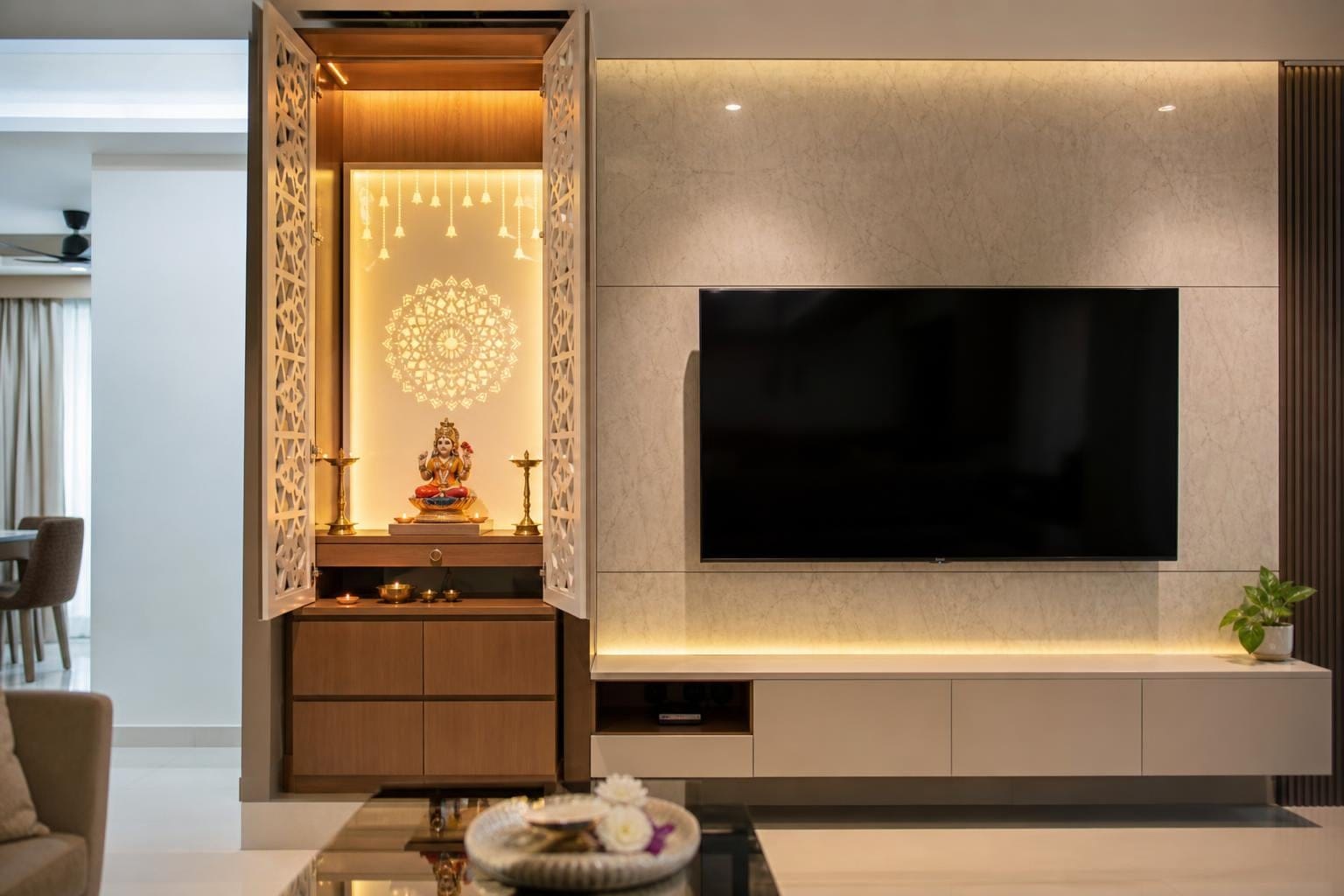
1. CNC Jaali Backlit Panel Design
Best for: Modern 3BHK and 4BHK apartments where the pooja area needs to function as a design focal point, not just a functional corner.
Price range: ₹1,00,000–₹1,80,000 (unit, backlighting, and professional installation)
Materials: CNC-cut hardwood or MDF panels on a BWP plywood subframe, warm 3000K LED sheets, matte acrylic diffuser behind the jaali. The subframe matters more than most people realize: a properly constructed BWP plywood backing with sealed edges prevents the moisture damage that destroys MDF-only constructions within two monsoon seasons.
Key features:
- CNC technology traces intricate lotus, Om, or geometric motifs with precision down to 0.5mm
- Entire unit stays under 120mm deep (about 5 inches), preserving floor area
- Warm backlighting creates a halo effect around the jaali pattern, visible from the living area
- Hardwood jaali inserts cost ₹1,800–₹3,500 per sq ft, significantly more durable than budget MDF alternatives
- When designed alongside your living room’s wall treatments, the jaali can echo the material palette used in TV units or console walls
Tradeoffs:
- Pure MDF jaali panels (without a BWP subframe) don’t handle Bangalore’s humidity, making construction method critical
- Dust settles in intricate cuts, requiring careful cleaning
- LED sheets need replacement every 3–5 years
- The quality gap between a ₹40,000 MDF-only version and a ₹1.2 lakh properly constructed one is enormous, and invisible in photos
Practitioners on interior design forums consistently note that backlit jaali panels are among the most photographed elements in Bangalore apartment tours, but also among the most frequently botched. The difference comes down to subframe construction and edge sealing, exactly the kind of detail that gets skipped when execution isn’t supervised.
For more on how lighting transforms pooja spaces, read about why lighting is the most underrated element in interior design.
2. Glass-Enclosed Pooja Sanctuary
Best for: Open-plan apartments (common in Whitefield, Sarjapur, and Electronic City developments) where you want visual connection with physical separation.
Price range: ₹1,00,000–₹2,00,000
Materials: Toughened or tempered glass panels (10mm–12mm), hardwood or powder-coated metal frame, frosted film options. Frame finished to match kitchen cabinetry or living room woodwork.
Key features:
- Full visibility of the pooja setup from living areas, maintaining the open feel of modern floor plans
- Frosted glass panels provide privacy while letting LED glow pass through
- Keeps incense smoke and oil lamp residue contained, protecting adjacent furniture and fabrics
- Frame material and finish can be coordinated with your home’s overall design language
- Properly engineered ventilation panels prevent heat buildup from oil lamps
Tradeoffs:
- Glass shows fingerprints and oil smudges readily (daily wiping needed)
- Acoustic separation is minimal (chanting and bells still audible, which some families prefer)
- Requires precise measurements; glass panels aren’t easily modified post-installation
- Quality of frame engineering determines whether the enclosure feels like a bespoke installation or a glass box
Vastu tip: Ensure the glass enclosure has at least one openable panel for ventilation. Stagnant air in a sealed pooja space goes against both Vastu principles and practical comfort during daily rituals.
3. Corian/Solid Surface Mandir
Best for: Families who perform daily rituals with oil, ghee, haldi, and water, and want a material that handles all of it gracefully.
Price range: ₹1,00,000–₹2,50,000 for a properly designed and installed unit
Detailed pricing tiers:
- Standard Corian mandir with jaali and LED: ₹1,00,000–₹1,50,000
- Premium 3D backlit Corian mandir: ₹1,50,000–₹2,00,000
- Luxury custom Corian pooja room with integrated storage: ₹2,00,000–₹2,50,000+
Materials: Corian is a solid surface material originally developed by DuPont, made from a blend of natural minerals and acrylic resin. It looks sleek like stone but can be shaped with CNC precision. Non-porous, seamless, and remarkably easy to maintain.
Key features:
- Non-porous surface means oil, ghee, and water don’t seep in, ever
- CNC carving precision down to 0.5mm (impossible with marble or most woods)
- Holds dimensions across Bangalore’s temperature and humidity swings
- Seamless joints create a monolithic, premium appearance
- Lightweight compared to marble, allowing wall-mounted installations without structural reinforcement
- The material’s stability makes it particularly well-suited to Bangalore’s monsoon conditions
Tradeoffs:
- Scratches from metal items (bells, brass lamps) are visible on lighter shades
- Requires specialized fabricators; not every workshop can work with Corian to the tolerances that premium installations demand
- Lacks the natural grain warmth of real wood for families who value traditional aesthetics
- Quality varies significantly between fabricators, making the choice of execution partner more important than the material itself
Corian has become the go-to for modern pooja room designs across Bangalore’s premium apartment segment. Wood warps in humidity, expands during monsoon, and chips at fine details. Corian holds steady across all of these conditions, which is why interior designers working in areas like HSR Layout, Hebbal, and Electronic City (where monsoon exposure is heavy) recommend it consistently.
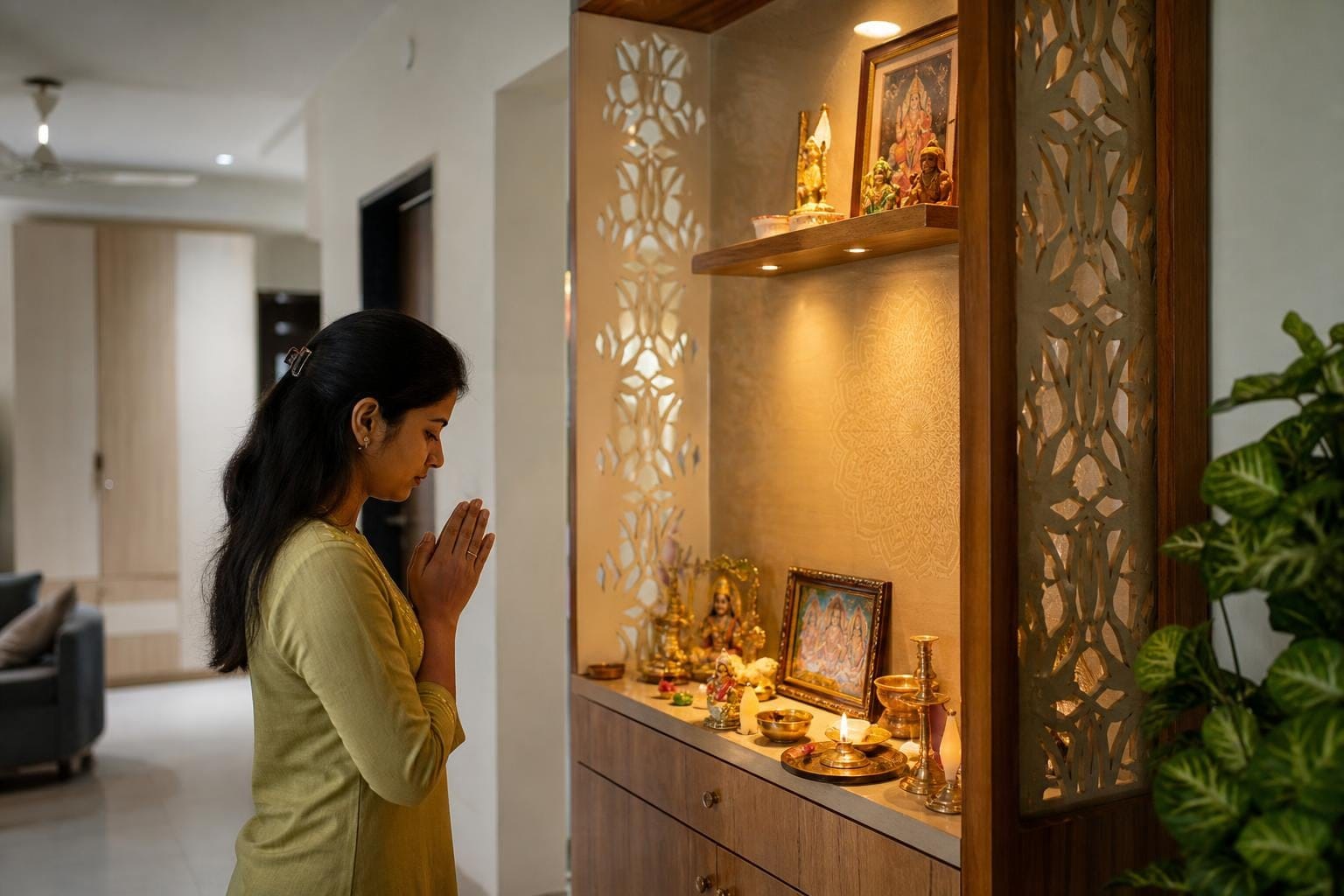
4. Jaali Partition Pooja Room
Best for: Open living-dining floor plans in 3BHK and 4BHK apartments where you want a defined sacred space without building walls.
Price range: ₹1,20,000–₹2,00,000
Materials: CNC-cut hardwood jaali or composite panels on a BWP plywood frame. Teak or premium veneer finish. Commercial-grade hinges if the partition includes openable sections.
Key features:
- Creates a semi-private pooja area within open-plan layouts
- Light and air flow freely through the jaali perforations
- Can extend from floor to ceiling for a dramatic architectural statement
- The jaali pattern itself becomes a design feature visible from the living room
- When designed as part of a full-home interior, the jaali material and finish can mirror elements used in your TV unit wall or dining area partition
Tradeoffs:
- Full-height partitions need precise engineering to avoid wobble or misalignment over time
- Acoustic separation is minimal
- Cleaning intricate jaali patterns is time-consuming
- The subframe construction determines whether this stays plumb and true for a decade or starts shifting within a year
For more on how wall treatments and panels work in Indian homes, the guide on wall panelling design options covers materials that overlap with jaali partition construction.
Bangalore’s newer apartment developments (Nambiar, Concorde, Adarsh projects) increasingly feature open floor plans that make dedicated pooja rooms architecturally challenging. A jaali partition solves this by creating sacred separation without sacrificing the spatial flow that makes these apartments feel generous.
Premium and Luxury Pooja Room Designs (₹2 Lakh+)
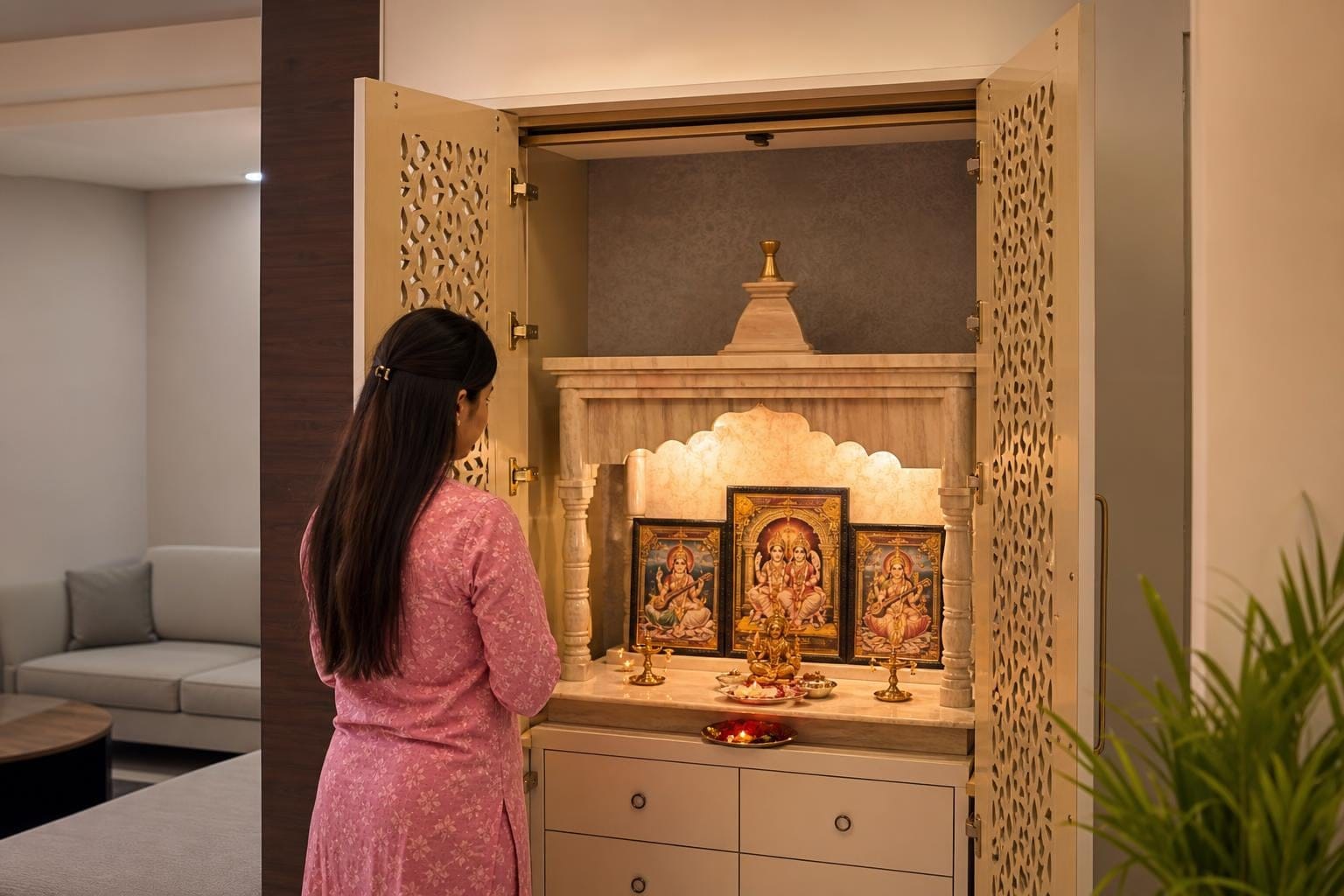
1. Traditional Carved Wooden Pooja Room
Best for: Villas and independent homes across Bangalore (JP Nagar, Jayanagar, Banashankari, Rajajinagar) where families value heirloom-quality craftsmanship that gets passed down generations.
Price range: ₹1,50,000–₹3,50,000+
Materials: Teak or rosewood with hand-carved pillars, gopura roof elements, and brass accents. Rosewood with carvings alone costs ₹50,000–₹1,00,000+ for the base structure at this quality level.
Key features:
- Hand-carved pillars and arches replicating South Indian temple architecture
- Teak’s natural oils make it resistant to termites and decay
- Develops a rich patina over decades, genuinely improving with age
- Accommodates larger idols, hanging bells, and elaborate lamp setups
- When executed by skilled craftsmen with proper joinery, these pieces become family heirlooms
Tradeoffs:
- Lead time of 6–10 weeks for custom carving work at this quality level
- Teak prices have risen significantly; genuine teak verification matters (a reputable design studio will handle sourcing and authentication)
- Oil and ghee stains are difficult to remove from wood grain, requiring periodic maintenance
- Heavy units (50–100 kg+) need reinforced wall mounting or dedicated floor placement
- Skilled wood carvers who can execute South Indian temple motifs to a high standard are increasingly difficult to source, which is why working through a design studio with established craftsman networks makes a measurable difference
Vastu tip: For a dedicated pooja room, recommended dimensions as per Vastu are 5 by 7 feet with idols facing northeast. The door should open inward and ideally be a double-panel door.
2. Temple-Style Dome Ceiling Mandir
Best for: Villas and independent homes with dedicated pooja rooms where ceiling height (9 ft+) allows architectural expression.
Price range: ₹2,00,000–₹4,50,000+
Materials: Teak or rosewood structure, POP or gypsum dome ceiling, cove lighting, carved pillars. All wood elements on BWP plywood subframes with commercial-grade hardware for any moving parts.
Key features:
- Dome-like ceiling creates the feel of an actual temple interior
- Carved pillars and arches frame the idol placement area with grandeur
- Pyramid or inverted dome shapes are considered ideal per Vastu, creating symmetry that amplifies the room’s spiritual character
- Cove lighting in the dome creates a divine glow without visible fixtures
- When designed within a full-home interior scope, the dome’s plasterwork and lighting can reference ceiling treatments used elsewhere in the home
Tradeoffs:
- Requires minimum 9–10 foot ceiling height to avoid a claustrophobic feel
- POP dome work needs skilled craftsmen and proper curing time (rushed curing leads to cracks within months)
- Expensive to modify or relocate once installed
- Dome acoustics can amplify bell sounds (worth considering if the room is near bedrooms)
The dome ceiling is where pooja room design and price intersect most dramatically. The visual impact of a properly executed dome with cove lighting and carved columns is transformative, but this is also the design category where execution quality makes the biggest difference between a space that feels genuinely sacred and one that feels like a stage set.
The false ceiling design guide with cost breakdown provides detailed numbers on dome and cove ceiling construction that applies directly to pooja rooms.
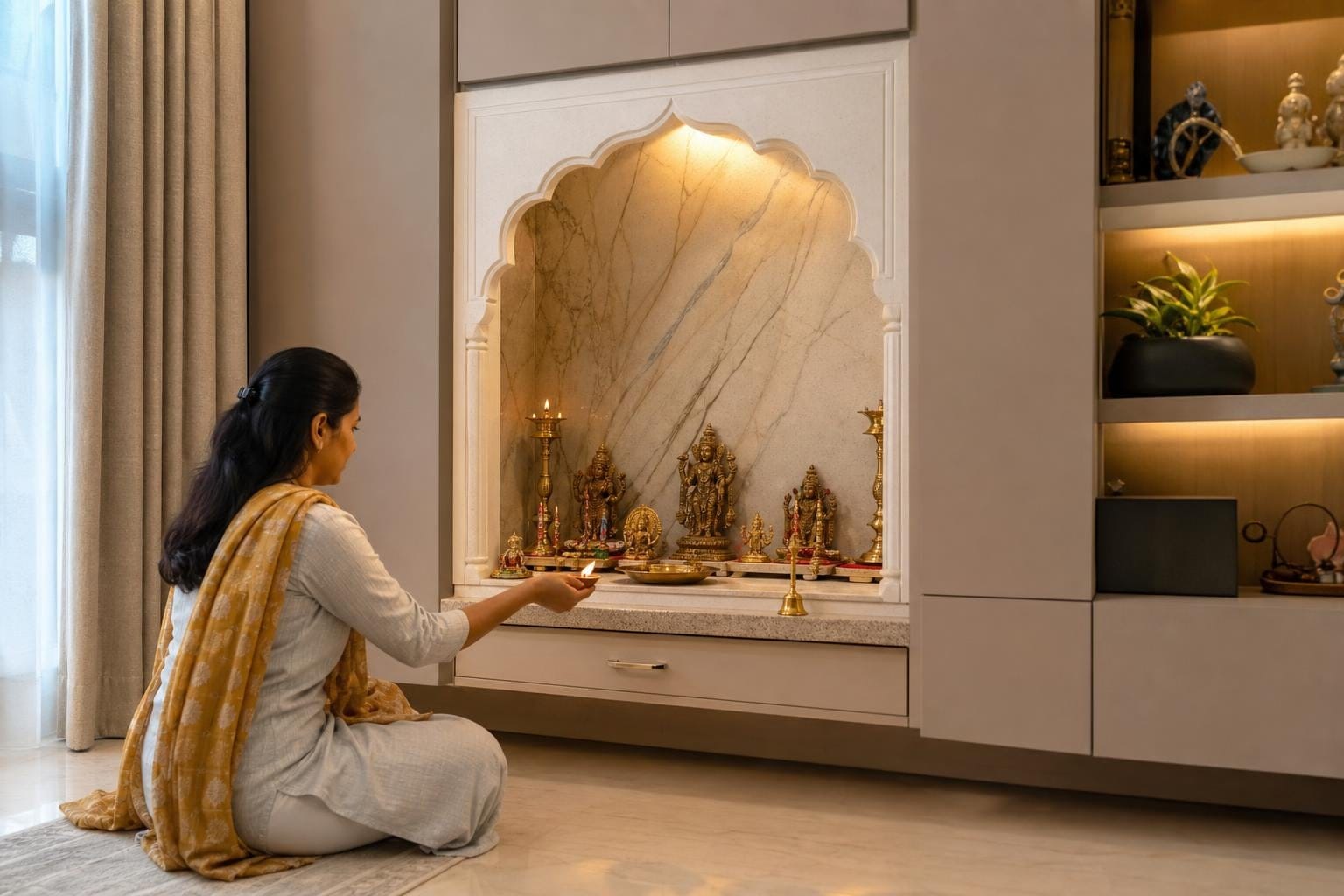
3. Marble Pooja Room
Best for: Villa owners across Bangalore who want a permanent, monumental installation and have the structural support for it.
Price range: ₹2,00,000–₹5,00,000+
Materials: Italian Carrara marble, Indian Makrana marble, or premium composite marble. At this budget level, the marble selection, cutting, and installation should be handled by specialists, not general contractors.
Key features:
- Unmatched visual grandeur and permanence
- Natural veining makes every installation unique
- Cool to the touch, pleasant during Bangalore’s warmer months
- Extremely durable when properly sealed and maintained
- The material itself communicates a level of permanence and investment that no other option matches
Tradeoffs:
- Extremely heavy, requiring structural assessment and sometimes reinforcement
- Marble is porous and stains from turmeric, oil, and flower residue (professional sealing every 1–2 years is non-negotiable)
- Limited to traditional hand-chiselling for decoration (CNC on marble is expensive and constrained)
- Permanent installation; this is not something you modify easily
- On-site assembly of heavy marble pieces adds labor complexity and cost, demanding experienced installation crews
For families who want the marble aesthetic without the weight and maintenance demands, Corian in white or cream shades provides a convincing alternative with dramatically better stain resistance and at roughly 40–60% of the cost. But for pure visual grandeur in a dedicated pooja room, nothing replaces real marble.
4. Full Custom Luxury Pooja Room (Turnkey)
Best for: Premium apartment and villa owners across Bangalore who want a bespoke, fully integrated pooja room designed and executed as part of their home’s complete interior, not assembled from off-the-shelf components.
Price range: ₹1,50,000–₹3,50,000+
Materials: BWP/marine-grade plywood in humidity-prone zones, commercial-grade hinges (Hettich or Blum) and ball-bearing drawer slides, premium laminates or natural veneers, integrated LED systems, reinforced shutter framing to prevent sagging over time.
Key features:
- End-to-end design: from 3D visualization to material selection to final installation
- Every element is custom, including the mandir unit, storage, lighting, flooring, ceiling treatment, and door
- Vastu compliance built into the floor plan from the concept stage
- Material grades and hardware specs disclosed upfront in a detailed BOQ (no substitutions during execution)
- Warranty-backed workmanship and materials
- The pooja room’s design vocabulary connects seamlessly with the rest of the home, same finish tones, same hardware quality, same construction standards
Tradeoffs:
- The highest price point in the spectrum
- Requires 8–14 weeks of lead time depending on complexity
- Demands a design partner who supervises execution, not just provides drawings
- Not a standalone service (most effective when part of a full-home interior scope)
This is where professional execution matters most. The difference between a pooja room assembled by a general carpenter from reference photos and one designed and built by an interior design studio with construction discipline is visible in the details: reinforced shutter framing that stays aligned after five years of daily use, sealed plywood edges that resist Bangalore’s monsoon humidity, hardware that operates smoothly across thousands of open-close cycles.
One common pattern on Reddit and interior design forums: homeowners who invested in premium materials but hired general contractors for execution frequently report misaligned panels, LED strips that fail within months, and doors that sag because the hinge placement didn’t account for the door’s weight. The materials weren’t the problem. The construction method was.
Understanding what BWP plywood is is relevant here. For any pooja room cabinetry in Bangalore, marine-grade plywood prevents the warping that destroys alignment and shortens the life of even expensive designs.
Pooja Room Material Comparison: What Your Investment Actually Buys
No pooja room design and price discussion is complete without understanding how materials perform over years of daily use in Bangalore’s climate:
| Factor | Teak / Rosewood | Marble | Corian | BWP Plywood + Veneer |
|---|---|---|---|---|
| Investment range | ₹1,50,000–₹3,50,000+ | ₹2,00,000–₹5,00,000+ | ₹1,00,000–₹2,50,000 | ₹1,00,000–₹2,00,000 |
| Durability | Very high (if treated) | Very high | Very high | High (with sealed edges) |
| Stain resistance | Low (oil/ghee seeps in) | Low (porous stone) | Excellent (non-porous) | Moderate (laminate-dependent) |
| Bangalore humidity | Needs treatment | Stable (but heavy) | Excellent | Excellent (BWP grade) |
| Carving precision | Hand-carved, costly | Limited to hand-chiselling | CNC to 0.5mm accuracy | CNC, clean lines |
| Weight | Moderate to heavy | Very heavy (50–150 kg+) | Light (10–25 kg) | Moderate |
| Character over time | Develops rich patina | Permanent, unchanged | Consistent, unchanged | Consistent with finish |
| Maintenance | Annual polishing | Sealing every 1–2 years | Wipe clean daily | Minimal |
| Best for | Heirloom, traditional | Grand, permanent | Modern, practical | Integrated, turnkey |
Bangalore-specific note: The city’s monsoon humidity is the single biggest factor in material selection. Apartments in Whitefield, Electronic City, Sarjapur, and Hebbal experience particularly heavy monsoon exposure. For these areas, Corian or BWP plywood constructions with sealed edges are the safest long-term choices. Untreated solid wood (even teak) needs periodic re-treatment, and standard plywood or MDF will fail within two to three monsoons.
For a deeper look at how cabinet materials behave in Indian conditions, the kitchen cabinet materials guide covers the same BWP plywood, laminate, and hardware decisions that apply to pooja room cabinetry.
Vastu Essentials for Pooja Room Design
Every pooja room design and price discussion needs to address Vastu, because most families treat it as non-negotiable. Here are the principles that directly affect design choices and costs:
Direction: The northeast (Ishanya corner) is the best location for a pooja room. This direction allows natural morning light to enter the space and is associated with clarity and spiritual energy. North or east are acceptable alternatives if northeast isn’t feasible in your apartment’s layout.
Idol placement: Idols should face northeast and be placed at least six inches from the back wall. Nothing should be stored above the idols. All storage should be below or beside the idol platform, which is why integrated lower cabinetry is standard in professionally designed pooja rooms.
Room dimensions: Recommended pooja room size as per Vastu is 5 by 7 feet for a dedicated room, with the mandir unit at least 3 feet tall. For apartments where a dedicated room isn’t possible, a minimum of 3 ft × 4 ft provides a functional and dignified pooja area.
Ceiling: A low ceiling with a pyramid-shaped or dome roof is considered ideal for creating symmetry and positive energy. This is one reason why temple-style dome designs are popular among Vastu-conscious families building out villas across Bangalore.
Door: Pooja room doors should ideally be two-paneled and open inward. Premium carved teak doors with brass fittings range from ₹35,000 to ₹95,000. CNC jaali door inserts in hardwood cost ₹1,800–₹3,500 per sq ft.
Ventilation: The room should have natural airflow or at least a small exhaust. This is practical, not just spiritual: incense, camphor, and oil lamps create smoke and soot that damages surfaces and finishes over time.
For comprehensive Vastu principles beyond the pooja room, the Vastu for home interior design guide covers placement rules for every room.
5 Costly Pooja Room Design Mistakes (And How to Avoid Them)
Mistake 1: Choosing Materials Based on Appearance Alone
This is the most expensive mistake on the list. A material that looks beautiful in a showroom or Pinterest board can fail spectacularly in Bangalore’s humidity. Homeowners on Reddit and design forums regularly report that untreated wood and standard MDF installations warp, swell, or delaminate within two to three monsoon seasons. The replacement cost is the full original investment plus demolition and reinstallation.
Fix: Specify BWP plywood for subframes, Corian for surfaces exposed to ritual use, or properly treated teak. The upfront premium (15–25% more) eliminates the need for full replacement within five years. A detailed BOQ that specifies exact material grades, rather than vague terms like “best quality plywood,” protects you from substitutions.
Mistake 2: Getting the Height Wrong
Placing the mandir too low forces uncomfortable bending during prayer. Too high, and daily rituals become difficult, especially for elderly family members. Both extremes also disrupt the visual proportion of the room.
Fix: The idol platform should sit at a height where your eyes meet the deity’s feet when standing. For seated prayer, adjust to chest height when sitting cross-legged. A design studio will mock this up in 3D renders before committing to construction.
Mistake 3: Ignoring Ventilation
Poor ventilation causes lingering smells from incense and oil lamps. Over time, the enclosed space gets stuffy, soot stains the ceiling, walls, and any false ceiling elements, and the accumulated residue requires expensive refinishing.
Fix: Include a small window, a ventilation grille, or a compact exhaust fan. Budget ₹3,000–₹8,000 for this, depending on the solution. It extends the lifespan of every surface in the room, particularly painted walls and ceiling treatments.
Mistake 4: Treating the Pooja Room as Separate from the Home’s Design
When the pooja room uses different materials, finishes, and hardware from the rest of the home, it feels disconnected. This is common when the pooja unit is purchased separately or built by a different carpenter after the main interior work is complete.
Fix: Design the pooja room as part of the full-home interior scope. The veneer or laminate finish should connect to your home’s palette. The hardware quality (hinges, slides) should match what’s used in your kitchen and wardrobes. The lighting scheme should complement adjacent rooms. This integration is one of the strongest arguments for turnkey interior execution.
Mistake 5: Underestimating Execution Complexity for Premium Designs
For a simple wall-mounted unit, execution risk is low. But for designs involving jaali partitions, dome ceilings, Corian fabrication, glass enclosures, or integrated pooja rooms within open floor plans, the gap between “designed” and “well-built” is enormous. Misaligned panels, uneven lighting, structural wobble, and sagging doors are all symptoms of poor execution, not poor design.
Fix: For any pooja room design and price exceeding ₹1 lakh, professional design with 3D visualization before execution is not optional. It’s the single most effective way to prevent costly rework. The design investment typically adds 10–15% but eliminates problems that cost 30–50% to fix after the fact.
For more on how small design oversights create expensive problems, the guide on interior design mistakes covers related issues across the home.
How to Choose the Right Pooja Room Design for Your Bangalore Home
Use this decision framework to narrow down your options:
Step 1: Determine your space and home type. A 3BHK apartment in Whitefield or HSR Layout with an open floor plan calls for a different approach than a villa in JP Nagar or Jayanagar with a dedicated pooja room. Apartments typically work best with glass-enclosed, CNC jaali, or Corian designs (₹1–₹2.5 lakh). Villas with dedicated rooms open up the full spectrum including carved wood, dome ceilings, and marble (₹2–₹5 lakh+).
Step 2: Assess your ritual patterns. Daily abhishekam with water and milk? Corian or sealed marble is essential. Simple morning prayer with incense? Teak or BWP plywood with premium veneer works beautifully. The ritual intensity determines the material, and the material determines the cost.
Step 3: Check your climate exposure. Ground-floor apartments, rooms near kitchens, or areas with poor ventilation need humidity-resistant materials. BWP plywood with sealed edges, Corian, or properly treated teak are the right choices for Bangalore. This isn’t a place to cut costs.
Step 4: Consider integration with your home’s overall interior. The pooja room should feel like it belongs to the same home as your kitchen, wardrobes, and living room. When designed as part of a full-home interior scope, the material palette, hardware quality, and finish tones naturally connect. When designed in isolation, it rarely feels cohesive.
Step 5: Choose your aesthetic direction. Traditional (carved teak, temple dome, brass accents) or contemporary (Corian, glass, CNC jaali with backlighting)? The 2026 trend in premium Bangalore homes leans toward what might be called “quiet devotion”: clean, symmetrical designs that are deeply symbolic without visual clutter. But traditional carved wood installations remain the choice for families who value craft and heirloom quality above everything else.
Step 6: Select your design partner. A pooja room at this investment level deserves the same construction discipline you’d expect for your kitchen or master bedroom: 3D renders before execution, specified material grades in a detailed BOQ, commercial-grade hardware, and warranty-backed workmanship. The 3D visualization process lets you refine every detail before a single cut is made.
Frequently Asked Questions
What is a realistic pooja room design and price for a premium Bangalore apartment?
For a 3BHK or 4BHK apartment in Bangalore, homeowners investing in quality interiors typically spend between ₹1,00,000 and ₹2,50,000 on their pooja room. This gets you a professionally designed CNC jaali panel, Corian mandir, glass-enclosed sanctuary, or jaali partition, all executed with BWP plywood subframes, commercial-grade hardware, and integrated lighting. When designed as part of a full-home interior project (₹25 lakh+ for a 3BHK), the pooja room typically represents 5–10% of the total budget.
Which material is best for a pooja room in Bangalore’s climate?
Corian and BWP (boiling water proof) plywood perform best in Bangalore’s humid monsoon conditions. Corian is non-porous and holds its dimensions across temperature swings, making it ideal for families who perform daily rituals. Standard MDF and untreated engineered wood are poor choices for Bangalore, as they swell and warp within one to two monsoon seasons. Teak performs well but requires periodic treatment to maintain its resistance.
How does a turnkey pooja room differ from a carpenter-built one?
The difference is in construction discipline and design integration. A turnkey approach means your pooja room is designed alongside your kitchen, wardrobes, and living room, sharing the same material palette, hardware quality, and finish standards. You receive 3D renders before execution, a detailed BOQ specifying exact material grades, and warranty-backed workmanship. A carpenter-built unit from reference images can look similar in photos but typically lacks reinforced framing, sealed plywood edges, and the hardware quality needed for years of daily use.
What is the minimum space needed for a proper pooja room?
A 3 ft × 4 ft dedicated area is sufficient for a well-designed pooja setup with an idol platform, integrated lighting, and basic storage. For a proper pooja room with standing space, a door, and storage, plan for at least 4 ft × 6 ft. Vastu recommends 5 ft × 7 ft for a dedicated room, which is achievable in most 3BHK apartments and villas.
How much do premium pooja room doors cost?
Carved teak doors with brass accents range from ₹35,000 to ₹95,000. CNC jaali door inserts in hardwood cost ₹1,800–₹3,500 per sq ft. The door is one of the most visible elements of a pooja room and worth investing in, particularly for designs where the pooja room opens onto a living area or hallway.
Is Corian better than marble for a pooja room?
For daily-use pooja rooms, Corian outperforms marble on stain resistance, weight, and customization. Marble stains from turmeric and oil, weighs significantly more (making wall-mounting impractical), and is limited to hand-chiselling for decorative work. Corian can be CNC-carved to 0.5mm precision, is non-porous, and wipes clean daily. Marble wins on raw visual grandeur and permanence for dedicated pooja rooms in villas where it can be floor-mounted on a proper foundation.
Should I follow Vastu for my pooja room design?
That’s a personal decision, but the practical elements of Vastu guidelines (northeast placement for morning light, ventilation requirements, idol height for comfortable prayer, storage below the deity) align with good design principles regardless of belief. Following them costs nothing extra and can actually simplify design decisions. A good design studio will incorporate Vastu into the floor plan from the concept stage rather than retrofitting it.
How long does a custom pooja room installation take?
Mid-range designs with CNC jaali or Corian fabrication need 4–6 weeks. Full custom luxury installations with dome ceilings, carved woodwork, and integrated lighting require 8–14 weeks from design finalization to completion. When the pooja room is part of a full-home interior project, the timeline is incorporated into the overall execution schedule (typically 8–15 weeks depending on home size).
Designing a pooja room for your Bangalore apartment or villa? The interior design cost guide for Bangalore breaks down realistic budgets for every room, including turnkey pooja room solutions that integrate seamlessly with your full-home interior.