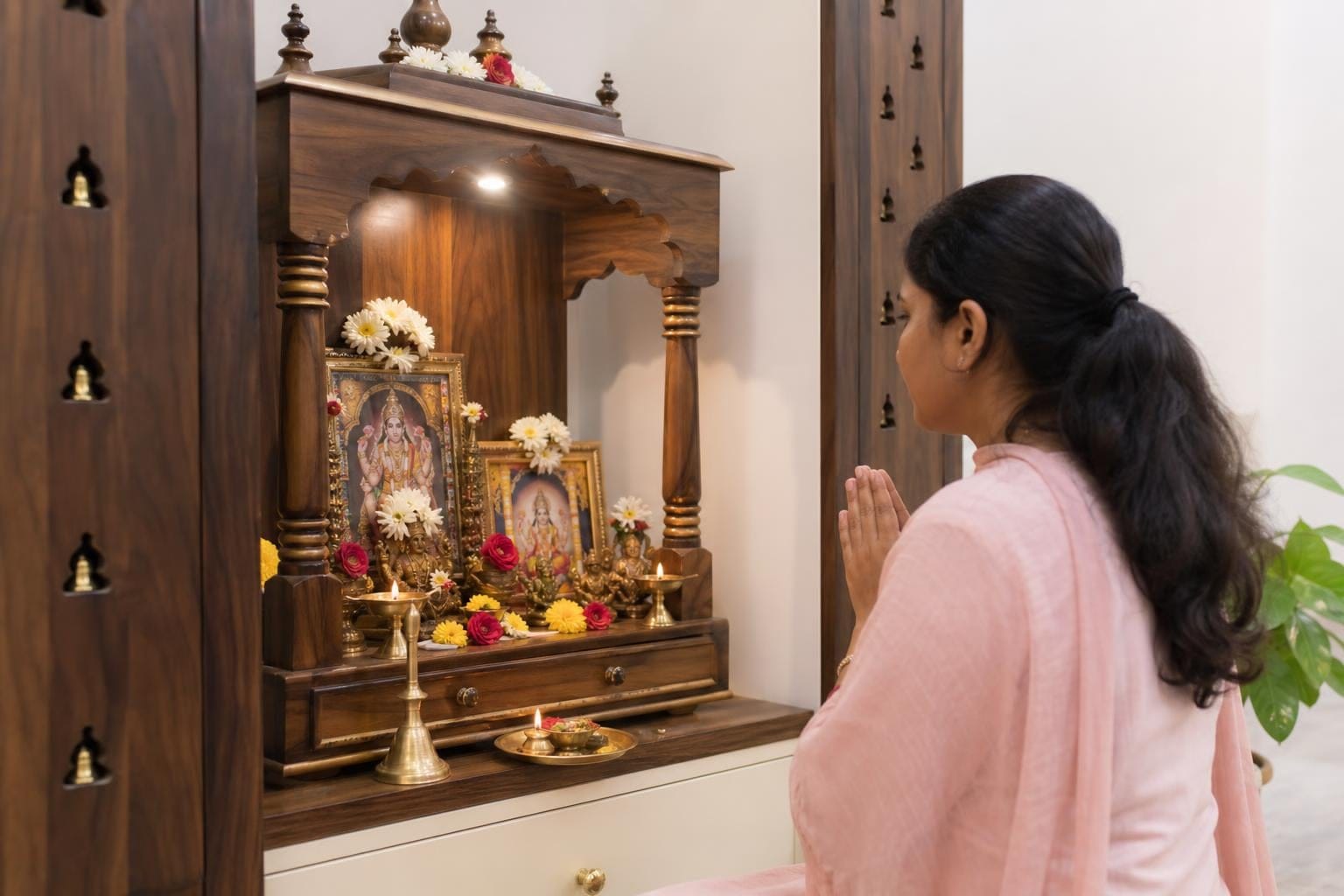
House Interior Design Pooja Room: 10 Designs (2026 Guide)
TL;DR
The pooja room deserves the same design rigor as your kitchen or living room. This guide covers 10 house interior design pooja room styles, from ₹8,000 wall-mounted units for compact apartments to ₹2,50,000+ luxury marble sanctuaries for villas. Each design includes real cost ranges, material recommendations, Vastu guidance, and Bangalore-specific tips on humidity resistance. Skip to the comparison table below for a quick overview, or read through for the construction-quality details that most design galleries leave out.
Why Your Pooja Room Deserves Real Design Attention
Most interior design articles treat the pooja room as an afterthought: a pretty shelf, some warm lights, done. That approach fails because the pooja room is one of the most heavily used spaces in an Indian home. Daily rituals, incense smoke, water and flower offerings, oil from diyas, monsoon humidity (especially in Bangalore from June through September) all put serious stress on materials that weren’t chosen carefully.
The difference between a pooja unit that looks great on Instagram and one that actually holds up after five years comes down to material selection, hardware quality, and edge sealing. These are exactly the details that glossy galleries skip.
This guide goes beyond inspiration. It covers 10 distinct house interior design pooja room styles with honest cost ranges, material specs, and practical construction notes, so you can brief your designer with confidence or make informed purchase decisions.
Planning your full home interiors alongside the pooja room? Check out this interior design cost guide for realistic Bangalore budgets.
At-a-Glance Comparison Table
| Design Type | Starting Cost | Key Material | Best For | Space Needed | Complexity |
|---|---|---|---|---|---|
| Wall-Mounted Floating Unit | ₹8,000 | Plywood + laminate | Small apartments, renters | 2×2 ft min | Low |
| Compact Corner Nook | ₹15,000 | Plywood + wood veneer | Open-plan homes | Corner space | Low |
| CNC Jaali Panel Design | ₹25,000 | MDF/plywood + CNC cut | Modern apartments | 3×3 ft+ | Medium |
| Traditional Carved Wooden Mandir | ₹25,000 | Teak/sheesham | Multigenerational homes | 4×4 ft+ | Medium-High |
| Backlit Marble Mandir | ₹55,000 | Marble + LED + wood | Luxury apartments | 3×4 ft+ | High |
| Glass-Enclosed Sanctuary | ₹40,000 | Toughened glass + wood | Contemporary homes | 4×4 ft+ | Medium-High |
| Living Room Integrated (Partition) | ₹20,000 | Partition + shelf unit | No dedicated room | Corner/wall | Medium |
| Concealed Cabinet | ₹30,000 | Plywood + sliding hardware | Minimalist/rental homes | 3×2 ft | Medium |
| False Ceiling Temple Design | ₹50,000+ | POP/gypsum + wood + lights | Dedicated pooja rooms | Full room | High |
| Full Luxury Room (Villa-Grade) | ₹1,50,000+ | Marble + teak + brass + gold | Villas, 4BHK+ | Full room | Very High |
10 House Interior Design Pooja Room Ideas
1. Wall-Mounted Floating Pooja Unit
Best for: 1BHK/2BHK apartments, studio apartments, and renters who need a compact sacred space.
This is the most practical starting point for small homes. A floating shelf unit mounts directly to the wall, leaving floor space free. The smallest workable size is about 2×2 feet, enough for essential idols and a few accessories.
Materials: Plywood carcass with laminate or veneer finish. For Bangalore homes, BWR-grade plywood is the baseline, as it resists the humidity from daily water offerings and monsoon moisture far better than MDF.
Cost range: Basic floating shelf designs start around ₹8,000. Premium custom wooden cabinets with internal lighting and storage drawers can reach ₹1,50,000. Most Bangalore clients invest between ₹20,000 and ₹50,000 for quality space-saving pooja units.
Pro tip: Specify 18-19mm plywood for shutters and doors, with 6-12mm for back panels. If the unit sits near an external wall or kitchen, insist on sealed edges to prevent moisture ingress. Practitioners on design forums consistently report that unsealed MDF edges swell within two monsoon seasons in coastal and humid cities.
Limitation: No visual grandeur. This is function-first design. You also won’t get the immersive, room-like experience that daily practitioners in multigenerational homes often want.
2. Compact Corner Pooja Nook
Best for: Open-plan apartments with no dedicated pooja room and limited wall space.
Unused corners near windows or dining areas usually become the most practical spot for a small mandir. The design typically involves a floating shelf, a soft back panel with lighting, and maybe one drawer underneath for incense and prayer books. It transforms dead space into something meaningful.
Materials: Plywood with wood veneer or laminate finish. A textured wall panel behind the unit adds depth without taking up extra space. For wall treatment ideas, explore these wall panelling options.
Cost range: Starting from ₹15,000 for a basic L-shaped corner unit. With LED backlighting and a veneer finish, expect ₹25,000 to ₹40,000.
Pro tip: Position the corner nook along the northeast or east wall of the room to satisfy Vastu preferences, even in an open-plan layout. If northeast isn’t available, north is the next best option.
Limitation: Storage is minimal. If your family uses multiple idols, large bell sets, or extensive puja samagri, this won’t hold everything.
3. CNC-Cut Jaali/Lattice Panel Design
Best for: Modern apartments wanting a blend of tradition and contemporary aesthetics, with good airflow.
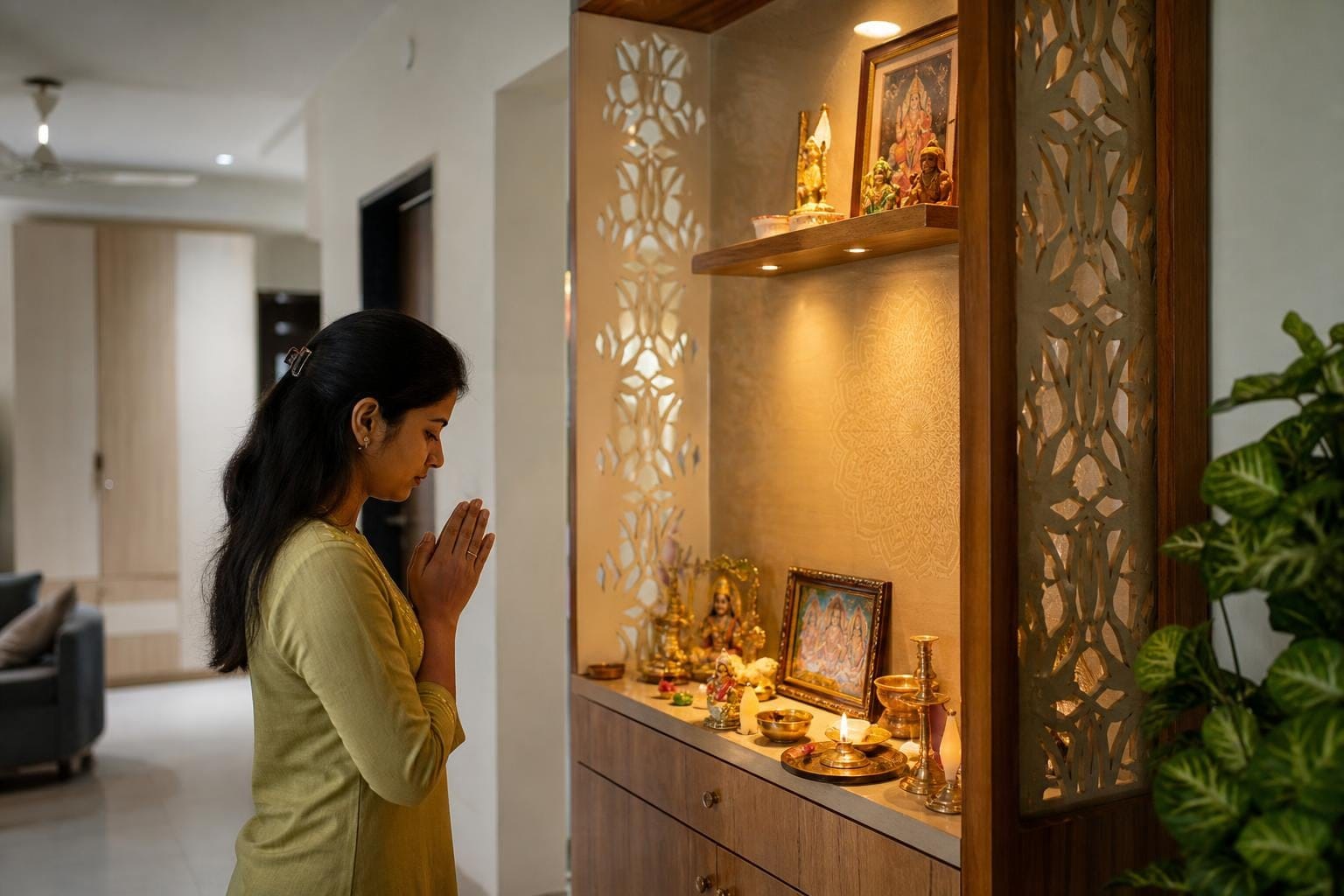
Laser-cut jaali panels are one of the dominant trends in pooja room interior design in 2026. These intricate screens allow light and air to flow through while adding privacy and cultural depth. The patterns range from geometric to floral to traditional temple motifs, all cut with CNC precision.
Materials: MDF, plywood, or metal with CNC routing. MDF gives the smoothest finish for painting, but it has a critical weakness: it dislikes long-term moisture. Near kitchens or damp external walls, warping risk rises significantly. For Bangalore homes, plywood-based CNC panels or powder-coated metal are safer bets.
Cost range: CNC jaali doors alone range from approximately ₹13,000 to ₹75,000+ depending on complexity, size, and material. A full pooja unit with jaali front panels starts around ₹25,000.
Pro tip: If you burn incense or diyas regularly, specifying fire-retardant plywood for the CNC panels adds a practical safety layer. Also consider ventilation slits at the top of the unit, as incense smoke discolors painted MDF faster than lacquered plywood.
Limitation: Intricate CNC patterns collect dust in every groove. Weekly cleaning is unavoidable. Also, very fine patterns in MDF become fragile and can chip during handling or installation.
4. Traditional Carved Wooden Mandir
Best for: South Indian families and multigenerational homes wanting temple-like grandeur with lasting quality.
Nothing replicates the warmth and spiritual weight of a hand-carved or machine-carved wooden mandir. Teak, rosewood, and sheesham are the classic choices, each bringing distinct grain patterns and natural durability. These designs often feature pillared fronts, arched doorways, and carved deity panels.
Materials: Teak naturally resists insects and moisture, making it ideal for Bangalore’s climate. Rosewood offers darker tones with exceptional carving detail. Sheesham (Indian rosewood) is a more affordable alternative with good durability.
Cost range: Teak wood pooja units typically run ₹15,000 to ₹50,000. Rosewood with intricate carvings commands ₹25,000 to ₹75,000. Engineered wood alternatives start at ₹8,000 to ₹25,000 but lack the longevity of solid wood.
Bangalore-specific note: Teak, sheesham, and engineered wood all perform well in Bangalore’s humidity. For the carcass structure behind carved panels, marine-grade plywood is recommended for better moisture resistance. To understand why BWP plywood matters in humid conditions, that guide applies equally to pooja rooms.
Limitation: Solid wood mandirs are heavy. Wall-mounting isn’t always feasible without structural support. They also need periodic oiling or polishing to maintain luster.
5. Backlit Marble Mandir
Best for: Luxury apartments and villas wanting a statement spiritual space that becomes the home’s visual centerpiece.
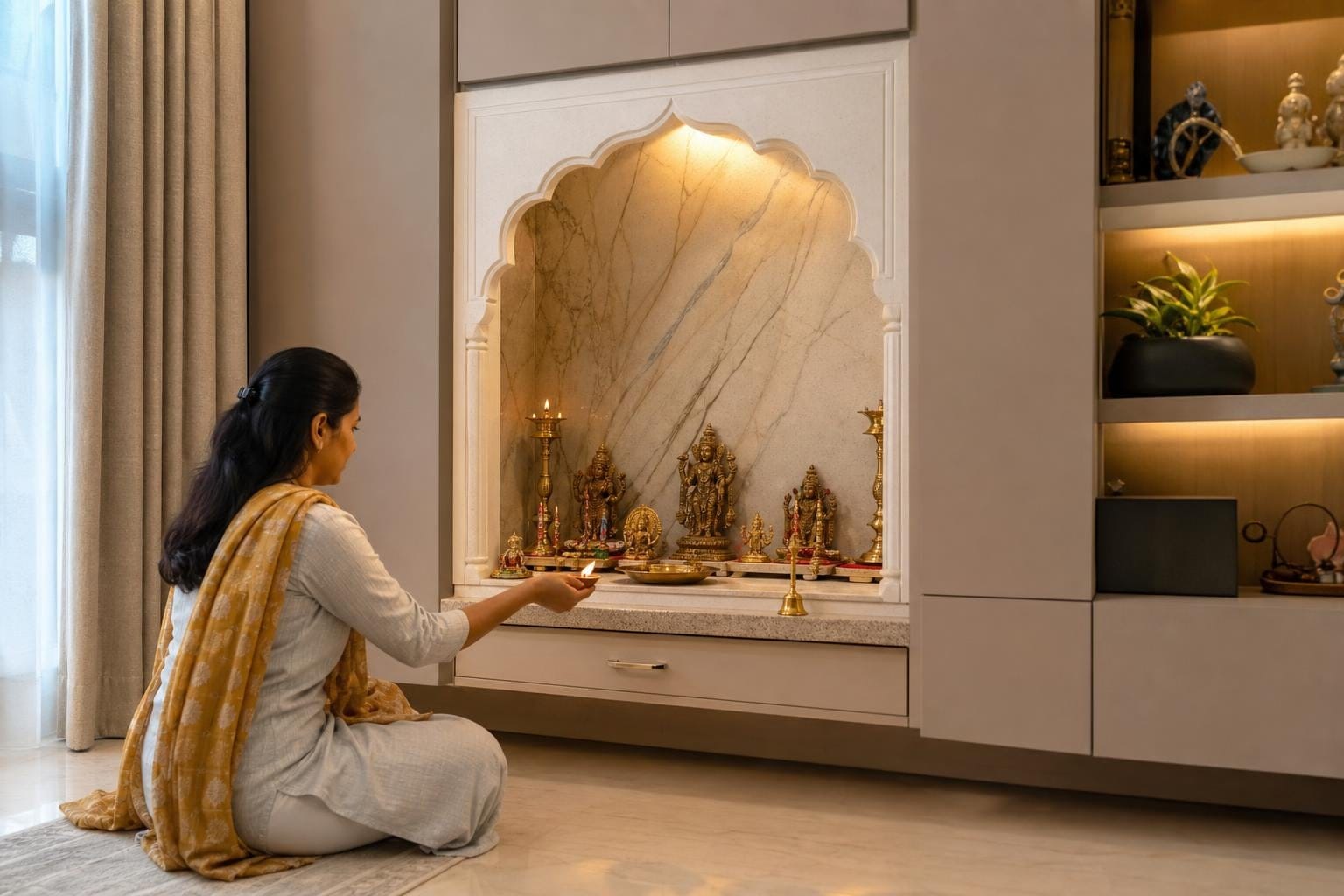
Backlit marble panels that create a luminous halo around your deities are one of the dominant design trends in 2026. The effect is striking: the translucency of certain marble varieties (especially white Makrana or Carrara) catches LED light and glows softly, producing an almost ethereal ambience.
Materials: Makrana or Carrara marble, LED panels, brass accents. Dense, less-porous marbles like Makrana resist staining better than softer stones. A honed (matte) finish is recommended so that light from diyas doesn’t reflect too harshly.
Cost range: Starter marble wall-mounted units range ₹18,000 to ₹45,000. Mid-range options with lattice work and backlighting run ₹55,000 to ₹1,20,000. Premium freestanding Makrana mandirs with shikhara, carved columns, and layered lighting start at ₹1,20,000 and go well beyond ₹2,50,000.
Stone pricing context: White marble runs ₹150 to ₹400 per sq ft. Black granite (sometimes used for base platforms) ranges ₹100 to ₹250 per sq ft. Jaisalmer stone, which adds warmth and tradition, falls between ₹80 and ₹200 per sq ft.
Pro tip: Always see a physical marble sample before committing. Marble varies dramatically slab to slab. Get your designer to create 3D visualizations before cutting expensive stone, as this prevents costly errors.
Limitation: Marble is heavy and requires structural assessment for wall-mounted installations. It also stains from turmeric, kumkum, and oil if not sealed properly. Regular re-sealing every 12-18 months is necessary.
6. Glass-Enclosed Pooja Sanctuary
Best for: Modern and contemporary homes wanting visual openness while preserving the sanctity of the prayer space.
Glass-enclosed pooja sanctuaries work well in urban apartments where the pooja area is visible from living or dining zones. The transparency maintains the open feel of the home while clearly demarcating sacred space. Subtle gold or brass frame accents elevate the enclosure from functional to beautiful.
Door options: Frosted glass for privacy, reeded glass for a textured look, or clear glass with etched deity motifs. Toughened (tempered) glass is non-negotiable for safety.
Cost range: Starting from ₹40,000 for a basic glass-and-wood unit. With etched glass panels and brass framing, costs reach ₹70,000 to ₹1,20,000.
Pro tip: Glass enclosures trap incense smoke. If your family uses incense daily, add a small exhaust vent or leave a gap at the top of the enclosure. Otherwise, the glass fogs with residue within weeks and needs constant cleaning.
Limitation: Fingerprints and smoke residue are visible immediately on clear glass. Frosted glass hides this better but reduces the visual transparency that’s the whole point of the design. It’s a tradeoff worth discussing with your designer upfront.
7. Living Room-Integrated Pooja with Partition
Best for: Open-plan apartments where a separate pooja room simply isn’t feasible.
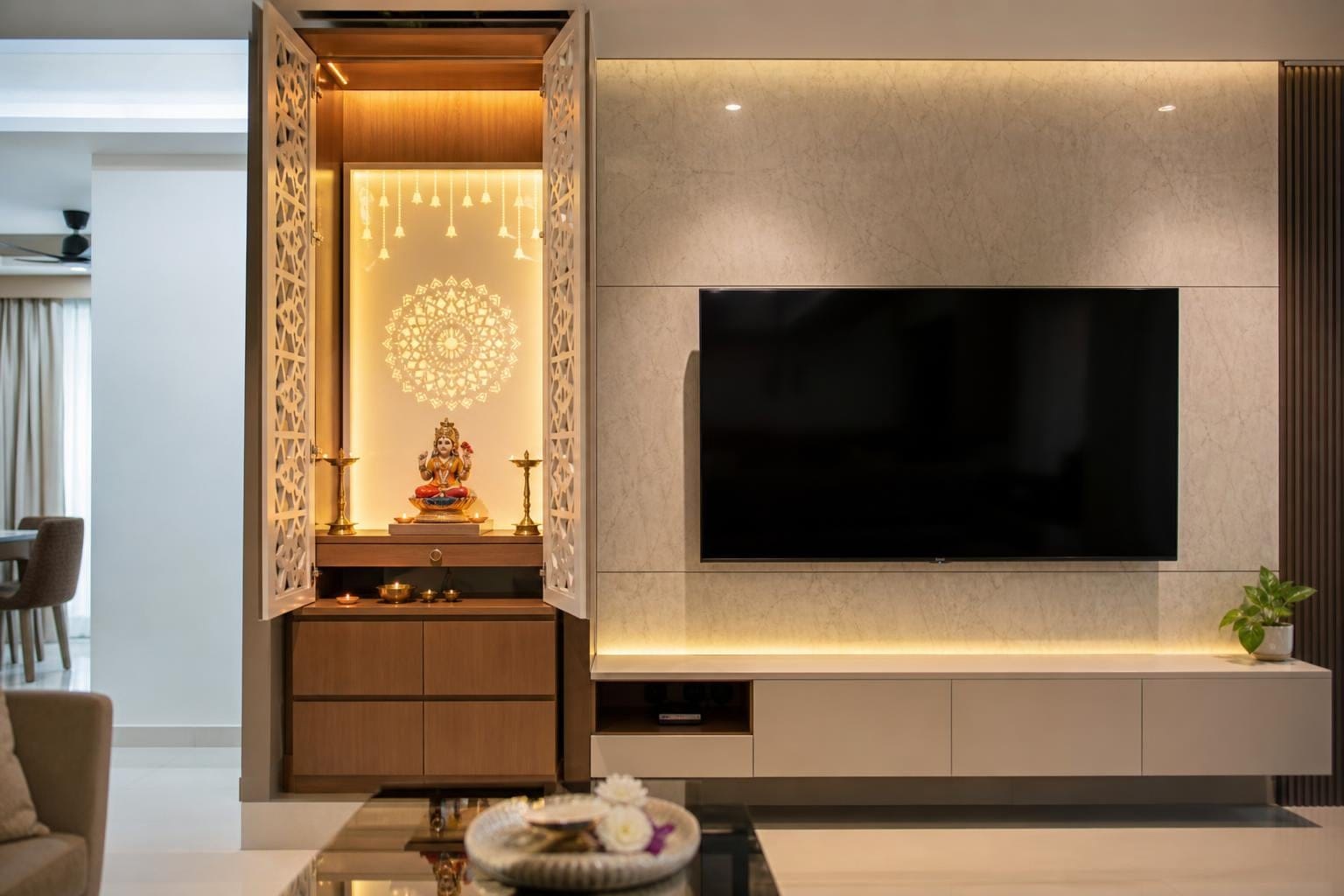
Many modern apartments feature open layouts that make dedicated pooja rooms impractical. The solution: turn a living room corner into a sacred zone using wooden or metal separators. A decorative jaali screen or frosted glass partition creates a semi-private pooja space without closing off the room.
Design approach: The partition does double duty, acting as both a room divider and a design element. Some designers match the partition material and finish with the TV unit on the opposite wall to create visual cohesion across the living room.
Cost range: Starting from ₹20,000 for a basic partition-and-shelf setup. With CNC jaali panels and integrated lighting, expect ₹40,000 to ₹70,000.
Bangalore-specific note: Using decorative jaali screens or frosted glass partitions to create semi-private pooja spaces within living rooms has become essential in Bangalore apartments, where 2BHK and 3BHK layouts rarely include a dedicated pooja room.
Limitation: Sound and smell travel freely. If morning prayers happen while others are sleeping in, this design offers visual separation but little acoustic or olfactory privacy.
8. False Ceiling Temple-Inspired Design
Best for: Homes with dedicated pooja rooms wanting a grand, immersive, temple-like atmosphere.
Ceilings in ancient Indian temples feature elaborate motifs, domes, and carved panels. Recreating this in a modern home uses false ceilings in POP, gypsum, or wooden panels to add floral patterns, concentric rings, or even deity narrative panels overhead. Combined with cove lighting, the effect is genuinely immersive.
Materials: POP (plaster of Paris) for intricate curves, gypsum boards for cleaner lines, or wooden panels for warmth. For a detailed comparison of ceiling materials and costs, this false ceiling design guide covers everything.
Cost range: Starting from ₹50,000 for a basic false ceiling treatment with cove lighting. Elaborate multi-layered designs with hand-painted or gold-leafed elements can exceed ₹1,50,000.
Pro tip: Keep the false ceiling height at least 9 feet from the floor in the pooja room. Anything lower makes the space feel oppressive rather than divine, especially with incense smoke filling the upper volume.
Limitation: Requires adequate ceiling height (10 ft+ original). In Bangalore apartments with standard 9.5 ft ceilings, a false ceiling treatment reduces headroom noticeably. It also adds to maintenance: POP ceilings can crack with building settlement.
9. Concealed/Hidden Pooja Cabinet
Best for: Minimalist homes, shared apartments, and multipurpose rooms where a visible mandir doesn’t fit the aesthetic.
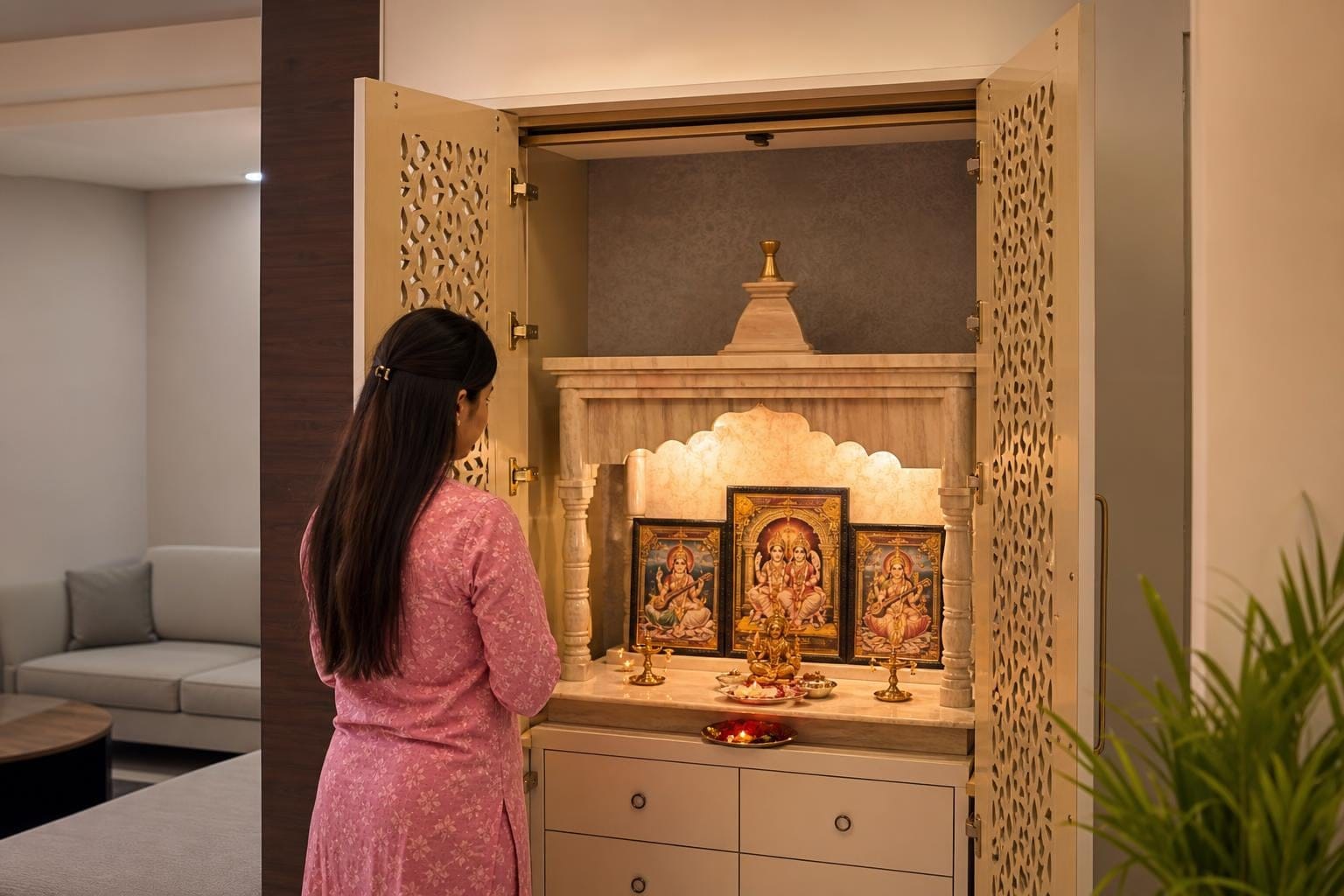
Hidden pooja rooms with sliding doors keep the hall tidy while providing full privacy for prayer. When closed, the cabinet looks like any other wall unit or wardrobe. Open it, and a fully equipped mandir with lighting, storage, and idol placement is revealed.
Materials: Plywood carcass with sliding hardware (soft-close mechanisms recommended), laminate or veneer exterior matching the room’s existing cabinetry.
Cost range: Starting from ₹30,000 for a basic concealed unit. With quality sliding hardware and integrated LED lighting, expect ₹50,000 to ₹80,000.
Pro tip: Use commercial-grade sliding hardware, not budget tracks. Cheap sliding mechanisms stick or derail within a year, especially when the doors are used twice daily. Ball-bearing slides and soft-close dampers make a real difference in daily use.
Limitation: The concealed design means no permanent visual reminder of the sacred space. Some families find that out of sight means out of practice. Also, ventilation is poor when doors are closed, so incense should only be burned with doors open.
10. Luxury Full-Room Pooja Design (Villa-Grade)
Best for: Villas, large 4BHK+ apartments, and HNI families wanting a dedicated, immersive temple experience at home.
This is the full expression of house interior design for a pooja room: marble flooring and walls, teak or rosewood carved panels, brass deity installations, gold leaf accents, layered lighting, and sometimes even a small water feature or bell installation at the entrance.
Materials: Makrana marble for walls and flooring, solid teak or rosewood for carvings and doors, brass elements, gold-plated accents, and silver idol installations. Every surface and fixture is premium-grade.
Cost range: Starting from ₹1,50,000 and easily exceeding ₹3,00,000+ for fully customized installations. The budget is driven primarily by marble grade, carving complexity, and gold/silver accents.
Design consideration: Multigenerational homes should account for accessibility. Keep the main platform at a height comfortable for elders (around 18-24 inches from the floor), ensure safe diya placement away from wooden elements, and provide adequate ventilation for extended incense use.
Limitation: Requires a dedicated room of at least 8×8 feet. Construction timeline is longer (8-12 weeks for custom marble and carving work). Maintenance demands are higher across all materials.
Ready to plan a pooja room that matches your home’s full interior vision? This pooja room design guide walks through the complete process from concept to execution.
How to Choose the Right Pooja Room Design for Your Home
With 10 options on the table, the decision comes down to five factors:
1. Available space. No dedicated room? Options 1, 2, 5 (wall-mounted), 7 (living room integrated), and 9 (concealed) work within existing rooms. Have a full room? Options 4, 5, 6, 8, and 10 shine.
2. Budget. Be honest about your range. A ₹15,000 budget rules out marble and CNC jaali. A ₹50,000 budget opens up most mid-range options. Above ₹1 lakh, the luxury tier becomes accessible.
3. Home style. Modern minimalist homes suit glass enclosures and concealed cabinets. Traditional homes call for carved wood and marble. Mixing styles (CNC jaali in a modern apartment) works when the material palette is consistent with the rest of the home.
4. Daily ritual frequency. Families performing morning and evening pujas need durable, easy-to-clean materials and good ventilation. Occasional-use pooja spaces can prioritize aesthetics over resilience.
5. Vastu priority level. Strict Vastu adherence limits placement options. Practical Vastu (discussed below) offers more flexibility for apartment layouts.
Vastu Essentials for Pooja Room Placement
Every house interior design pooja room article mentions northeast. Here’s what that actually means in practice, and what to do when northeast isn’t available.
The gold standard: Per Vastu Shastra, a pooja room is best placed in the northeast direction of the house (Ishan Kona). This is considered the most sacred direction for all religious activities.
Second-best options: If northeast isn’t possible, the east or north direction is also auspicious. Many Bangalore apartments have bathrooms or balconies in the northeast, making east or north walls the practical alternative.
What to avoid: The south direction should be avoided for religious activities. Also keep the pooja unit away from bathrooms and staircases. Ground floor placement is ideal, though in apartments this usually means the main living level.
Apartment reality check: Not every home has a dedicated room. In most Bangalore apartments, a pooja unit in the living room placed along the northeast wall is the most workable solution. Practitioners on Reddit and home design forums frequently note that strict northeast placement is rarely possible in pre-built apartments, and that east-facing units work perfectly well.
Idol placement specifics: The ideal idol height should not exceed 9 inches and be at least 2 inches tall. The idol should sit at least 6 inches above the ground and an inch away from the wall for proper air circulation and cleaning access.
For complete Vastu guidance across all rooms, this Vastu for home interiors guide covers the full picture.
Materials That Last: What to Specify for Your Pooja Room
This section is where most design articles fall short. Pretty images are useless if your pooja unit warps in two monsoon seasons. Here’s what actually matters.
Plywood Grades
Pooja units face daily humidity from water offerings, flower moisture, incense, and Bangalore’s monsoon season. The plywood grade you choose determines whether the unit lasts 3 years or 15.
| Grade | Moisture Resistance | Cost (per sq ft, metros) | Best For |
|---|---|---|---|
| MR (Moisture Resistant) | Low, swells with repeated exposure | ₹45-75 | Fully air-conditioned, dry rooms only |
| BWR (Boiling Water Resistant) | Good, handles daily humidity | ₹85-140 | Most pooja rooms, Bangalore apartments |
| BWP (Boiling Water Proof) / Marine | Excellent, survives sustained moisture | ₹150-250 | Kitchen-adjacent pooja units, external wall positions |
The recommendation: Choose BWR plywood as the minimum for any Bangalore pooja room. Choose BWP if the unit is near a kitchen, on an external wall, or in a ground-floor apartment with rising damp risk.
Choose MDF only if: the space is fully air-conditioned, the budget is tight, and you prioritize a smooth laminate finish. MDF warps when exposed to repeated moisture, and pooja rooms generate more humidity than most people realize.
Thickness specs: For shutters and doors, 18-19mm. For back panels, 6-12mm. These aren’t arbitrary numbers. Thin shutters sag under the weight of idols placed on interior shelves.
Wood Types for Bangalore
Teak is the premium choice: naturally insect-resistant and moisture-tolerant. Sheesham is a strong mid-range alternative. Engineered wood (plywood with veneer) offers the look of solid wood at a fraction of the cost and weight, with better dimensional stability in fluctuating humidity.
Stone Selection
White marble symbolizes purity and is the most popular choice for backlit panels (₹150-400 per sq ft). Black granite provides grounding energy and works well for base platforms (₹100-250 per sq ft). Jaisalmer stone adds warmth and tradition at a lower price point (₹80-200 per sq ft).
Lighting Your Pooja Room: A Layered Approach
“Use warm lights” is advice you’ll find everywhere. Here are the actual specs that make pooja room lighting work.
The Three Layers
Layer 1: Ambient. One dimmable ceiling fixture provides overall illumination. A recessed downlight or a small pendant works.
Layer 2: Task/Accent. A 2-3W spotlight focused on the idol creates a visual focal point. This is the light that draws the eye during prayer.
Layer 3: Backlight. A 4-6W LED strip behind the mandir or along the back panel creates the signature glow that makes backlit designs so popular.
Specifications That Matter
Color temperature: Warm white between 2700K and 3000K is the sweet spot. It flatters brass and wood tones while keeping the space soothing for extended prayers.
CRI (Color Rendering Index): Keep it above 90. This ensures that reds, golds, and the warm tones of kumkum and flowers render beautifully rather than looking washed out.
Lumen target: For a typical 3×4 ft pooja niche, aim for 400-800 lumens total across all three layers. LEDs consume up to 80% less energy than incandescent bulbs and last up to 25,000 hours.
Smart Lighting Scenes
If you’re using smart switches or dimmers, consider three presets:
- Aarti scene: Accent spots at 80-90%, warm cove lighting at full, ambient at 50%.
- Meditation scene: Everything at 30-40%, with only the backlit panel on.
- Night scene: A subtle 5-10% glow from the backlight strip, acting as a gentle nightlight.
For a deeper look at how lighting transforms every room, this home lighting guide covers the complete approach.
Pooja Room Door Options
The door is often the most visible element of a pooja room design. Here are the main choices:
CNC jaali doors: The most popular option in 2026. Intricate patterns cut into MDF or plywood allow light and air through while adding cultural richness. Cost: ₹13,000 to ₹75,000+ depending on complexity.
Carved wooden doors: Traditional and timeless. Teak or sheesham carved doors add weight and gravitas. Best for traditional mandirs.
Glass doors: Frosted, reeded, or clear with etched motifs. Great for glass-enclosed sanctuaries where visibility is desired.
Sliding doors: Save circulation space compared to swing doors. Ideal for small pooja room ideas in apartments where a swing door would block a walkway.
Foldable doors: Accordion-style panels that fold flat against the sides. Good for concealed cabinets where you want full-width access.
WPC (Wood Plastic Composite) doors: Budget-friendly and highly moisture-resistant. Lack the visual warmth of real wood but perform well in humid conditions.
Safety note: If you burn incense or diyas regularly, fire-retardant plywood for door panels adds a meaningful safety layer, especially for CNC jaali designs where the thin lattice work is more combustible than solid panels.
Pooja Room Colour Palettes and Wall Treatments
Colour sets the spiritual tone of the space. The most effective pooja room palettes in Indian homes are:
Whites and creams: Purity and calm. Pair with brass accents and warm lighting for a classic look.
Gold and beige: Warmth and opulence. Works especially well with marble and wood combinations.
Saffron and orange accents: Spiritually significant, but use sparingly as accent walls or panel strips rather than full room coverage.
Deep wood tones: Teak, walnut, and rosewood finishes create a temple-like warmth without painted walls.
For the back wall behind the mandir, textured finishes add depth without cost. Explore wall texture design ideas for options that complement pooja room aesthetics.
Bangalore-Specific Considerations
Designing a house interior design pooja room in Bangalore comes with specific challenges that generic design guides ignore.
Monsoon humidity (June through September): Pooja units on external walls or near kitchens face sustained moisture exposure. MDF is risky here. BWR plywood is the minimum; BWP is better for vulnerable positions.
Apartment constraints: Most 2BHK and 3BHK apartments in Whitefield, HSR Layout, Electronic City, and Sarjapur don’t include dedicated pooja rooms. Wall-mounted, corner, and living room-integrated designs are the practical reality.
Multigenerational households: Many Bangalore families include elders who perform daily rituals. Design should account for comfortable platform heights (18-24 inches), easy-to-clean surfaces, safe diya placement with adequate clearance from wood and fabric, and proper ventilation for incense.
Incense and smoke management: Bangalore’s apartments often have limited natural ventilation. An exhaust fan or ceiling vent in dedicated pooja rooms prevents residue buildup on walls, ceilings, and idol surfaces. One project manager shared in a YouTube walkthrough that incense residue is the number one cause of premature refinishing in pooja rooms, more than water or humidity.
FAQ
What is the ideal direction for a pooja room as per Vastu?
Northeast (Ishan Kona) is considered the most auspicious direction. If northeast isn’t available in your apartment layout, east or north are suitable alternatives. Avoid the south direction entirely for pooja rooms.
What is the minimum size for a pooja room?
A pooja room can be as compact as 2×2 feet for a wall-mounted unit with essential idols and accessories. For a dedicated room, 8×8 feet is the recommended minimum to allow comfortable movement during rituals.
Which plywood grade should I use for a pooja room in Bangalore?
BWR (Boiling Water Resistant) plywood is the minimum recommendation for Bangalore’s humidity. For pooja units near kitchens or external walls, BWP (Boiling Water Proof) or marine-grade plywood provides better protection. MDF should be reserved for fully air-conditioned, dry rooms only.
How much does a pooja room interior design cost in India?
Costs range widely. A basic wall-mounted floating unit starts at ₹8,000. Mid-range designs with CNC jaali or marble backlighting fall between ₹40,000 and ₹1,20,000. Premium full-room installations with marble, teak, and gold accents start at ₹1,50,000 and can exceed ₹3,00,000.
Can I have a pooja room in the living room?
Yes. Many modern apartments integrate pooja spaces into the living room using decorative partitions, jaali screens, or frosted glass dividers. Place the unit along the northeast or east wall for Vastu compliance. For more ideas on integrating sacred and social spaces, see this living room design guide.
What lighting colour temperature is best for a pooja room?
Warm white between 2700K and 3000K. This temperature flatters brass, wood, and gold tones while creating a calm, meditative atmosphere. Keep CRI (Color Rendering Index) above 90 so that reds, golds, and flower colours appear natural.
How do I protect my pooja room from incense and diya smoke damage?
Use honed (matte) finishes on marble to avoid harsh smoke staining. Ensure ventilation through a small exhaust vent or gap above glass enclosures. Choose lacquered or sealed plywood surfaces over painted MDF, as they resist smoke residue better. Clean idol surfaces weekly with a dry cloth to prevent cumulative buildup.
Should I use marble or wood for my pooja room?
It depends on your budget and aesthetic preference. Marble creates a luminous, formal atmosphere and works beautifully with backlighting, but it’s heavier, more expensive, and requires regular sealing. Wood (especially teak) offers warmth, natural moisture resistance, and traditional character at a lower price point. Many premium designs combine both: marble back panels with wooden frames and shelving.
Designing a pooja room that balances beauty, durability, and spiritual significance takes more than a Pinterest board. If you’re planning house interior design with a pooja room in Bangalore, a professional consultation ensures your materials, layout, and Vastu alignment work together from day one. Explore the complete pooja room interior design guide or book a consultation to bring your vision to life.