What Is BWP Plywood and Why It Matters for Kitchens in India
TL;DR: BWP plywood stands for Boiling Water Proof plywood, a high water-resistance grade designed for moisture-heavy areas like kitchen sink bases, RO/dishwasher zones, and utility cabinets. In Indian kitchens, specifying IS 710 BWP/marine-grade plywood for wet zones is a baseline precaution against swelling, delamination, and early failure. But the label alone is not enough. Homeowners must verify the BIS standard, licence number, edge sealing, hardware quality, and written BOQ before any panel gets laminated and installed.
What Is BWP Plywood and Why It Matters for Kitchens in India
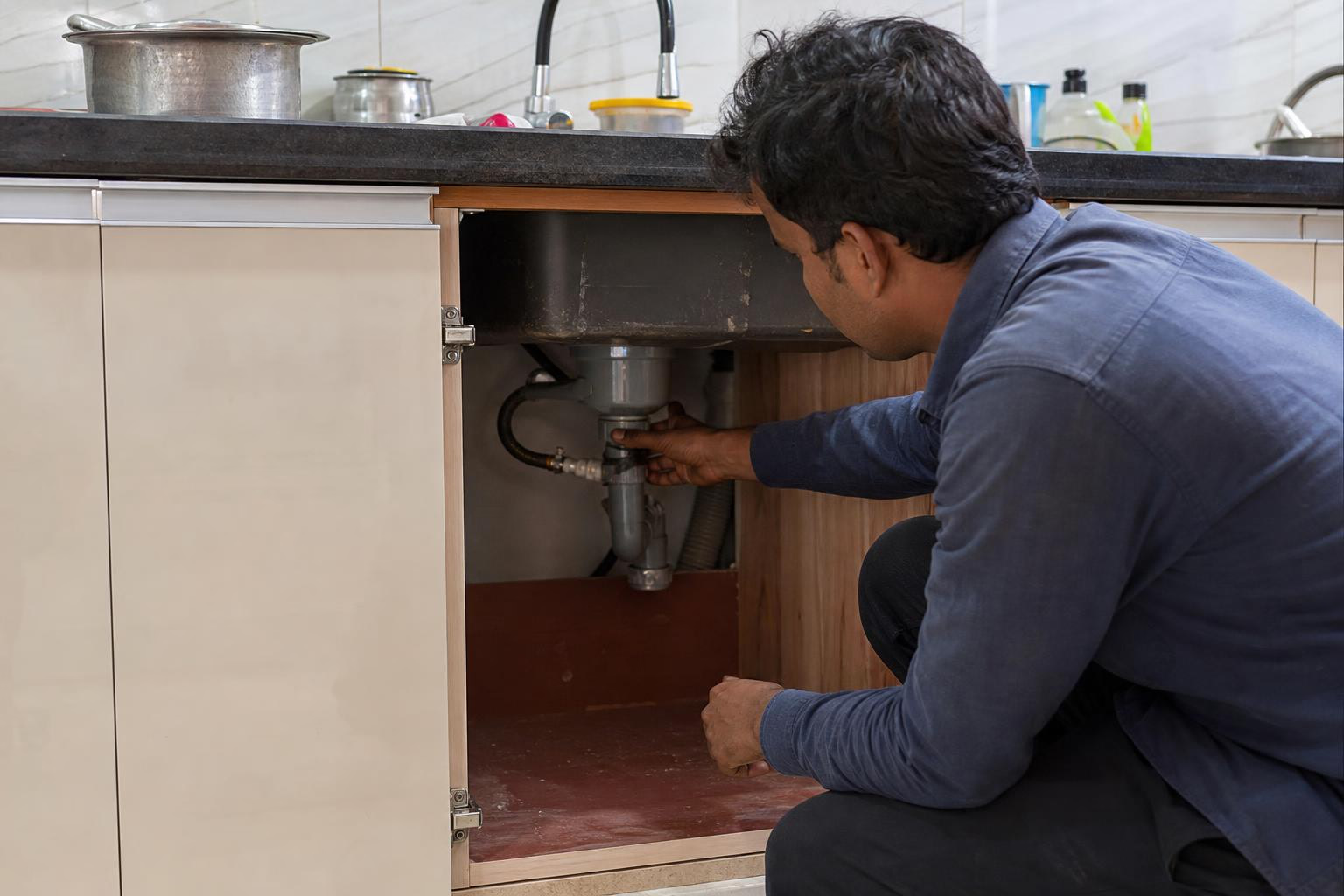
A modular kitchen can look flawless on handover day and still fail within months if the wrong board sits under the sink. Water pools from a leaking pipe. Steam condenses behind shutters. Mopping water creeps under the plinth. The plywood inside a kitchen faces punishment that bedroom furniture never sees.
BWP plywood matters for kitchens in India because it is built for exactly this kind of environment. BWP stands for Boiling Water Proof, a plywood grade where the adhesive bond between veneer layers withstands prolonged moisture exposure. In common Indian kitchen buying language, “BWP 710” or “marine plywood” typically refers to plywood conforming to IS 710, the Bureau of Indian Standards specification for marine plywood.
But a “BWP” stamp on a sheet is not the whole story. Homeowners need to verify the standard, thickness, edge sealing, hardware quality, and written specification before any panel gets laminated. This article is a glossary entry that works as a buyer guide, covering what BWP means, where it belongs in a kitchen, what it does not protect against, and how to verify that you actually got what you paid for.
Understanding BWP plywood is one of the first material decisions that separates a kitchen built to last from one that fails expensively.
If you are planning a kitchen in Bengaluru and want materials specified transparently from the start, explore our services to see how turnkey execution works.
BWP Plywood Meaning in Simple Words
Plywood is made by bonding thin wood veneers in alternating layers. The type of adhesive holding those layers together determines water resistance.
BWP plywood uses phenol-formaldehyde resin, a waterproof adhesive that survives boiling water without delaminating. That is where the name comes from: Boiling Water Proof.
You will hear several names used interchangeably in the market: BWP plywood, 710 plywood, marine plywood, IS 710 plywood. These mostly point to the same thing. The BIS product manual for IS 710 classifies marine plywood as “Grade: BWP,” requires BWP-grade adhesive, and allows standard thicknesses from 3 mm to 25 mm.
One distinction that most articles miss: BWP is a grade, not a wood species or manufacturing technique. Gurjan or eucalyptus refers to the core wood species. Calibrated means the sheet has been machine-levelled for uniform thickness. A sheet can be Gurjan BWP calibrated plywood, combining all three attributes. These are not competing choices.
Why Indian Kitchens Need Better Plywood Than Bedrooms
A bedroom wardrobe handles ambient humidity. A kitchen cabinet handles direct assault. The gap between these two conditions is large enough that using the same material for both is a common, costly mistake.
Indian kitchens face a specific set of stressors. Steam from pressure cooking and boiling hits overhead cabinets daily. Sink splash and plumbing leaks soak the base cabinet from inside. RO purifier and dishwasher drips create slow, hidden moisture buildup. Mopping water seeps around base cabinets. Heavy steel utensils and appliances load shelves beyond what bedroom furniture ever carries. Add monsoon humidity in cities like Bengaluru, and termite risk in many Indian regions, and the case for a stronger plywood grade becomes obvious.
When cheaper plywood is used in these conditions, the failures are predictable: swelling near the sink, sagging shelves, loose hinges, peeling laminates, and a damp smell from rotting wood.
BWP plywood matters for kitchens because kitchen cabinets are hidden structures. Once laminates and edge bands cover the board, you cannot see what grade was used. If the wrong material went in, you discover it only when something fails. By then, fixing it means tearing apart finished modules.
For a broader look at how kitchen planning connects to material choices and layout decisions, our modular kitchen design guide covers the full process.
Where BWP Plywood Should Be Used in a Kitchen
Not every cabinet faces the same water risk. The practical approach is zone-wise material planning: BWP where moisture is highest, and potentially BWR or HDHMR where conditions stay drier.
| Kitchen Zone | Risk Level | Recommended Board | Why |
|---|---|---|---|
| Sink base cabinet | Very high | IS 710 BWP/marine-grade plywood | Pipe leaks, water splash, damp cleaning supplies |
| RO/dishwasher area | Very high | IS 710 BWP/marine-grade plywood | Slow leaks go unnoticed for weeks |
| Utility/laundry cabinet | Very high | IS 710 BWP/marine-grade plywood | Standing moisture, washing machine water |
| Floor-standing base cabinets | High | BWP preferred | Mopping water, floor condensation, spills |
| Hob/cooking base | Medium-high | BWP or high-quality BWR | Steam, heat, oil, utensil loads |
| Overhead cabinets (away from sink/hob) | Medium | BWR/HDHMR acceptable if sealed; BWP for premium consistency | Less direct water contact |
| Shutters/doors | Medium | HDHMR, BWP, or BWR depending on finish | Finish quality and warping resistance matter here |
| Dry pantry/tall unit | Medium-low | BWR/HDHMR or BWP | Load-bearing with occasional humidity |
| Bedroom wardrobe/TV unit | Low | MR/BWR usually enough | BWP is often overkill in dry rooms |
Practitioners on Reddit consistently echo this zone-based logic. In a modular kitchen cost discussion, one user pointed out that BWP is not needed for the entire kitchen, only the sink area and wet zones. Others recommended BWP at minimum for base and wet zones, with BWR or HDHMR elsewhere depending on budget.
For premium projects, BWP throughout the kitchen carcass offers consistency and long-term risk reduction. For budget-conscious projects, the zone-wise approach targets spending where failure consequences are worst.
Since sink placement and utility zones shift with layout, compare kitchen layouts before finalising where BWP is non-negotiable.
BWP vs BWR vs MR: What Is the Difference?
The three main plywood water-resistance grades form a clear hierarchy.
MR (Moisture Resistant) handles normal indoor humidity. Fine for bedroom wardrobes, TV units, and dry wall panelling. Should not go in active wet kitchen zones. During Bengaluru’s monsoon months, even MR in kitchen base cabinets can swell and delaminate.
BWR (Boiling Water Resistant) performs better than MR in areas with occasional moisture. Works for upper kitchen cabinets, semi-dry storage, and wardrobes near moderate humidity. Not the same assurance as IS 710 BWP for sink and wet base zones. Greenply explains BWP as suited to high-moisture kitchens and bathrooms, while BWR fits occasional exposure.
BWP (Boiling Water Proof) is the strongest grade. For kitchen wet zones, this is the safe specification, particularly IS 710 marine-grade plywood.
Here is an important standards nuance that trips up buyers. Historically, BWP was associated exclusively with IS 710 marine plywood. But BIS amended IS 303 (the general-purpose plywood standard) in 2024 to include MR, BWR, and BWP grades. This means a sheet marked “IS 303 Grade BWP” is technically a valid BWP product, but it is not the same as IS 710 marine plywood.
A recent buyer on Reddit discovered exactly this confusion. They purchased plywood marketed as BWP but found it stamped “IS:303 Type:AA Grade:BWP” instead of IS:710. Another commenter shared that they bought a product marketed as “Sainik 710” that was actually printed with IS:303.
The takeaway: for wet kitchen zones, specify IS 710 BWP/marine-grade plywood. If a sheet says BWP but does not reference IS 710, ask what standard it conforms to. For a deeper comparison of cabinet board options and costs, see our kitchen cabinet materials guide.
Is BWP Plywood the Same as Marine Plywood?
In common Indian market language, yes. IS 710 is the BIS marine plywood specification, and its product manual classifies marine plywood as Grade BWP. The BIS description states IS 710 covers plywood designed for environments with extended moisture exposure, including tests for water resistance, glue adhesion, strength, and formaldehyde content.
But because the word “BWP” now also appears under IS 303:2024 for general-purpose plywood, the safer buying phrase is “IS 710 BWP/marine-grade plywood” when you want the highest wet-zone assurance.
BWP vs HDHMR vs MDF for Kitchen Cabinets
HDHMR (High Density High Moisture Resistant board) has gained popularity in Indian kitchens for good reason. Its uniform density makes it excellent for CNC routing, acrylic/laminate bonding, and smooth shutters.
But HDHMR is not plywood. It is an engineered fibreboard. And it is not a blanket replacement for IS 710 BWP in wet carcasses.
BWP plywood remains the safest choice for sink bases, dishwasher zones, and any carcass that contacts water directly. Its layered veneer structure handles moisture penetration better than fibreboard when edges are sealed.
HDHMR works well for shutters, wall cabinets, and components where finish quality and routing precision matter. But if a contract specifies BWP and the vendor substitutes HDHMR, that is a swap, not an upgrade. Practitioners on Reddit report exactly this: one homeowner discovered HDHMR in kitchen shutters and upper cabinets despite paying for BWP throughout.
Standard MDF and particle board should stay out of wet kitchen carcasses. Exposed MDF edges absorb moisture rapidly and swell, sometimes within one monsoon season.
The practical answer: BWP plywood for wet base carcasses, HDHMR for shutters and dry upper modules where its finish advantages shine, and no standard MDF or particle board near water.
Is BWP Plywood Really Waterproof?
This is the most misunderstood part. BWP is waterproof in the sense that its phenol-formaldehyde adhesive bond resists boiling water and high-moisture conditions far better than MR or BWR grades. The layers will not separate under prolonged moisture.
But the wood surface and cut edges are still wood. They absorb water if left unsealed. The waterproof property applies to the glue bond between veneers, not the wood itself. If water enters through unsealed edges, bad laminate joints, screw holes, or a slow plumbing leak, the cabinet can still fail.
Practitioners on Reddit are blunt about this. In a quote-review thread, one commenter noted that most kitchen failures start from edges, not the center of the board. They advised asking whether visible edges have 2 mm PVC/PUR edge banding and whether cut edges inside carcasses are sealed.
Kitchen durability is a system, not a single material choice:
- Board grade provides the moisture-resistant foundation
- Thickness (typically 18/19 mm for carcasses) ensures structural strength
- Edge sealing prevents water from entering through cut surfaces
- Hardware must be corrosion-resistant in wet zones, because rusting screws cause failures even on good boards
- Installation quality ties everything together
A BWP kitchen with unsealed edges and cheap hardware will underperform a well-executed BWR kitchen with proper sealing and commercial-grade fittings. The board matters, but so does everything around it.
How to Check If BWP Plywood Is Genuine
Most articles say “check the ISI mark” and stop there. That is not enough.
1. Ask for the exact brand and product name. Not just “BWP plywood” but the specific manufacturer’s product line.
2. Confirm the standard. For wet kitchen zones, insist on IS 710 BWP/marine-grade. If the vendor offers a different BWP variant, ask which BIS standard it conforms to.
3. Check sheet markings. Look for the ISI/BIS standard mark, IS number (710 for marine grade), manufacturer name, grade, thickness, and CM/L licence number.
4. Verify the licence on the BIS Care app. Download the BIS Care app and use “Verify Licence Details.” Enter the CM/L number to confirm manufacturer name, licence validity, product scope, and whether the licence covers the grade printed on the sheet.
5. Inspect the edge. Genuine IS 710 BWP plywood typically shows dark reddish-brown phenol-formaldehyde resin lines at the edge. Commercial plywood with urea-formaldehyde glue shows lighter lines. Check for core gaps, voids, and inconsistent layer thickness.
6. Inspect before lamination. This is critical for factory-made modular kitchens. Once panels are finished with laminates and edge banding, the core material is invisible. Practitioners on Reddit warn that some firms promise branded BWP but substitute non-branded plywood when the client is not on site.
7. Keep stamped offcuts. After cutting, retain pieces showing the original ISI stamp. These serve as evidence of what was actually used.
8. Get it in writing. The plywood grade, standard, brand, and thickness should appear on the invoice and BOQ. A verbal promise has no weight if a dispute arises.
Understanding what warranties actually protect matters as much as material verification. Our guide on interior design warranties covers the gaps most homeowners miss.
What to Ask Your Interior Designer Before Work Starts
The best time to prevent material problems is before a single sheet gets cut.
- Which plywood grade and brand will be used in the sink base, base cabinets, overhead cabinets, shutters, and back panels?
- Is the sink/base carcass IS 710 BWP/marine-grade?
- What thickness is specified for carcasses, shutters, shelves, back panels, and drawer bottoms?
- Are all cut edges sealed with edge banding? What thickness and type?
- Are screws, hinges, and drawer slides corrosion-resistant in wet zones?
- Which hardware brand and model is specified?
- Will the plywood brand, grade, and standard appear on the invoice and BOQ?
- Can I inspect raw sheets before cutting and lamination?
- What material substitutions are allowed, and do they require written approval?
A Reddit quote-review thread offers a useful rule: do not compare only the total price between vendors. Lock the exact plywood grade, ISI marking, thickness, hardware model numbers, edge banding specifications, exclusions, and payment milestones. The cheapest quote often hides the most substitutions.
Sample BOQ line for wet zones: “18/19 mm IS 710 BWP/marine-grade plywood carcass; 6/8/9 mm BWP back panel; all cut edges sealed; laminate/edge banding on exposed edges; stainless or corrosion-resistant screws in wet zones; no material substitution without written approval.”
BWP Plywood Cost: Is It Worth Paying More?
BWP plywood costs more than MR and BWR because of stronger resin, denser construction, and tougher manufacturing requirements. Market prices vary widely by thickness, brand, city, and certification level, typically falling between ₹90 and ₹180 per square foot.
The premium is most justified in wet zones. Replacing a swollen, delaminated sink base cabinet means dismantling countertops, disconnecting plumbing, removing finished panels, and rebuilding. The cost of that repair dwarfs the upfront price difference between BWP and a cheaper grade.
For dry bedrooms and TV units, BWP is usually unnecessary. A furniture manufacturer sharing their experience on Reddit put it plainly: BWP 710 is overkill for beds, wardrobes, and TV units, and the money is better spent on plywood quality, proper edge banding, and a good laminate finish.
The smart approach: spend on BWP plywood where failure is expensive (wet kitchen zones, bathroom vanities, utility cabinets), and allocate savings toward better hardware, finishes, and edge sealing everywhere else.
For a broader view of how material choices affect project budgets in Bengaluru, read our interior design cost guide.
A Note for Bengaluru Homeowners
Bengaluru kitchens may not face coastal salt air, but they face monsoon humidity lasting months, apartment utility areas with poor ventilation, RO purifier drips in compact kitchens, and mopping water around base cabinets. MR plywood in wet kitchen zones can swell and warp during monsoon season.
For Bengaluru apartments, especially in areas like Whitefield, Electronic City, Sarjapur, and HSR Layout where new residential projects are dense, specifying IS 710 BWP plywood for wet zones is a baseline precaution, not a luxury upgrade.
Quick Glossary
- BWP: Boiling Water Proof plywood, the highest water-resistance grade in standard plywood
- BWR: Boiling Water Resistant plywood, better than MR but below BWP
- MR: Moisture Resistant plywood, suited for dry interiors
- IS 710: BIS marine plywood specification, classifies marine plywood as Grade BWP
- IS 303: BIS general-purpose plywood specification, 2024 version lists MR, BWR, and BWP grades
- Marine plywood: Plywood for extended moisture exposure, commonly used interchangeably with IS 710 BWP
- Carcass: The structural box of a cabinet (sides, top, bottom, back)
- Shutter: The cabinet door or front panel
- Edge banding: Protective strip sealing exposed board edges to block moisture
- Calibrated plywood: Machine-levelled plywood with uniform thickness
- Gurjan/Eucalyptus: Core wood species, not waterproof grades
- CM/L number: BIS licence number on certified products, verifiable through the BIS Care app
- HDHMR: High Density High Moisture Resistant board, an engineered fibreboard, not plywood
Frequently Asked Questions
What is the full form of BWP plywood?
BWP stands for Boiling Water Proof plywood. It refers to plywood where the adhesive bond between veneer layers withstands prolonged moisture and boiling water exposure, making it suitable for wet zones in kitchens, bathrooms, and utility areas.
Is BWP plywood needed for the entire kitchen?
Not necessarily. For a premium kitchen, BWP throughout the carcass reduces risk and keeps the specification consistent. For a budget-conscious kitchen, IS 710 BWP should be used at minimum in the sink base, RO/dishwasher area, and utility zone. BWR or HDHMR can work in dry upper cabinets and shutters if edges are properly sealed.
What is the difference between BWP and BWR plywood?
BWP is designed for sustained moisture exposure. BWR handles occasional moisture but does not offer the same assurance as IS 710 BWP in high-risk wet zones like sink bases and dishwasher areas. For active wet kitchen carcasses, BWP is the safer choice.
Is BWP plywood completely waterproof?
No material is failure-proof. BWP’s adhesive bond is highly water-resistant, but exposed wood edges and unsealed cut surfaces can still absorb moisture. Edge sealing, laminate quality, corrosion-resistant hardware, and proper installation all determine whether BWP performs as intended.
Is BWP plywood the same as marine plywood?
In common Indian market language, yes. IS 710 is the BIS marine plywood specification, and it classifies marine plywood as Grade BWP. However, the term BWP now also appears under IS 303:2024 for general-purpose plywood. Specify “IS 710 BWP/marine-grade plywood” for wet kitchen zones to avoid ambiguity.
Can HDHMR replace BWP plywood in kitchens?
HDHMR works well for shutters, wall cabinets, and dry units where its smooth finish and CNC routing are advantages. It is not a suitable replacement for IS 710 BWP in sink bases, dishwasher zones, or utility cabinets where direct water contact is likely.
How can I verify if BWP plywood is genuine?
Check the ISI/BIS mark, IS standard number, and CM/L licence number printed on the sheet. Use the BIS Care app to verify the manufacturer, licence validity, and product scope. Inspect raw sheets before lamination and keep stamped offcuts as documentation.
Should wardrobes use BWP plywood?
Usually not, unless the wardrobe sits in a damp room, against a bathroom wall, or in a poorly ventilated space. For dry wardrobes and TV units, good quality MR or BWR plywood with proper edge banding is enough. Spending BWP-grade money on dry furniture is often unnecessary.
Ready to plan a kitchen with properly specified materials and documented construction standards? View our gallery to see finished interiors, or get in touch to discuss your project in Bengaluru.