


 ChatGPT
 Perplexity
 Google AI
 Grok
Grok Claude
Most Indian kitchens run on a single overhead light. It illuminates the room in a general way and creates shadows on every work surface where you actually need to see clearly. I fix this on almost every kitchen redesign I do. Bad lighting is an afterthought in most kitchen projects — decided at the end when budget and attention are depleted. It should be one of the first decisions.
Quick Summary
- Three layers: task, ambient, and accent. One ceiling light covers none of them properly.
- Under-cabinet task lighting is non-negotiable — it eliminates the shadow zone directly below upper cabinets where you prep and cook
- 4000K to 5000K for cooking areas, 2700K to 3000K for dining. Do not mix warm and cool in the same space.
- A 100 sq ft kitchen needs 6,000 to 7,000 total lumens
- Under-cabinet LED strips: Rs.500 to Rs.3,000 per running foot depending on quality
- Install dimmers. The difference between cooking mode and evening mode is significant.

Physics. Light comes from above. Your upper cabinets and your own body block it. The countertop directly below the cabinet overhang — exactly where you are chopping, mixing, and working — sits in shadow.
Indian cooking requires accurate judgement of food colour, texture, and cooking progress. Whether the dal has reached the right consistency. Whether oil is hot enough. Whether the spice has bloomed properly. Poorly lit countertops make this harder than it needs to be.
Professional kitchen lighting uses three types working together. Each addresses something the others cannot. Plan lighting early — before cabinets go in, before the ceiling is closed. Retrofitting task lighting after the fact is difficult and expensive.

Direct, focused illumination for specific work areas: countertops, the hob, the sink.
Under-Cabinet LED Strips
The single most impactful addition to any kitchen that lacks them. Mounted on the underside of upper cabinets, they illuminate the countertop directly below — the exact shadow zone that overhead lighting creates. Position them toward the front edge of the cabinet for the best spread.
Quality matters. Cheap strips have uneven distribution — you see individual LEDs rather than a continuous wash. Quality strips at Rs.1,500 to Rs.3,000 per running foot produce consistent, even light. Basic options at Rs.500 to Rs.800 work but show the compromise.
Hob Lighting
The chimney often has integrated lighting. If yours does not, a recessed downlight or track light directly above the cooking zone fills this. Standard overhead lighting creates a shadow above the hob where the person cooking blocks the light from reaching the work surface.
Sink Lighting
Often forgotten. A downlight or under-cabinet strip directly above the sink. Dishwashing and food prep at the sink benefit from direct illumination in exactly the same way countertops do.
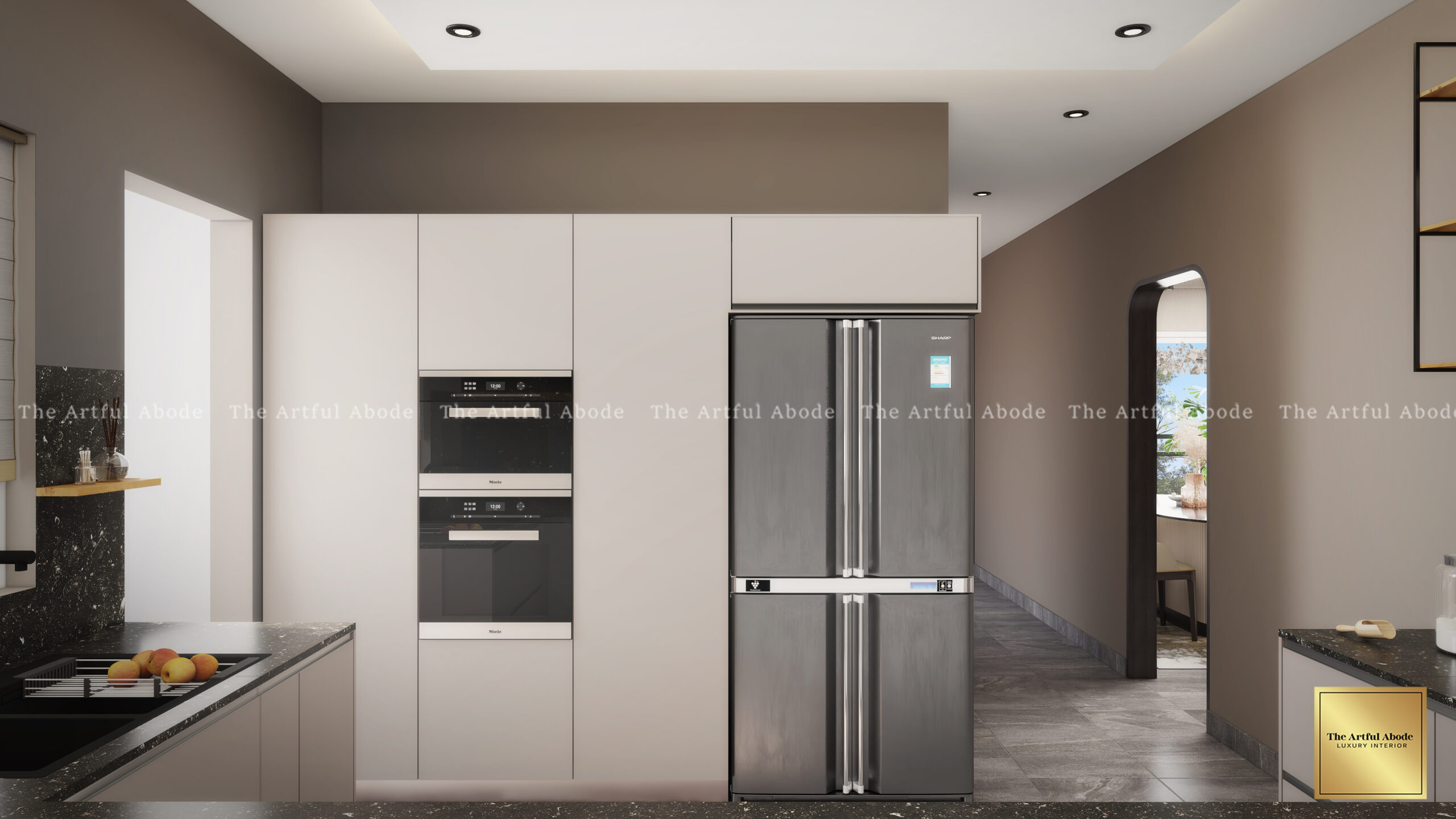
General illumination. Enough to move through the kitchen comfortably and safely.
Recessed ceiling downlights are the most practical choice — even overhead illumination without consuming visual space. A 100 sq ft kitchen needs approximately 6,000 to 7,000 total lumens. At 600 to 700 lumens per downlight, that is 8 to 12 fixtures. Most kitchens have 2 or 3. The difference is immediately visible.
Track lighting offers flexibility — individual lights directed toward specific zones. Useful when you want to cover the work triangle without installing a full downlight grid.
One mistake I see constantly: a single large decorative pendant used as the primary light source. Pendants scatter light in all directions. They look good. They do not illuminate countertops effectively. Use them as accent or supplementary, not as primary ambient.
Keep colour temperature consistent with task lighting. Mixing warm and cool sources in the same room creates a jarring inconsistency.
The Artful Abode designs kitchen lighting for projects across Bangalore. Book a free consultation and we will put together a complete lighting plan before your kitchen build starts.
Book a Free ConsultationAccent Lighting
Highlights specific features and adds visual depth. Should be on separate circuits from task and ambient so you can use it independently in the evenings.
Inside glass-front cabinets: strip lighting or individual spotlights show off what is stored there. Adds a warm, layered quality to the overall kitchen look. Particularly effective with china or glassware on display.
Under-cabinet toe kick lighting: LED strips at floor level create a floating effect and add depth to the base of the kitchen. A quality finishing detail.
Open shelving: accent lighting from above or below highlights what is displayed and prevents open shelves from reading as dark holes in the cabinetry.
Lighting Over an Island or Peninsula
Perimeter lighting cannot reach an island effectively. It needs its own dedicated overhead lighting. Pendant lights should hang 70 to 80 cm above the countertop surface. For an island 120 cm long, two pendants at 40 cm intervals. Size the pendants proportionally — too small looks tentative, too large overwhelms.
Recessed downlights directly above the island are the cleaner alternative. Position them so they cover the working surface without casting shadows from the person standing at the island.
LED Specifications and Costs
LEDs are the right choice for kitchen lighting. 25,000+ hour lifespan, energy-efficient, available across all colour temperatures, fully dimmable.
You interact with the lighting every single day for 15 years. This is not where to cut corners.
Common Mistakes in Indian Kitchens
Only overhead lighting. The most common and most impactful fix available. Under-cabinet strips alone transform a poorly lit kitchen. This single addition makes more difference than any other lighting change.
Wrong colour temperature. 2700K warm white in a cooking area makes it harder to judge food colour. 5000K cool daylight in a dining area is harsh and unflattering for meals. 4000K to 5000K for cooking, 2700K to 3000K for dining.
No dedicated hob lighting. Standard overhead lighting creates a shadow above the hob where the person cooking blocks the light from reaching the work surface. Every kitchen needs a dedicated light source at or directly above the hob.
No internal cabinet lighting where glass fronts are used. Glass-front cabinets with no internal lighting read as dark boxes. The whole point of glass fronts is display — light what is inside them.
Fixed intensity everywhere. No dimmers. A kitchen that can only be fully bright or fully off is not serving both cooking mode and evening mode. Dimmers on ambient circuits cost very little relative to the kitchen and make a daily difference.
Final Thought
Kitchen lighting is the detail that makes everything else look the way it should. The right countertop, the right cabinet finish, the right colour palette — all of these are undermined by poor lighting, and all look better with good lighting than they actually are.
Plan lighting early. Before cabinets go in, before the ceiling is closed. Retrofitting task lighting after the fact is difficult and expensive.
The Artful Abode designs kitchen lighting for projects across Bangalore — Whitefield, Koramangala, HSR Layout, Indiranagar. Book a free consultation and we will put together a complete lighting plan before your kitchen build starts.